
TL;DR
Anthropic’s $965 billion valuation and $65 billion Series H are driven by a focus on expanding compute infrastructure, not just raising money. This is about securing the hardware needed to train and run the biggest AI models, signaling a shift towards infrastructure-centered AI growth.
When a startup hits a $965 billion valuation, it’s tempting to think about market hype or investor greed. But behind the headlines, a different story emerges—one about raw compute power. Anthropic’s latest funding round is less about valuation and more about securing the hardware backbone for the AI giants of tomorrow.
This isn’t just another billion-dollar raise. It’s a strategic move to lock in the capacity needed to train and serve massive models. Think of it as financing the engine room of AI’s next era, where compute, chips, and cloud infrastructure rule the game.
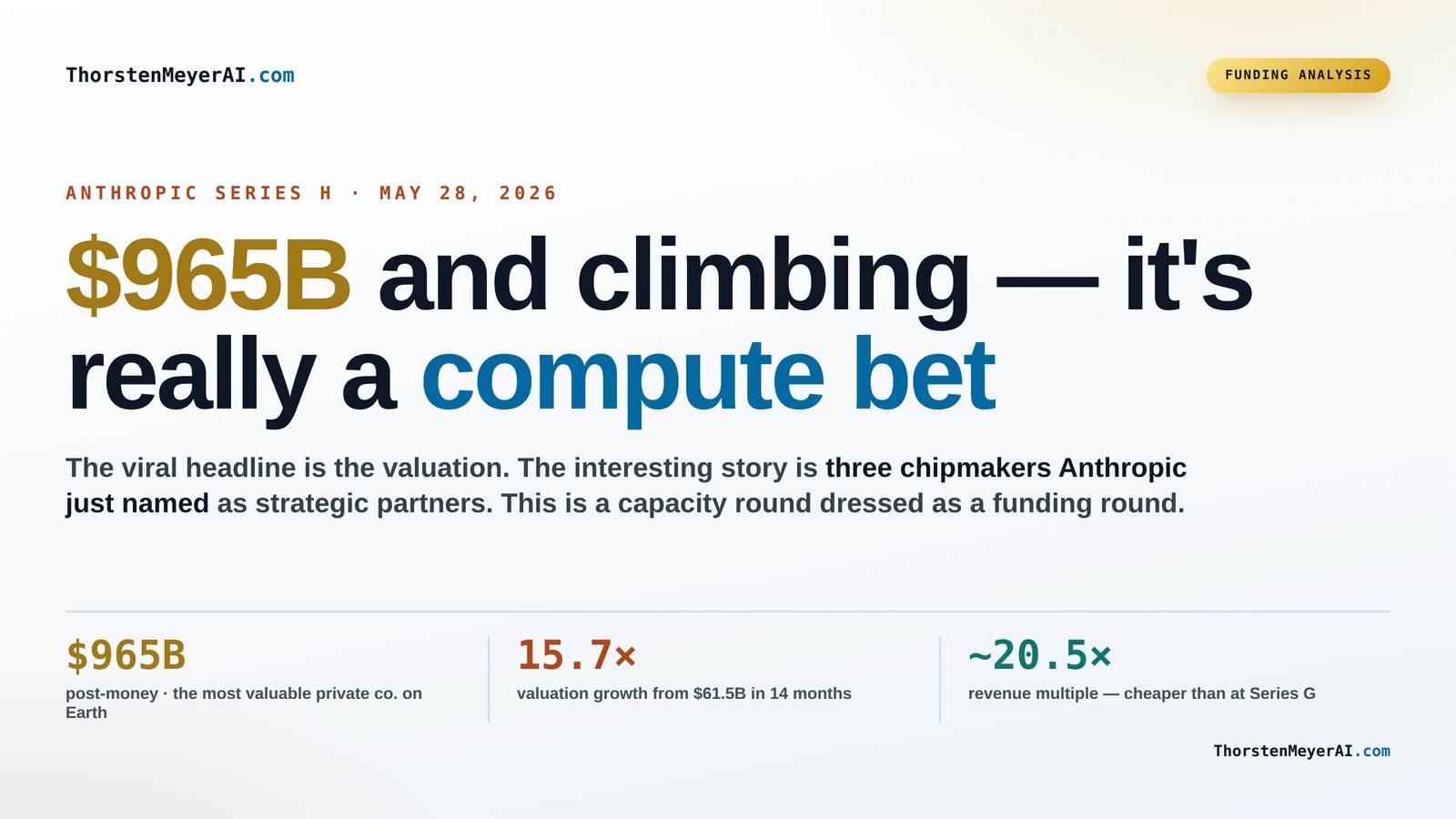
$965B and climbing — it’s really a compute bet
The viral headline is the valuation. The interesting story is in the press release’s middle paragraphs — and in three chipmakers Anthropic just named as strategic partners. This is a capacity round dressed as a funding round.
The numbers nobody can quite parse in sequence
Read together they describe a trajectory with no precedent in enterprise software. Read individually, each looks like a typo.
From $61.5B to $965B in fourteen months
Salesforce took roughly two decades to reach revenue numbers Anthropic just blew past. The sequence below is the part most coverage skips — it’s not the size, it’s the shape.
Anthropic’s valuation ladder · Mar 2025 → May 2026
Five rounds, fourteen months. Bar height is the valuation; the climb itself is the story. Tap any milestone for context.
The multiple actually got cheaper
Bubbles look like multiples expanding while revenue lags. Anthropic’s pattern is the inverse — the valuation tripled, but revenue grew faster, and the multiple compressed.
Revenue-to-valuation multiple · Series G → Series H
Same company, three months apart. The denominator (revenue) is outrunning the numerator (valuation) — exactly the opposite of what a bubble narrative predicts.
10+ gigawatts and three chipmakers
When you name Micron, Samsung & SK hynix alongside your equity backers, you’re saying the binding constraint isn’t demand or model quality — it’s the physical supply of memory chips. The Series H is a capacity round.
Compute commitments backing Anthropic’s capacity bet
$200B+ in announced compute spend across multi-year contracts. The $65B Series H raise has to be read against that bill, not against operating losses.
A genuinely durable bet — or a structural exposure?
Both readings can be true at once. The answer arrives over the next 18–24 months as the gigawatts come online and either fill with paying demand or don’t.
Revenue growth has no precedent in B2B software ($1B → $47B in 17 months). The multiple is compressing, not expanding. Claude is the only frontier model on all 3 major clouds. Enterprise AI spend share went from ~10% to >65% in a year. Compute commitments are tied to specific contracts with capacity dates.
20× revenue is not cheap by any historical software-investing standard. Revenue is reported gross of cloud-reseller pass-throughs, which inflates the top line. Profitability is 2 years out. Amodei’s own warning: a 12-month delay in AI progress “would make him bankrupt” — the compute commitments are a structural exposure to demand persistence.
The valuation race — and the IPO context
Anthropic shipped Opus 4.8 the same morning as Series H — not a coincidence. One week after OpenAI filed confidentially for IPO. The late-2026 frame is set: two frontier AI companies racing to public markets, each pitching durability.
Key Takeaways
- Anthropic’s valuation increase is driven by its focus on expanding compute infrastructure, not just market hype.
- Over $15 billion of the $65 billion raise already comes from committed hyperscaler investments, mainly for hardware.
- The shrinking valuation multiple, despite rising revenue, signals investor confidence in real, hardware-supported growth.
- Partnerships with chipmakers like Micron, Samsung, and SK hynix are central to scaling AI models at unprecedented capacity.
- Future of AI hinges on infrastructure—big models require big hardware, making startup valuations more like hardware plays.

AI Data Center Infrastructure Engineering: Power Distribution, Liquid Cooling, High-Density Networking, and Energy Efficiency for GPU Training … Hardware & Compiler Engineering Series)
As an affiliate, we earn on qualifying purchases.
As an affiliate, we earn on qualifying purchases.
How Anthropic’s valuation skyrocketed — and what it really means
Anthropic’s valuation jumped from $61.5 billion in March 2025 to nearly a trillion dollars just over a year later. That’s a 15.7× increase. But the real shocker? The company’s revenue shot up even faster, crossing an eye-popping $47 billion run-rate in early May 2026.
This rapid valuation growth, paired with soaring revenue, suggests a different story: one where the focus is on infrastructure, not just market hype. It’s a signal that the race isn’t just about building smarter AI but about having the hardware to power it. This shift indicates that investors see future value not solely in current products but in the capacity to develop and deploy larger, more complex models. The implication is that the value of AI firms is increasingly tied to their hardware and infrastructure investments—assets that enable scalability and performance—rather than just their existing revenue streams. This realization could lead to a paradigm where infrastructure becomes a primary driver of valuation, encouraging companies to prioritize hardware development as a core part of growth strategies.


AI Systems Performance Engineering: Optimizing Model Training and Inference Workloads with GPUs, CUDA, and PyTorch
As an affiliate, we earn on qualifying purchases.
As an affiliate, we earn on qualifying purchases.
Why this round is really about buying compute — not just raising funds
While headlines scream about a $65 billion raise, the core message is about capacity. Over $15 billion of the round already comes from committed hyperscaler investments, including $5 billion from Amazon. The rest is aimed at expanding compute infrastructure with chips from Micron, Samsung, and SK hynix.
Think of this as stocking up on the fuel needed for the next wave of AI models. Anthropic is betting that access to massive compute power—more than just talent or data—is the real bottleneck to scaling its models. This focus on hardware investments reflects a strategic recognition that the future of AI depends on physical infrastructure. It’s a tradeoff: companies must allocate significant resources upfront toward hardware, which may delay immediate profit but creates a foundation for exponential growth. This approach also reduces reliance on external cloud providers over time, giving companies more control over their compute environment. Essentially, the move signals a shift from viewing infrastructure as a cost center to considering it a vital strategic asset that directly influences competitive positioning in AI development.


Platform Engineering for Artificial Intelligence: Designing scalable infrastructure, data pipelines, and model lifecycle management for generative AI and agentic protocols (English Edition)
As an affiliate, we earn on qualifying purchases.
As an affiliate, we earn on qualifying purchases.
The numbers tell a different story: revenue vs. valuation
In February 2026, Anthropic was valued at $380 billion with $14 billion in revenue—around 27× revenue. Today, at nearly $1 trillion, the valuation is roughly $47 billion in revenue, dropping the multiple to about 20.5×.
This shift indicates that investors are increasingly valuing the company based on its infrastructure investments and growth potential rather than just its current revenue. It reflects a broader understanding: that the real value lies in the hardware and capacity to support future AI advancements, not only in present revenues. This change in valuation multiples signifies a transition in investor perception—from valuing companies solely on revenue metrics to appreciating their hardware assets and long-term growth infrastructure. It suggests that the market is starting to see infrastructure as a critical component of value creation, which could lead to more aggressive investments in hardware and longer-term commitments from investors aiming to capitalize on the hardware-driven AI boom.


The AI Data Center Race: No-Constraints Thinking for the Age of Compute
As an affiliate, we earn on qualifying purchases.
As an affiliate, we earn on qualifying purchases.
Who’s backing this giant move? The key partners and what they bring
Anthropic’s round was led by major players like Altimeter, Dragoneer, and Sequoia. Big names like Blackstone, Fidelity, and Temasek also jumped in. Hyperscalers like Amazon committed $5 billion, with others like Microsoft and Nvidia maintaining strategic ties.
Most of this money is pre-allocated to infrastructure—chips, cloud services, and memory—highlighting a shared belief: AI growth hinges on hardware, not just algorithms. This backing signals a strategic shift where hardware partners become as vital as software developers, emphasizing that the future of AI depends on building the physical infrastructure. The involvement of these investors and partners underscores a collective understanding: the race for AI dominance is increasingly a hardware race, requiring significant investments in the physical building blocks of AI systems. This collaboration indicates a recognition that breakthroughs in AI are closely tied to advancements in hardware technology, and that maintaining leadership requires deep integration with chip and memory providers, ensuring access to cutting-edge components essential for training and deploying large models at scale.

How much of this is new cash? The real value of the capacity round
The $65 billion isn’t all fresh money. About $15 billion already came from commitments by hyperscalers like Amazon. The remaining funds are aimed at expanding compute capacity, especially through partnerships with chipmakers and cloud providers.
This isn’t just a funding boost; it’s a strategic investment in the infrastructure needed for AI’s future—training models that could dwarf today’s giants. By focusing on hardware investments, Anthropic is positioning itself to be at the forefront of scalable AI development, where hardware efficiency and capacity directly translate into competitive advantage. This approach involves tradeoffs, such as longer timelines for hardware deployment versus immediate valuation gains, but it ultimately aims to build a sustainable foundation for AI’s exponential growth. The emphasis on existing commitments alongside new investments underscores a deliberate strategy: leveraging proven partnerships and pre-existing hardware pipelines to accelerate deployment timelines and ensure readiness for future AI demands.

What does all this mean for AI’s future?
The shift toward infrastructure investment signals a fundamental change: AI companies are becoming hardware giants as much as software creators. The race to dominate the next chapter of AI depends on access to unprecedented compute power.
Imagine a world where the biggest AI models are akin to massive data centers—requiring billions of dollars in chips, memory, and cloud resources. That’s the new battleground. This move could also reshape industry dynamics, favoring players with deep hardware expertise and large-scale infrastructure capabilities, potentially creating barriers to entry for smaller firms. The implications include a potential realignment of the AI ecosystem, where hardware and infrastructure capabilities become key differentiators, and where future growth is more tightly coupled with physical assets than ever before. This infrastructure-centric approach might also influence global AI policy, supply chains, and innovation cycles, as countries and corporations compete for hardware dominance, shaping the future landscape of AI development and deployment.
Frequently Asked Questions
How can Anthropic be worth $965B if it’s still private?
Valuations for private companies like Anthropic are based on investor interest and future growth potential. This round reflects confidence in its infrastructure capacity and revenue trajectory, not just current cash flow.Is this round really about revenue, or mostly about compute access?
Most of the focus is on compute capacity. The funds are allocated primarily to hardware, chips, and cloud infrastructure to support training and deploying larger, more powerful models.Why are chip and memory companies part of this story?
Because AI’s future depends on hardware. Partnerships with Micron, Samsung, and SK hynix show that access to advanced chips and memory is the bottleneck for scaling models, making these firms key players.What does this mean for the cost of training and running AI models?
Costs will skyrocket. Larger models require massive compute, meaning more chips, memory, and cloud resources—costs that will be factored into AI pricing and infrastructure investments.Does this valuation signal an impending IPO?
Not necessarily. While it boosts Anthropic’s profile, the focus remains on infrastructure and growth. A public offering could happen later, once hardware and capacity investments solidify.Conclusion
This isn’t just a billion-dollar funding spree; it’s a blueprint for AI’s hardware future. Anthropic’s focus on capacity signals a world where the race isn’t only about smarter algorithms but also about securing the chips and cloud power to run them.
As AI giants grow bigger, the real game shifts from pure software innovation to infrastructure dominance. The question is no longer just how smart your models are, but how much hardware you can afford to deploy.