
TL;DR

Get business pricing on office and shipping supplies
- Business-only prices and quantity discounts
- Tax-exempt purchasing
- Multiple users, one account, clear invoices
IdeaClyst creates a private, local-first war room for your ideas, combining AI-driven debate with real research. It helps founders evaluate, discover, and plan confidently—without risking their raw ideas or data.
Imagine having an honest, no-holds-barred debate about your startup idea—without the fear of being talked over or influenced by bias. That’s what IdeaClyst offers: a dedicated space where ideas are pressure-tested by AI models playing different roles, all while staying on your own machine. It’s like a mini war room for your brain, designed to cut through the noise and zero in on what truly matters.
As a founder, your biggest challenge isn’t just coming up with ideas. It’s knowing which one to chase—fast. You’ve probably wasted months chasing a shiny new concept only to realize it’s not a fit. Learn more about making smart decisions. With IdeaClyst, you get a clear, data-backed way to evaluate and refine your ideas—saving time, money, and your sanity.
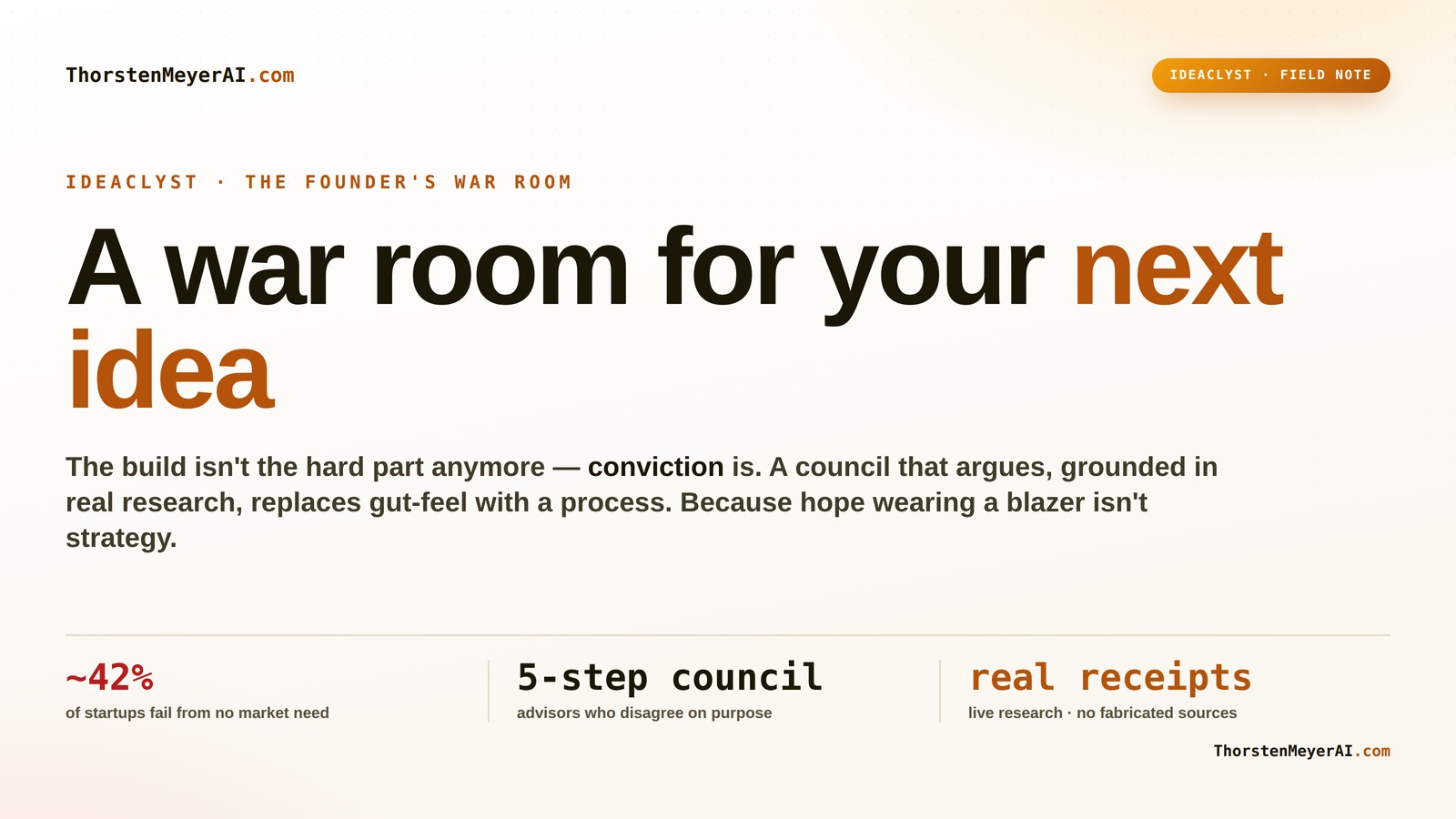
A war room for your next idea
The build isn’t the hard part anymore — conviction is. Knowing which idea deserves the next six months, and being able to defend it. Most founders answer with gut feel and optimistic math. That’s hope wearing a blazer. IdeaClyst replaces it with a process.
The most expensive decision is what to build
The single most valuable thing a tool can do is talk you out of the wrong six months. The numbers make the case better than any pitch.
Three tools in one — on your own machine
Strip away the framing and IdeaClyst is three things at once, all running locally with nothing leaving your laptop.
An AI council
Pressure-tests an idea you bring it — advisors who argue on purpose.
A discovery engine
Finds ideas you didn’t know to look for by hunting real demand signals.
A founder’s workspace
Carries winners from “interesting” all the way to “ready to build.”
Advisors who disagree on purpose
Not one confident, agreeable answer — a structured five-step deliberation where models play different roles and turn on their own work. The disagreement is the feature.
The five-step deliberation
A council that leads with the bad news surfaces the objections you’d otherwise find the expensive way, on month five.
Product strategy
Who’s it for, what’s the wedge, why now, what’s the business model.
Technical architecture
What would it actually take to build — and where’s the risk.
Critique pass
The council turns on its own work. Where’s the hand-waving? What kills this?
Second, independent critique
A different voice, a different angle — so blind spots don’t survive.
Final synthesis
Everything into one coherent founder packet: strategy, architecture, validation, plan.
When IdeaClyst cites a source, it actually fetched it
The hard departure from “ask an AI what it thinks of my startup.” It runs in a strict, real-data-only mode — if it can’t gather genuine evidence, it says so plainly rather than inventing a plausible paragraph.
Confidence with receipts
No fabricated statistics, no imaginary competitors, no made-up citations. The packet survives a skeptical co-founder or a sharp investor because the reasoning has receipts.
Market research first
Scouts the landscape before the council reasons about anything.
Competitor read
Real positioning, pricing signals, feature claims — differentiation vs. reality.
Validation with links
Not “talk to customers” — concrete signals & sources you can click.
From the blank page to build-ready
Evaluation is half the problem; the blank page is the other half. And a plan is worthless if it dies in a tab you never reopen.
Bring a space, not an idea
“AI for accountants,” “tools for indie game studios” — plus your goal and real capacity. It hunts demand signals across HN, Reddit, Product Hunt, GitHub, pricing pages.
- An honest market read — leads with the bad news when a space is hard
- An opportunity map — high pain, thin competition
- Ranked candidates — wedge, who pays, effort, risk, confidence
- each with KILL CRITERIA — when to walk away
A home and a forward path
Every promising idea gets carried forward, with every artifact in plain files on your disk.
- Validation tooling — sprint board, interview list, evidence browser
- Founder profile — a personal-fit lens; same discovery, different advice
- Build workspaces — funnel, personas, landing draft, version history
- “Build this idea” → a PRD + task queue, ready for a coding agent
Key Takeaways
- A war room turns chaotic ideas into visual, actionable plans, speeding up decision-making.
- IdeaClyst’s structured AI council stages debate, reducing founder bias and surfacing hidden risks.
- Local-first, open-source design keeps your raw ideas private, secure, and under your control.
- Both physical and digital setups work—choose based on your team’s needs and workflow.
- Regular updates, clear roles, and visual artifacts keep your idea war room effective and energized.
AI startup idea validation software
As an affiliate, we earn on qualifying purchases.
As an affiliate, we earn on qualifying purchases.
What a war room does—and why it turbocharges your decision-making
A war room isn’t just a fancy name for a meeting space. It’s a dedicated hub where your team can gather to visualize progress, identify roadblocks, and focus on high-priority tasks. Think of it as the command center for your startup’s next big move.
For example, a tech startup might set up a digital war room with sticky notes, flowcharts, and data dashboards showing customer feedback, product metrics, and competitor moves. The goal? Make everything visible, so everyone understands the current state and what needs to happen next. When you have this clarity, decision-making becomes faster and more confident—like having a GPS that recalculates in real time.
Deeply, a well-organized war room facilitates shared understanding and alignment, which are critical for complex projects involving multiple stakeholders. Discover strategies for effective collaboration. It reduces the cognitive load on individual team members by consolidating information, allowing quicker recognition of issues and opportunities. This means decisions are not only faster but also more informed, with fewer costly missteps. The tradeoff, however, is that maintaining a high-quality war room requires discipline and ongoing updates; neglecting this can lead to outdated or misleading visuals that hinder rather than help progress.
local AI debate tool for entrepreneurs
As an affiliate, we earn on qualifying purchases.
As an affiliate, we earn on qualifying purchases.
How IdeaClyst turns your messy idea pile into a focused battle plan
IdeaClyst acts like a virtual council—an AI-powered brainstorming board that stages a structured debate about your idea. You feed it a sentence, a paragraph, or a rough ambition. Then, it convenes five different ‘advisors’: one questions your market fit, another evaluates technical risk, another critiques your assumptions, and so on.
For instance, you might say, ‘I want to build an AI-driven health app for seniors.’ Within seconds, IdeaClyst’s council will dissect that concept, challenge its viability, and suggest pivots. The result? A comprehensive founder packet—strategy, architecture, validation plan—that’s all saved as Markdown files on your local machine.
Deeply, this structured debate process surfaces hidden risks that aren’t obvious at first glance. For example, your market assumptions might overlook demographic nuances, or your technical plan might underestimate integration complexity. By forcing these diverse perspectives into the conversation, you’re less likely to overlook critical flaws. The implication is that your ideas become more robust and adaptable, reducing the chance of costly failures later. The tradeoff is that this process requires honest input and a willingness to confront uncomfortable truths, which can be challenging but ultimately leads to stronger, more defensible plans.
research and decision-making software for founders
As an affiliate, we earn on qualifying purchases.
As an affiliate, we earn on qualifying purchases.
Physical vs. digital war rooms—what’s best for founders today
A physical war room uses whiteboards, sticky notes, and printed charts—think of a startup’s war room in a garage or office. It’s tactile, visual, and great for team bonding. But in 2026, digital war rooms are just as powerful, especially when they’re portable and customizable.
For example, a founder working remotely might use a digital setup with shared dashboards, real-time chat, and embedded research links. Explore private equity insights. IdeaClyst’s local-first design means everything stays on your computer, accessible without an internet connection. This makes it perfect for on-the-go decision-making, whether in a coffee shop or a client site.
Deeply, the choice between physical and digital depends on your team’s workflow, security needs, and collaboration style. Physical setups foster spontaneous interactions and creative energy, while digital setups excel in flexibility and remote access. The implication is that a hybrid approach often offers the best of both worlds—using digital tools like IdeaClyst for structured analysis while maintaining physical spaces for team bonding and brainstorming sessions. The tradeoff is that digital tools require discipline to keep information organized, but they enable more scalable and accessible collaboration.
As an affiliate, we earn on qualifying purchases.
Best practices to make your idea war room work for you
To get the most out of your war room, keep it focused, clutter-free, and accessible. Use visual artifacts like flowcharts, SWOT analyses, and key metrics. Assign clear roles—who owns what?—and schedule regular check-ins to keep momentum.
Deeply, establishing routines for updating and reviewing the war room ensures it remains a living document that evolves with your project. Clarity in roles prevents duplication or neglect, making sure each team member knows their responsibilities. Improve your team’s productivity with marketing tools. Additionally, integrating feedback loops and milestones helps maintain momentum and accountability. The implication is that a disciplined approach turns a static space into a dynamic engine for decision-making. The tradeoff is that maintaining this discipline requires effort and commitment, but the payoff is a more aligned, proactive team that can pivot quickly when needed.
Avoid these common war room mistakes
Clutter is the enemy. Too many sticky notes, endless spreadsheets, or scattered files can turn your war room into a chaos pit. Clarity gets lost, and decision fatigue takes over.
Another trap? Over-reliance on consensus. If everyone agrees too quickly, you might miss critical risks. The goal is honest debate—embracing disagreement helps find holes in your plan.
Finally, neglecting updates can make your war room outdated and useless. Regularly refresh the content, and keep the conversation alive. Learn how to maintain an effective war room.
Deeply, these mistakes can create a false sense of progress or lead to overlooked issues that become costly down the line. Cluttered or stagnant war rooms hinder rapid iteration and accurate assessments. Embracing honest debate and continuous updates ensures your war room remains a strategic asset rather than a liability. The tradeoff is dedicating time and discipline to upkeep, but the benefit is a sharper, more resilient decision-making process that adapts to evolving insights.
What to put on your walls or boards for maximum impact
Effective war rooms feature visual artifacts that tell a story. Use sticky notes for ideas, color-coded by priority. Include customer personas, competitor maps, and technical risk charts. For example, a product team might display a Kanban board tracking feature development and testing phases.
Also, include a section for ongoing research—links, summaries, or live data feeds. The more visible, the better you can spot gaps and opportunities quickly.
Deeply, the visual artifacts you choose should serve as cognitive anchors—helping your team quickly grasp complex information, see patterns, and identify bottlenecks. For example, color-coding priorities can help focus attention on critical issues, while live data feeds keep everyone updated on real-time metrics. The implication is that well-designed visuals reduce cognitive overload and promote faster, better decisions. The tradeoff is that creating and maintaining these artifacts takes effort, but the payoff is a more intuitive and responsive planning environment.
Keeping momentum after capturing your idea
Once your idea is laid out, don’t let the energy fade. Schedule weekly reviews, assign ownership, and keep the debates going. Use your war room to track progress and flag new risks as they emerge.
Deeply, sustaining momentum requires embedding the war room into your regular workflow—making it a habit rather than an ad hoc activity. Regular reviews ensure that ideas don’t stagnate and that new insights are integrated promptly. Assigning clear ownership prevents tasks from falling through the cracks, while ongoing debates foster continuous improvement. The implication is that a disciplined, iterative process transforms a static repository into an active engine for innovation and risk mitigation. The tradeoff is that it demands ongoing effort, but the payoff is a more agile, informed, and resilient startup process.
Frequently Asked Questions
Is IdeaClyst a physical space or a digital tool?
IdeaClyst is a digital tool that runs entirely on your own machine. It’s a local-first, open-source software designed to help you create an idea war room without cloud dependencies or subscriptions.How does the AI council help me make better decisions?
The AI council stages a structured debate among different model ‘advisors,’ each critiquing your idea from a specific angle—market, tech, risks—reducing bias and revealing blind spots you might miss solo.What should I include on my idea war room boards?
Use visual artifacts like customer personas, competitor maps, technical risk charts, and a Kanban board. Keep research links and validation plans visible to spot gaps and opportunities fast.Can I use a war room if I work remotely?
Absolutely. Digital setups like IdeaClyst are perfect for remote teams, allowing you to maintain a focused, visual space on your laptop or desktop, whether you’re in your home office or on the road.What’s the biggest mistake to avoid in a war room?
Clutter. Overloading your space with too many notes or data causes confusion. Also, avoid complacency—keep content fresh and debates honest for maximum impact.Conclusion
Think of your next big idea as a battlefield—and your war room as the command post. With tools like IdeaClyst, you get a private, debate-driven space that’s always ready to challenge your assumptions and sharpen your focus. The best ideas aren’t just born—they’re fought for, refined, and fought again.
So, set up your own idea war room. Make it visual, make it honest, and let the best plan win. Because in the end, success favors the prepared and the relentless.
Halloween Picks
halloween
As an affiliate, we earn on qualifying purchases.



![Financing the AI boom: from cash flows to debt [pdf]](https://leadermenu.com/wp-content/uploads/2026/07/financing-the-ai-boom-from-cash-flows-to-debt-pdf-featured-560x300.jpg)