📊 Full opportunity report: The Business Case For VR Factory Training In Manufacturing Industries on IdeaNavigator AI — validation score, market gap, and execution plan.

Get business pricing on office and shipping supplies
- Business-only prices and quantity discounts
- Tax-exempt purchasing
- Multiple users, one account, clear invoices
TL;DR
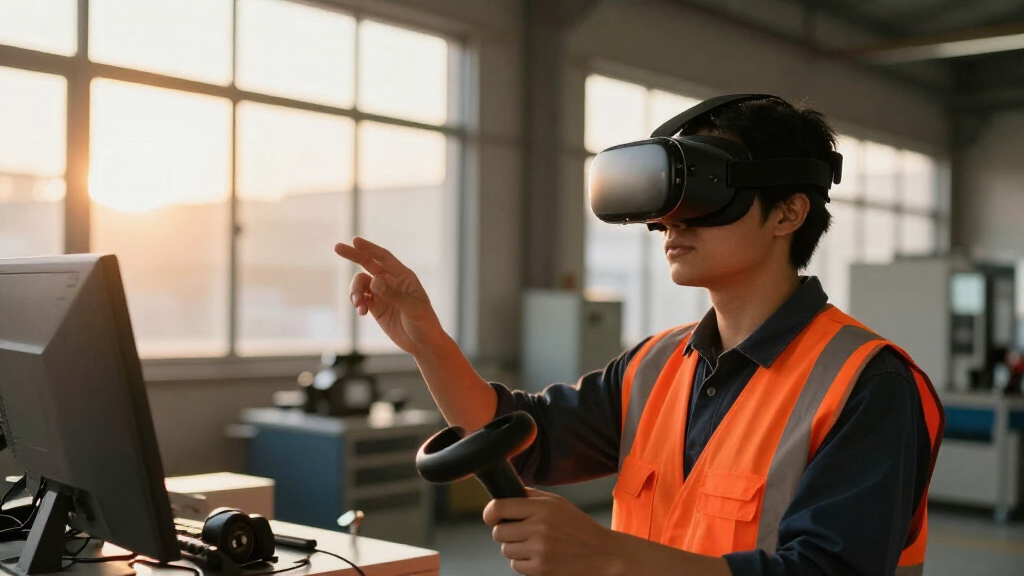
Manufacturers are testing VR training modules to address labor shortages and safety risks. Early pilots focus on high-risk procedures, showing potential for faster onboarding and improved hazard recognition.
Manufacturers are testing virtual reality (VR) training modules as a solution to accelerate onboarding and improve safety on dangerous equipment. This emerging approach aims to address significant labor shortages and skills gaps, with early pilots showing promising results for faster competency and hazard recognition, making it a potentially transformative tool for the manufacturing sector.
Manufacturing companies, especially those facing a severe labor shortage—estimated at over 409,000 unfilled positions in the U.S. as of August 2025—are exploring VR training to rapidly onboard new workers. Traditional methods, such as classroom instruction and on-the-floor training, are slow, inconsistent, and pose safety risks when conducted on live machinery. VR offers a controlled, standardized environment where workers can learn high-risk procedures without danger.
Recent technological developments, including affordable standalone headsets like Meta Quest and Pico, have lowered hardware costs, making VR deployment feasible for mid-to-large manufacturers. These companies are developing focused modules for high-risk procedures such as lockout/tagout (LOTO) and forklift safety, with cloud dashboards that track performance metrics like completion times, hazard recognition accuracy, and quiz scores. Early pilots involve shipping 5-10 headsets to a single plant, measuring improvements against existing classroom benchmarks.
Revenue models include subscription-based SaaS platforms, custom scenario development, and optional hardware management services. The broader immersive enterprise training market is valued at approximately USD 14.55 billion in 2025, with manufacturing training representing a significant segment. Pilot programs aim to validate VR’s effectiveness by comparing time-to-competency and hazard recognition scores between VR-trained cohorts and traditional classroom groups, with success defined by measurable improvements and client commitments to expand.
Potential Impact on Manufacturing Workforce Training
The adoption of VR training in manufacturing could significantly reduce onboarding times, improve safety outcomes, and decrease costs associated with accidents and high employee turnover. As the labor shortage intensifies, faster and more effective training methods are critical. Early pilot results suggest VR can deliver consistent, engaging, and risk-free learning experiences, which may lead to widespread adoption if these benefits are confirmed at scale.
Furthermore, VR training aligns with broader industry trends toward digital transformation and Industry 4.0, integrating immersive learning into existing safety and operational protocols. If proven effective, it could reshape how manufacturing companies approach workforce development, making safety and skills training more scalable and adaptable across multiple plants and procedures.
VR headset for industrial training
As an affiliate, we earn on qualifying purchases.
As an affiliate, we earn on qualifying purchases.
Manufacturing Skills Gap and Technological Advances
The manufacturing sector faces a persistent skills gap, worsened by a rapidly aging workforce and a lack of new entrants. The U.S. alone had over 409,000 unfilled manufacturing jobs in August 2025, with projections indicating a need for 3.8 million new workers by 2033. Traditional training methods struggle to keep pace with demand, especially for high-risk tasks requiring precise skills and safety awareness.
Meanwhile, recent advancements in XR hardware, such as standalone headsets, have drastically reduced costs, enabling more accessible deployment of immersive training solutions. Cloud-native streaming and software platforms facilitate tracking and analytics, allowing companies to measure training outcomes objectively. This convergence of technology and workforce needs has created a fertile environment for VR to become a mainstream training tool in manufacturing.
Initial pilot programs are testing the effectiveness of VR modules focused on safety-critical procedures, with early results indicating improvements in hazard recognition and faster competency achievement. These efforts are part of a broader trend toward digital transformation in industrial training, driven by both economic pressures and technological innovation.
standalone VR headset for manufacturing
As an affiliate, we earn on qualifying purchases.
As an affiliate, we earn on qualifying purchases.
Uncertainties About VR Training Effectiveness and Adoption
While initial pilot results are promising, it is not yet clear how well VR training will scale across different procedures and plant environments. Long-term data on retention, real-world safety improvements, and cost savings remain limited. Additionally, questions about user acceptance, integration with existing training programs, and the ROI for manufacturers are still being evaluated.
It is also uncertain whether the industry will widely adopt VR as a standard training method or if it will remain a supplemental tool for specific high-risk tasks. Further pilots and longitudinal studies are needed to establish definitive evidence of its effectiveness and cost-benefit advantages.
As an affiliate, we earn on qualifying purchases.
Next Steps for VR Workforce Training Validation
Manufacturers plan to conduct 60- to 90-day pilot programs focusing on specific procedures such as lockout/tagout and forklift safety, comparing VR-trained cohorts to traditional classroom groups. These pilots aim to measure improvements in time-to-competency, hazard recognition, and supervisor-rated readiness. Success in these pilots could lead to wider deployment across multiple plants and procedures.
Additionally, vendors will continue refining content, expanding modules, and integrating analytics features. Industry stakeholders will monitor pilot outcomes and develop best practices for VR adoption in manufacturing training, potentially leading to industry-wide standards and increased investment in immersive learning solutions.
Regulatory bodies and safety organizations may also begin to recognize VR training as an effective safety tool, influencing future compliance standards and safety protocols.
VR training software for factories
As an affiliate, we earn on qualifying purchases.
As an affiliate, we earn on qualifying purchases.
Key Questions
How cost-effective is VR training compared to traditional methods?
Early estimates suggest that VR training can reduce onboarding times and safety incidents, potentially lowering overall training and accident-related costs. However, comprehensive cost-benefit analyses are still underway as pilot programs gather more data.
What procedures are most suitable for VR training in manufacturing?
High-risk, repetitive, or complex procedures such as lockout/tagout, forklift operation, and machine safety are considered most suitable for initial VR module development due to their safety-critical nature and the benefits of simulation-based learning.
Will VR replace traditional classroom training entirely?
It is unlikely that VR will replace all traditional training methods. Instead, it is expected to serve as a complementary tool, especially for high-risk or complex tasks, enhancing overall training effectiveness.
What are the main barriers to wider VR adoption in manufacturing?
Key barriers include initial content development costs, integration with existing training programs, user acceptance, and the need for ongoing content updates. Pilot programs aim to address these issues and demonstrate tangible ROI.
Source: IdeaNavigator AI
Halloween Picks
halloween
As an affiliate, we earn on qualifying purchases.