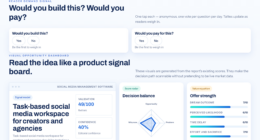

📊 Full opportunity report: Forezai · Polybot: When the AI Disagrees With the Odds on ThorstenMeyerAI.com — validation score, market gap, and execution plan.

Get business pricing on office and shipping supplies
- Business-only prices and quantity discounts
- Tax-exempt purchasing
- Multiple users, one account, clear invoices
TL;DR
Polybot is an AI trading bot that compares its own probability estimates with market prices on Polymarket. It aims to determine when an AI can confidently disagree with the market and act accordingly, emphasizing its experimental nature and risks.
Polybot, an AI trading bot developed privately and not publicly available, designed for the prediction market platform Polymarket, is testing whether an AI can reliably identify when its probability estimates diverge from the market prices and whether such divergences should trigger trades. This experiment explores the potential and limitations of AI in financial prediction, emphasizing its experimental and risk-aware nature.
Developed by Forezai, Polybot compares its own probability estimates, derived from public information, against the implied prices of prediction markets. The core idea is to identify significant gaps where the AI’s assessment differs from the market, but only act when the disparity exceeds a threshold that accounts for transaction costs, model uncertainty, and market noise. The system is designed to trade rarely, focusing on high-confidence disagreements, and records its reasoning for transparency and calibration. This approach aims to evaluate whether AI can meaningfully outperform or challenge market consensus without falling prey to overconfidence or noise.
Polybot is explicitly positioned as a research tool, not a money-making system. Its creators emphasize that market prices already aggregate extensive information, making beating them difficult. The experiment tests whether AI estimates can be calibrated over time to provide genuine edges, with careful attention to avoiding overtrading and unnecessary risks. The project underscores that, while promising, such systems face significant challenges from market dynamics, costs, and adversarial behaviors.
Polybot — when the AI disagrees with the odds
A prediction market puts a price on the future. Polybot asks: can an AI’s own estimate diverge from that price for real — and should it ever act on the gap?
Not financial, investment, legal or tax advice; not a recommendation or solicitation to trade, invest or use any software. Forezai · Polybot is experimental software developed privately and not publicly available, provided “as is” without warranty of accuracy or profitability. Trading and automated trading carry a substantial risk of loss including total loss of capital; past or backtested performance does not indicate future results. Prediction-market participation is restricted or prohibited in some jurisdictions (including for US persons) — you are solely responsible for compliance with applicable law. Consult a licensed professional before any financial decision. Produced with AI assistance under human editorial oversight; independent commentary, the author’s own views. Product and company names are trademarks of their respective owners; mention does not imply endorsement.
Implications for AI and Prediction Markets
This experiment highlights the potential for AI to serve as a forecasting tool capable of identifying mispricings in prediction markets. If successful, it could influence how automated systems are used to interpret market signals and inform decision-making. However, it also underscores the risks of overconfidence, the importance of calibration, and the need for rigorous risk management. For traders, researchers, and policymakers, Polybot exemplifies the ongoing effort to understand the boundaries of AI in financial prediction and the importance of transparency and caution in deploying such tools.
Products Worth Considering

Logitech MX Mechanical Mini Mac Wireless Keyboard Low-Profile – Space Grey

Logitech MX Mechanical Wireless Illuminated Keyboard, Tactile Quiet, Graphite

Canon PIXMA PRO-200S Wireless Professional Inkjet Photo Printer
As an affiliate, we earn on qualifying purchases.
Background on Prediction Markets and AI Challenges
Prediction markets like Polymarket allow participants to bet on future events, with prices reflecting collective probabilities. These markets are difficult to beat because they aggregate diverse information and opinions. Past attempts at creating AI-based trading systems have often failed to outperform due to issues like slippage, fees, and market adaptation. Polybot builds on this context by explicitly testing whether an AI can find genuine edges through independent analysis, rather than relying solely on market data.
The project is part of a broader exploration of AI’s role in financial prediction, emphasizing transparency, calibration, and risk awareness. Its open-source nature allows for community scrutiny and iterative improvement, acknowledging that the system remains experimental and not a guaranteed profit source.
“Polybot is designed to be a research artifact, not a money-making tool. Its goal is to understand when and how an AI can reliably identify mispricings in prediction markets.”
— Thorsten Meyer, creator of Polybot
Uncertainties in AI Market Disagreement Detection
It remains unclear how reliably Polybot can identify true mispricings over extended periods, especially in live markets with slippage, liquidity constraints, and adversarial behavior. The system’s calibration and effectiveness are still being tested, and whether it can outperform market consensus consistently is unknown. Additionally, the impact of model confidence and threshold settings on trading behavior requires further evaluation.
Next Steps for Polybot Development and Testing
Developers plan to deploy Polybot across more markets to gather longer-term data on its calibration and decision-making accuracy. Ongoing analysis will focus on its ability to avoid false positives, adapt thresholds, and improve its estimation methods. Community feedback and peer review are encouraged to refine the approach, with the ultimate goal of understanding AI’s true potential and limits in prediction markets.
Key Questions
Can Polybot reliably beat prediction markets?
Currently, Polybot is an experimental tool designed to test the conditions under which an AI might identify genuine mispricings. Its effectiveness in consistently beating markets remains unproven and is part of ongoing research.
Is Polybot meant for live trading or research?
Polybot is intended as a research artifact, not a commercial trading system. It emphasizes transparency, calibration, and understanding AI’s limitations rather than profit generation.
What are the risks of using Polybot?
Using Polybot involves substantial risks, including potential losses due to market costs, model errors, and adversarial behaviors. It is developed privately and is not publicly available; it is experimental, and users should treat it as risk capital only.
How does Polybot record its reasoning?
Each estimate generated by Polybot includes recorded reasoning, allowing users to inspect why the AI considered a particular mispricing and assess its calibration over time.
What will determine Polybot’s success?
Its success depends on consistent calibration of probability estimates, ability to avoid overtrading, and identifying genuine mispricings that persist over time, rather than short-term noise or luck.
Source: ThorstenMeyerAI.com