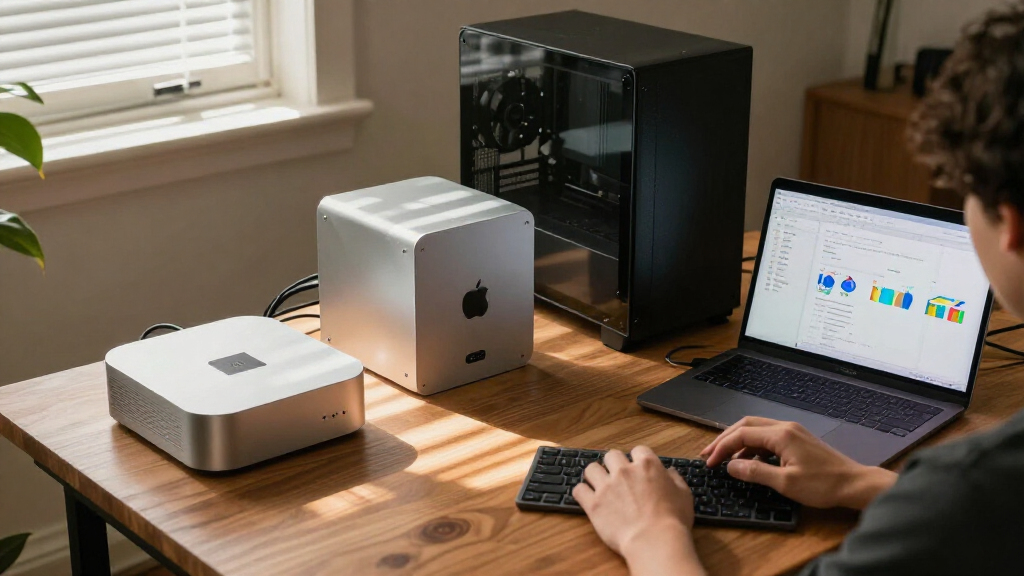

🔍 Read the full analysis: Four Ways To Run AI: Mac Mini, Mac Studio, GPU PC And Cloud API on ThorstenMeyerAI.com

Get business pricing on office and shipping supplies
- Business-only prices and quantity discounts
- Tax-exempt purchasing
- Multiple users, one account, clear invoices
TL;DR
A November 19 comparison from ThorstenMeyerAI.com weighs a Mac mini, Mac Studio, Nvidia GPU PC and cloud API for running AI. It concludes that the best fit depends on whether a user needs an always-on agent, large local models, Nvidia-first tools or access to leading closed models; the article is a specifications-based assessment, not a controlled performance test.
ThorstenMeyerAI.com published a comparison on November 19 of four ways to run AI: a Mac mini, Mac Studio, a PC with an Nvidia graphics card, or a cloud API. The report says the right setup depends on the task, with memory capacity, software compatibility and power use shaping the choice; it does not provide controlled speed tests or a universal buying recommendation.
The comparison separates always-on agents that call a cloud model from workloads that run models locally. For a cloud-connected agent, the computer mainly handles the agent loop, files and tools, rather than the model itself. Apple lists the base Mac mini’s idle power use at 4 watts, according to the report. That makes a small machine a possible option for an agent that runs continuously, but the article does not report a direct power or cost comparison across all four choices.
For local models, the report identifies accessible memory as a key constraint. It lists the Mac mini’s maximum unified memory as 64 GB; Mac Studio configurations reach 128 GB with M5 Max or 512 GB with M5 Ultra. Nvidia’s GeForce RTX 5090 has 32 GB of on-card memory. A model that exceeds that capacity may need to be split between GPU memory and system memory, which can affect how it runs.
Those figures are specifications, not a direct measure of performance. The article says Apple lists memory bandwidth of 1.2 terabytes per second for M5 Ultra and 460 or 614 GB/s for M5 Max, while Nvidia’s cited RTX 5090 page gives a 512-bit memory interface but no bandwidth figure. Neither company’s cited material provides token-speed comparisons between the Mac Studio and the graphics card.
Decision guide · local AI hardware
Which machine fits which AI job?
Five common jobs, one after another, with the machine that fits each best on today’s specifications.
First question: does the model run in the cloud, or on your own machine? If it runs in the cloud, the box only keeps the agent going.
The job
- 1An agent that calls cloud models, running around the clock
→ Mac mini - 2A private assistant with a small open model
→ Mac mini - 3Huge open models with hundreds of billions of parameters
→ Mac Studio - 4Tools built for Nvidia’s CUDA, training, serving many users
→ GPU PC - 5The strongest models and the hardest tasks
→ Cloud API
The machine
Mac mini
up to 64 GB · 4 W at idle
Mac Studio
up to 512 GB · 385 W at most
GPU PC
32 GB on the card · 575 W card
Cloud API
strongest models · per-token bills
Sources: Apple, Mac mini and Mac Studio technical specifications and power pages; Nvidia, GeForce RTX 5090 specifications; all retrieved November 19, 2026. Matching of jobs to machines: our reading, not a buying recommendation.
Graphic: Powered by Thorsten Meyer AI
Choosing Hardware by AI Workload
The comparison matters because “running AI” covers different jobs. A small computer may be sufficient when it runs an agent that sends requests to a cloud model. A person who wants to load a large open model locally may instead prioritize memory capacity, while a team serving models through software built around Nvidia’s CUDA may favor a GPU PC.
Power and system requirements also differ. The report cites Apple’s maximum whole-system draw of 385 watts for Mac Studio with M5 Ultra, compared with Nvidia’s 575-watt rating for the RTX 5090 card alone and its recommendation for a 1,000-watt system power supply. These are not equivalent measurements, but they show why users should account for the full system, not just model capability.
For readers deciding whether to buy hardware or use a service, the comparison also notes that leading closed models are not available for download, leaving a cloud service as the route to those models. The report does not estimate subscription or API costs against hardware ownership, so it cannot establish which option is cheaper for a particular workload.
Products Worth Considering

Logitech MX Mechanical Mini for Mac Wireless Keyboard, Space Gray

Samsung Essential S3 27-Inch FHD Curved Monitor (S36GD)

Logitech MX Brio Ultra HD 4K Webcam
As an affiliate, we earn on qualifying purchases.
Memory, Software and Model Access
The article’s memory rule of thumb estimates that, at 4-bit precision, weights use about half a gigabyte per billion parameters, before overhead and conversation context. On that arithmetic, a 70-billion-parameter model needs about 35 GB for weights, while a 671-billion-parameter model needs about 336 GB. These are estimates based on the stated precision, not guarantees that a model will fit or run well in a given configuration.
Software support is another dividing line. The report says common local tools such as MLX, LM Studio, Ollama and llama.cpp support Apple silicon in different ways. It cites MLX tools for LoRA and QLoRA fine-tuning and PyTorch’s Mac backend for GPU training. By contrast, it describes vLLM as shipping CUDA binaries and relying on a community-maintained plugin for Apple silicon. Tool availability can change, and compatibility does not by itself establish equal performance.
The comparison also cautions against treating desktop hardware as a solution for large-scale model training. It describes small fine-tunes as possible on Macs but says large-model training is not a desktop task on any of the four options. Clustering Macs is technically documented, the article says, but calls it a project involving Thunderbolt 5 connections between each pair of machines and a macOS Recovery setting; the base Mac mini with M6 has Thunderbolt 4.
“The CPU and GPU have direct access to the same memory pool.”
— Apple, as quoted in the ThorstenMeyerAI.com report
Performance and Cost Still Vary
The comparison is based on manufacturer specifications and tool documentation checked on November 19, 2026; it is not a benchmark across equivalent models and workloads. The report says neither Apple nor Nvidia publishes the cited token-speed comparison, and it gives no test results for latency, throughput, reliability or energy use while running AI tasks.
Several practical details remain dependent on configuration: the price of a complete GPU PC, the effect of splitting a model between GPU and system memory, and the ongoing cost of cloud API use. The article lists Apple US starting prices of $2,499 for an M5 Max Mac Studio and $5,499 for an M5 Ultra model, but says Nvidia’s product page does not list an RTX 5090 price. Actual system prices and cloud costs are not established by the comparison.
It is also unclear how quickly tool support and product specifications may change. The report’s conclusions reflect the listed hardware and documentation on its publication date; they should not be read as a guarantee that a particular model, workflow or software version will perform as expected.
Check Workloads Before Buying
The report points readers toward matching hardware to a specific workload rather than choosing by category alone. Before committing, users would need to check the model’s memory requirements, required software and expected usage, then test their own workflow where possible. A cloud API user should also compare service pricing and data requirements; a local setup should be checked for model compatibility and memory headroom.
No follow-up benchmark or product change is announced in the source material. The comparison is a snapshot of specifications and documentation as of November 19, 2026, so the next useful development would be measured testing across the same models and tasks, alongside updated pricing and compatibility information.
Key Questions
Which setup is best for an AI agent that runs all day?
The report says many always-on agents do not need a large local machine if they call a cloud model. A Mac mini may run the agent loop, files and tools, but the best fit depends on the agent’s actual workload and power needs.
Is a Mac Studio better than an RTX 5090 PC for local models?
There is no universal winner in the comparison. The cited Mac Studio configurations offer up to 512 GB of unified memory, while the RTX 5090 has 32 GB of on-card memory. The report says a GPU PC may suit software built for CUDA, while a Mac Studio can hold larger models in its shared memory pool; it provides no direct speed benchmark.
Can a Mac run AI model training?
The report says Mac tools support GPU training and small fine-tunes, including LoRA and QLoRA through MLX-related tools. It also says large-model training is not a desktop job on any of the compared systems.
Why use a cloud API instead of local hardware?
The source says leading closed models cannot be downloaded, so a cloud service is needed to access them. It does not compare API costs with hardware costs or assess the data and privacy terms of particular providers.
Source: ThorstenMeyerAI.com