
🔍 Read the full analysis: Best Local AI Machines: Top 10 Mini PCs 2027 on ThorstenMeyerAI.com

Get business pricing on office and shipping supplies
- Business-only prices and quantity discounts
- Tax-exempt purchasing
- Multiple users, one account, clear invoices
TL;DR
ThorstenMeyerAI.com presents a 2027 guide to mini PCs for local AI workloads, emphasizing memory capacity and bandwidth, cooling, and eGPU connectivity. The supplied material names only a handful of products and gives no complete list of 10, test results, or verifiable 2027 product data, so the promised top 10 cannot be confirmed from it.
The guide names the GMKtec EVO-X3, equipped in the source with an AMD Ryzen AI Max+ 395 processor and 128GB of LPDDR5X memory, as its top pick. It says the memory pool is suited to larger local language models, but supplies no benchmark results, model configurations or measured inference speeds to support a direct performance comparison. The source also identifies the GEEKOM GT13 MAX, with a Core Ultra 9 185H, as an alternative for users who value Intel’s software ecosystem and port selection.
Other products mentioned include the GMKtec K17, described as space-saving but potentially limited by cooling, the GEEKOM A9 Max, credited with a larger chassis and vapor-chamber cooling, and the GMKtec K15, which the source says includes Oculink for connecting an external graphics card. The provided text cuts off during the K15 description and does not name the remaining products needed to make a 10-device list.
The author says the selection process considered NPU performance, memory bandwidth and thermal management, with port options and build quality as additional factors. The guide says devices with less than 16GB of soldered RAM were excluded and that models capable of running quantized 7-billion- and 13-billion-parameter language models were prioritized. However, it provides no testing methodology, recorded temperatures, token-generation figures or full product-by-product specifications in the material supplied.
The 10 picks
- 1
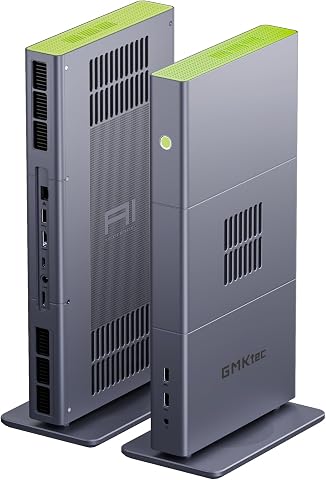 GMKtec EVO-X3 Mini PC with AMD Ryzen AI Max+ 395, 128GB LPDDR5X RAM, and 2TB…View on Amazon →
- 2
 GMKtec EVO-X3 Mini PC with AMD Ryzen AI Max+ 395, 128GB LPDDR5X, and 2TB PCIe…View on Amazon →
- 3
 GMKtec EVO-X2 Mini PC with AMD Ryzen AI Max+ 395View on Amazon →
- 4
 GMKtec EVO-X2 AI Mini PC with AMD Ryzen AI Max+ 395View on Amazon →
- 5
 GEEKOM A9 Max AI Mini PC with AMD Ryzen AI 9 HX 470, 32GB DDR5 RAM, and 2TB SSDView on Amazon →
- 6
 GEEKOM GT15 Max Business & Professional Mini PC with Intel Core Ultra 9, 32GB…View on Amazon →
- 7
 GEEKOM GT1 Mega AI Mini PC with Intel 14th Gen Core Ultra 9, 32GB DDR5, 1TB N…View on Amazon →
- 8
 GMKtec K15 AI Mini PC Oculink Intel Ultra 5 125U 32GB DDR5 512GB SSD, Desktop…View on Amazon →
- 9
 Glorlin Mini PC with AMD Ryzen 7 Pro 8845HS, 16GB DDR5 RAM, 500GB PCIe 4.0 SS…View on Amazon →
- 10
 GMKtec K17 Mini AI PC with Intel Core Ultra 5 226V, 16GB LPDDR5XView on Amazon →
What Shapes Local AI Performance
The guide’s central point is that a mini PC’s headline processor rating does not alone determine its usefulness for local AI inference. Memory capacity and bandwidth can constrain the size of a model that fits in memory and the speed at which data can be supplied to the processor. Cooling also affects how long a system can maintain performance under sustained workloads, rather than only during short bursts.
Those tradeoffs matter to buyers deciding between a compact, lower-cost system and a machine intended for longer AI sessions. External-GPU support through Oculink or Thunderbolt may offer an upgrade route, but the source provides no standardized measurements showing how much performance any listed connection adds. Readers should treat the recommendations as a buying guide’s assessment, not as independently verified comparative results.
Products Worth Considering
Canon IVY 2 Mini Photo Printer Bundle, Blush Pink

Dell XPS Tower 8960 Desktop, Intel Core i7-13700, NVIDIA GeForce RTX 4060, 16GB DDR5, 512GB SSD

Samsung 34-inch ViewFinity S50GC Ultra-WQHD Monitor
As an affiliate, we earn on qualifying purchases.
The Guide’s Selection Criteria
The source frames local-AI mini PC selection around three technical considerations: shared or high-bandwidth memory, the balance between an NPU and integrated graphics, and heat management. It says unified memory can avoid moving data between separate system RAM and graphics memory, while noting that the software in use affects whether an NPU or graphics processor is more helpful.
It also points to different software ecosystems, naming AMD’s Ryzen AI software and Intel’s OpenVINO. The supplied material characterizes OpenVINO as useful for some computer-vision work and AMD software as having gained traction for image generation, but offers no independent software comparisons or compatibility tests. Its advice is therefore most useful as a checklist of factors to investigate rather than proof that one platform is broadly superior.
““Memory bandwidth is the primary bottleneck for local AI performance.””
— ThorstenMeyerAI.com guide
The Missing Ranking and Test Data
The supplied source does not contain 10 distinct product entries, despite the title’s promise. It also does not state the guide’s publication date, confirm 2027 availability or prices, or give links to product specifications and independent reviews. Product configurations can vary, so the listed memory and processor details should be checked against current manufacturer listings before purchase.
The performance claims remain unverified in the material provided: there are no named model builds, inference-speed measurements, sustained-load temperatures, noise readings or like-for-like comparisons. It is also unclear how the author’s ranking weighs price against performance or whether every cited feature is available on every configuration.
Check Listings Before Buying
Readers considering one of the named machines should compare the exact configuration with current manufacturer or retailer specifications, especially memory capacity, memory type, cooling design and expansion ports. They should also confirm that their preferred AI software supports the processor’s drivers and that the system can run their intended model within its memory limits.
A substantiated top-10 comparison would need to identify all 10 devices and publish comparable workload, temperature, noise and price data. The supplied source does not say whether such testing or an expanded ranking will follow.
Key Questions
Does the supplied guide name all 10 mini PCs?
No. The provided text names the GMKtec EVO-X3, GEEKOM GT13 MAX, GMKtec K17, GEEKOM A9 Max and GMKtec K15, but does not provide a complete list of 10. The source also cuts off during its K15 discussion.
Which model does the source rank first?
ThorstenMeyerAI.com names the GMKtec EVO-X3 with an AMD Ryzen AI Max+ 395 and 128GB of LPDDR5X memory as its top pick. The supplied material does not include benchmark data that independently confirms the ranking.
What should buyers prioritize for local AI?
The guide emphasizes memory capacity and bandwidth, cooling under sustained load, and compatibility with the AI software a buyer plans to use. It presents these as selection criteria, not a guarantee of performance.
Can the listed performance claims be verified from this source?
Not from the supplied text. It includes no measured inference speeds, temperatures, noise levels or comparable test conditions, and it does not establish current 2027 pricing or availability.
Source: ThorstenMeyerAI.com