

Disclosure: Gewerkton is built by our publisher — we build it ourselves and write down what we learn.

Get business pricing on office and shipping supplies
- Business-only prices and quantity discounts
- Tax-exempt purchasing
- Multiple users, one account, clear invoices
Not every crew on a construction site shares one language, and cross-border projects do not share one country either. Gewerkton, the construction-site documentation platform our publisher builds, treats both as settings. Its website comes in 40 languages and asks visitors which of five regions they are in. Inside the product, the Cloud line handles region, AI provider and evidence, with region and provider chosen by the operator. Gewerkton is in beta, and Cloud is in public beta.
Forty languages, one evidence chain
The language menu on gewerkton.com lists 40 entries. It runs from German, English and the major European languages through Ukrainian, Russian and the Nordic languages to Chinese in simplified and traditional script, Japanese, Korean, Vietnamese, Thai, Indonesian, Malay, Filipino, Hindi, Bengali and Nepali, and on to Arabic, Persian and Urdu. Those last three are set right to left. If a visitor’s browser prefers a language the site offers but the page is shown in another one, a short note appears: “This page is also available in …”, with a link to open it.
Every language version except German and English carries a footer note that marks it as a translation and says the German version prevails where the two differ. The machine-readable summary on the site gives the same count for the product itself: 40 in-app content and translation languages. Reports follow the same thinking. Embedded Noto fonts render Chinese, Japanese, Korean, Thai and Devanagari correctly in PDF reports.
The website describes the situations this is meant for. One is cross-border teams: “EU, US and APAC on the same project”, where everyone works in their own language and the evidence original stays unambiguous. Another is overseas projects in Asia with Chinese, Korean or Vietnamese crews, “multilingual from recording to report, data residency by choice”.
Five regions, chosen in the browser
Next to the languages sits a second menu, labelled “Country and region”, in the top navigation and again in the footer. It offers five answers: Europe, East Asia, Southeast Asia, South Asia, and Americas and other regions. The last one is also where any country lands that none of the other lists covers.
The region is worked out in the browser, not on a server. A region chosen on an earlier visit wins. Without one, the page looks for a country in the browser’s language settings, then at the time zone, and falls back to Europe. The privacy policy states that browser language and time zone are read locally for this preselection and that none of it is transmitted to Gewerkton or any third party. The choice itself is kept in the browser under a single entry.
What changes with the region are the pictures. Each region has its own version of the scroll film at the top of the page, of the looping clips and of the stills. Where a region has no complete version of a particular file, the page loads the European version of that file instead, one file at a time.
Casting by region
The people in those films follow a simple rule set for the production: in each region, women and men whose background fits that region, with the individual people changing from region to region. The opening still of the East Asia version shows a site manager in a blue helmet briefing a crew in white helmets inside a concrete shell. The Americas version shows a similar briefing on an upper floor with a mixed crew.
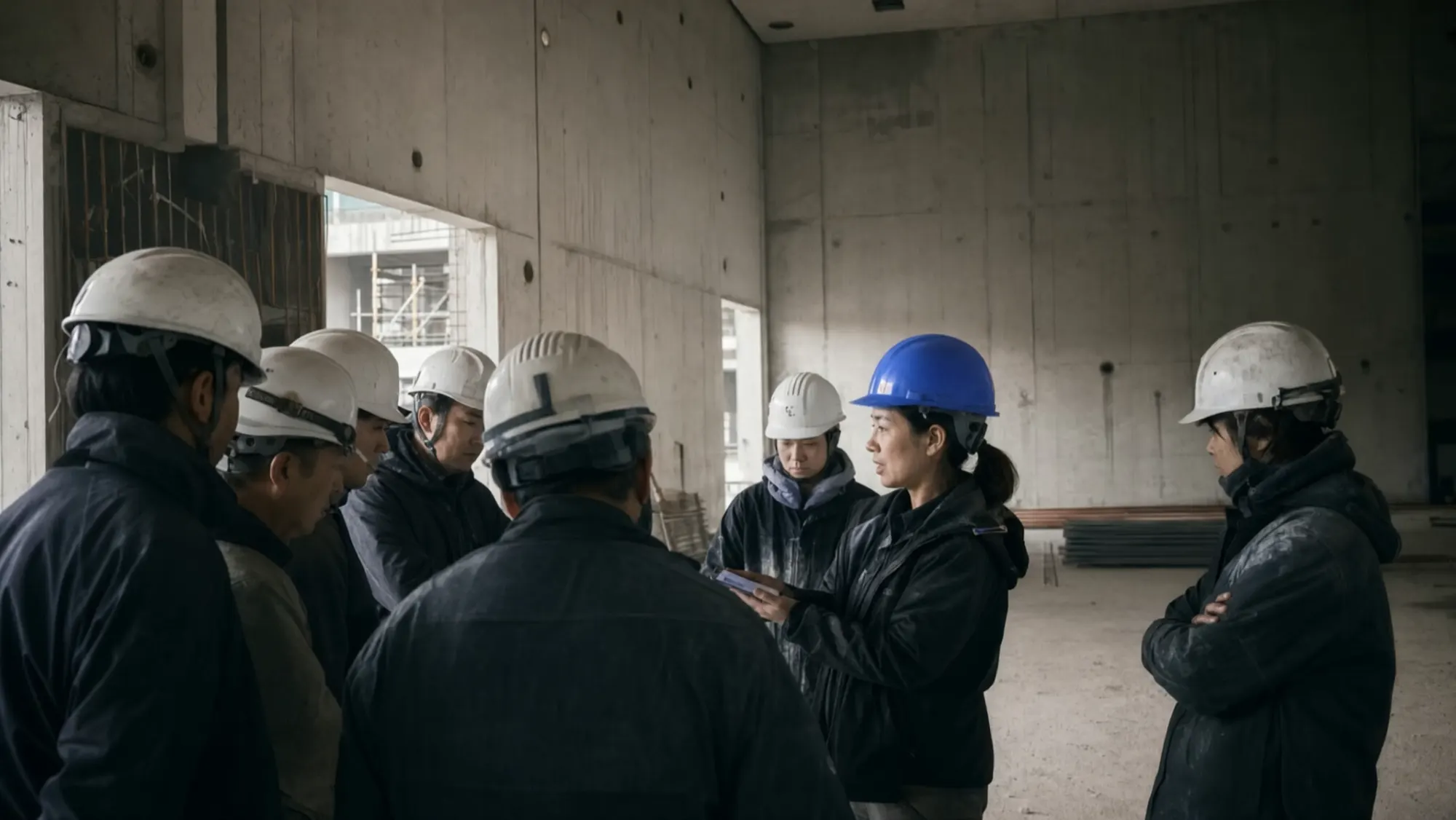
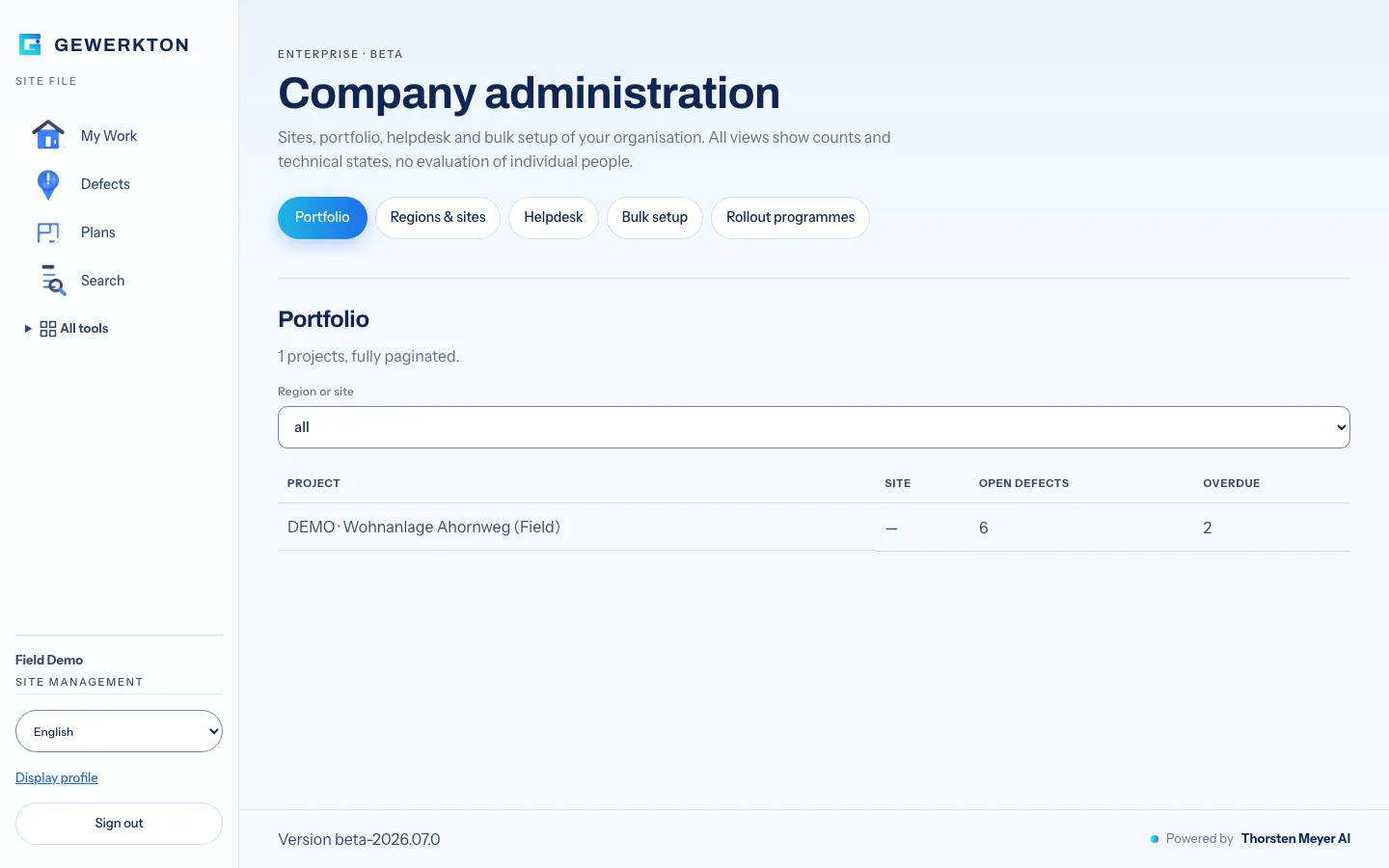
None of these scenes is filmed. Every generated medium on the site carries a visible “AI-generated” note, and the files carry a machine-readable marker as well. Where a scene shows an app, the screen is not generated: in the website’s words, the scenes around the screens are AI-generated, and “what is on the screen is real”, filled with a fictional demo project.
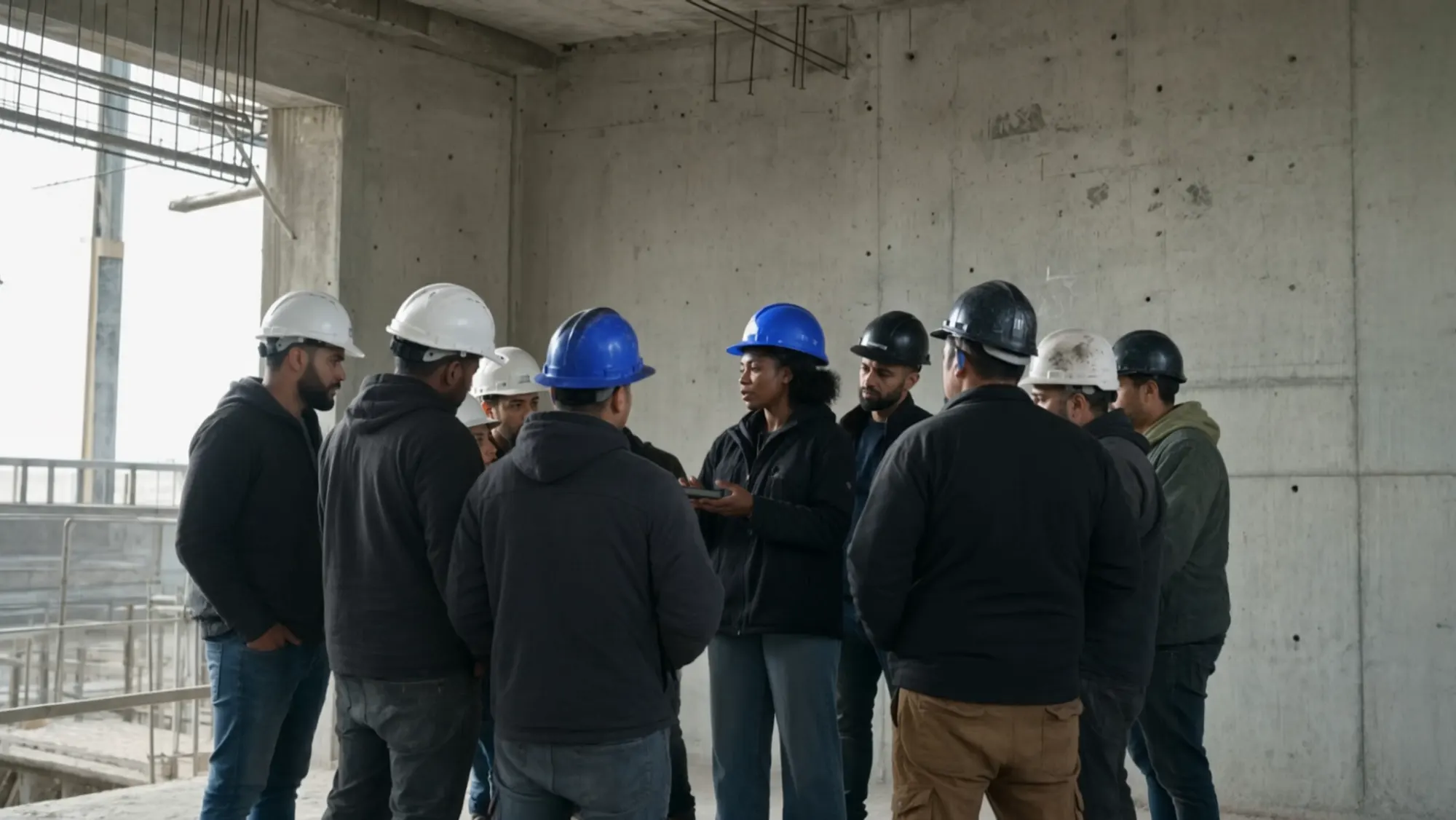
Cloud: region first
The same idea runs through the product. The Cloud page says it “handles region, provider and evidence for day to day operations”, and that it describes only what runs today. The page uses the regional pictures on purpose, because region is its subject. Operations decide the region: the EU, on premises, or a region in mainland China. The operator enables what is permitted in their own setting, and the interface makes no claim of legal permissibility. Access and residency are governed separately under a data trustee arrangement.
Region, provider and retention are operator settings. “Gewerkton does not make that decision for you,” the page says.
Your own AI keys, provider by region
AI functions run with the company’s own accounts. Cloud supports 13 providers under a bring-your-own-key principle: 12 that connect directly, plus OpenRouter as a gateway to further models. Switching provider stays a setting and does not turn into a rebuild. The operator enables direct providers and residency regions, and the company chooses API or subscription mode under its own contract and assessment.
The website names OpenAI and Anthropic first and says every region chooses AI hosted in a country it trusts. For China it names Chinese models such as Qwen, Zhipu, Moonshot, DeepSeek, MiniMax or ByteDance. In the EU, operations stay in the EU or on the company’s own premises. Each region is enabled deliberately by the operator.
Speech is handled close to home as well. Transcription runs without external speech services: on premises the audio never leaves the building, and in the cloud it stays in the EU system environment. Access is granted only by role and project, and the site states plainly that there is no AI training on the customer’s data.
Evidence that travels
The third part is evidence. Daywork reports, defect notices and company reports come out of the same evidence chain. IFC, BCF and GAEB go in and out, so data is not trapped inside the tool, and when a project ends, its data can be exported in full.
Some of the regional detail sits deeper in the product. Deadlines are calculated in the project’s construction-site time zone, not by the server’s clock. Inbound messages from LINE, KakaoTalk and WeChat arrive signed and remain suggestions until a person accepts them. And one Cloud function that is already built keeps the course of each deadline per defect, naming the working days left with weekends and company holidays already taken out.
Where it stands
Gewerkton is in beta. 2026 is its beta year, and general availability is planned for 2027, which the website calls a plan and not a promise. Cloud and Studio are in public beta, and Field is in beta ahead of the public beta. All five lines are built and in beta, and none has been in use at a customer yet. That includes the capabilities the site lists as already built: they are built and tested, but not yet used by a customer.
The region menu sits at the top of the home page and in every footer. The beta page shows where each line stands, and access opens step by step through a waitlist.
Halloween Picks

Vexalify 11-Inch Halloween Pumpkin Fog Machine with Bluetooth Speaker and 12-Color LED Lights

10.5 ft Lighted Pumpkin and Ghost Halloween Inflatable Archway

Fun Costumes Creepy Twin Boys Halloween Animatronic
As an affiliate, we earn on qualifying purchases.