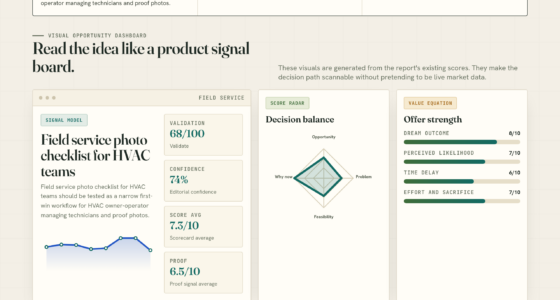
📊 Full opportunity report: The Delegation Ladder: The Four Agentic Loops, And What Each One Lets You Stop Doing on ThorstenMeyerAI.com — validation score, market gap, and execution plan.

Get business pricing on office and shipping supplies
- Business-only prices and quantity discounts
- Tax-exempt purchasing
- Multiple users, one account, clear invoices
TL;DR
The article explains the four levels of agentic loops in AI development, from simple turn-based checks to fully autonomous workflows. Each rung allows progressively more delegation, transforming AI from a tool into a process. Understanding these levels helps organizations manage AI complexity and control.
Anthropic’s team has outlined a framework called the ‘Delegation Ladder,’ detailing four levels of agentic loops in AI systems that progressively delegate control from humans to autonomous processes. This framework clarifies how organizations can structure AI workflows to optimize efficiency while managing risk. The development is significant as it shifts the understanding of AI from simple tools to complex, self-operating systems, with implications for both technical design and business management.
The ‘Delegation Ladder’ describes four distinct agentic loops: turn-based, goal-based, time-based, and proactive. Each level represents a different degree of autonomy, with increasing delegation of decision-making and control. Anthropic’s Claude Code team published a clear definition: a loop is an agent repeating cycles of work until a stop condition is met, with each rung allowing the system to handle more of the process independently.
The first rung, turn-based, involves human oversight where the AI performs a task, checks its work, and the human reviews before proceeding. The second, goal-based, enables the AI to determine when to stop based on predefined success criteria, reducing the need for human intervention. The third, time-based, involves scheduled or event-triggered re-executions, automating routine updates or monitoring. The top, proactive, encompasses fully autonomous, event-driven workflows that can orchestrate multiple agents without human input, including self-scheduling and dynamic decision-making.
Anthropic emphasizes that not all tasks require the highest level of delegation, advocating for starting simple and climbing the ladder only when justified. They warn that system quality and verification are critical to prevent errors as control shifts upward.
The delegation ladder: four agentic loops, and what each lets you stop doing
Strip the hype and a “loop” is simple — an agent repeating work until a stop condition is met. The useful lens isn’t the mechanics, it’s what you hand off. Four loop types = four rungs of delegation, from a tool you operate to a process that runs.
The whole framework reduces to one question about your own work: where am I the bottleneck, and which single piece can I hand off? Can you write the check? Is the goal concrete? Does the work arrive on a schedule? That answer picks your rung — and you climb one step at a time. The real skill isn’t operating a loop; it’s the judgment of what to delegate and how far — enough hands off to gain leverage, enough on the wheel that “runs without you” doesn’t become “runs away from you.”
Implications for AI Development and Business Automation
This framework clarifies how organizations can progressively delegate tasks to AI, reducing manual oversight and increasing efficiency. It highlights the importance of system design, verification, and discipline in deploying autonomous workflows. As AI systems move up the ladder, the potential for scalable, self-managing processes grows, but so does the need for careful control and oversight to prevent errors or unintended consequences.
As an affiliate, we earn on qualifying purchases.
Evolution of AI Automation Strategies
The concept of loops in AI has gained prominence with recent discussions on designing more autonomous systems. Historically, AI has been treated as a tool operated directly by humans, but recent developments emphasize creating systems that can self-manage through structured control levels. Anthropic’s framework builds on prior work by formalizing the degrees of autonomy and providing practical guidance for implementation. The idea aligns with broader trends toward autonomous workflows in industries like software development, operations, and customer service, where reducing human intervention can improve speed and consistency.
“The Delegation Ladder offers a clear map for how far we can let AI systems handle tasks independently, from simple checks to full automation.”
— Thorsten Meyer, AI researcher
AI decision-making automation software
As an affiliate, we earn on qualifying purchases.
As an affiliate, we earn on qualifying purchases.
Unanswered Questions About Implementation and Risks
It is not yet clear how organizations will practically implement these loops at scale, especially concerning verification and safety at higher levels of autonomy. The specific challenges of managing complex, multi-agent workflows and preventing unintended behaviors remain under discussion. Additionally, the framework’s applicability across different industries and task types is still being evaluated, and real-world case studies are limited.
AI process orchestration platforms
As an affiliate, we earn on qualifying purchases.
As an affiliate, we earn on qualifying purchases.
Next Steps for Organizations Adopting the Delegation Ladder
Organizations are expected to experiment with the lower rungs—turn-based and goal-based loops—before gradually adopting more autonomous, proactive workflows. Industry leaders may develop best practices for verification, safety, and oversight as they scale these systems. Further research and case studies will clarify the risks and benefits, guiding broader adoption and refinement of the framework.
As an affiliate, we earn on qualifying purchases.
Key Questions
What is the main purpose of the Delegation Ladder?
The framework aims to help organizations understand and implement different levels of AI autonomy, from simple checks to fully autonomous workflows, optimizing efficiency while managing risk.
How do the four loops differ in terms of control?
The first loop involves human oversight at each step, while the second allows the AI to decide when to stop based on goals. The third automates repeated tasks based on time or events, and the fourth enables fully autonomous, event-driven processes without human input.
What are the risks of moving up the ladder?
Higher levels of autonomy increase complexity and the potential for errors or unintended behaviors. Proper verification, system design, and oversight are essential to mitigate these risks.
Is this framework applicable across industries?
While the principles are broadly relevant, practical implementation depends on specific tasks, safety requirements, and organizational capacity. More case studies are needed to evaluate its versatility.
What should organizations do next?
Start with simple, verified loops and gradually adopt higher levels of autonomy as confidence and systems mature. Focus on verification, documentation, and safety protocols during this process.
Source: ThorstenMeyerAI.com
Halloween Picks
halloween
As an affiliate, we earn on qualifying purchases.