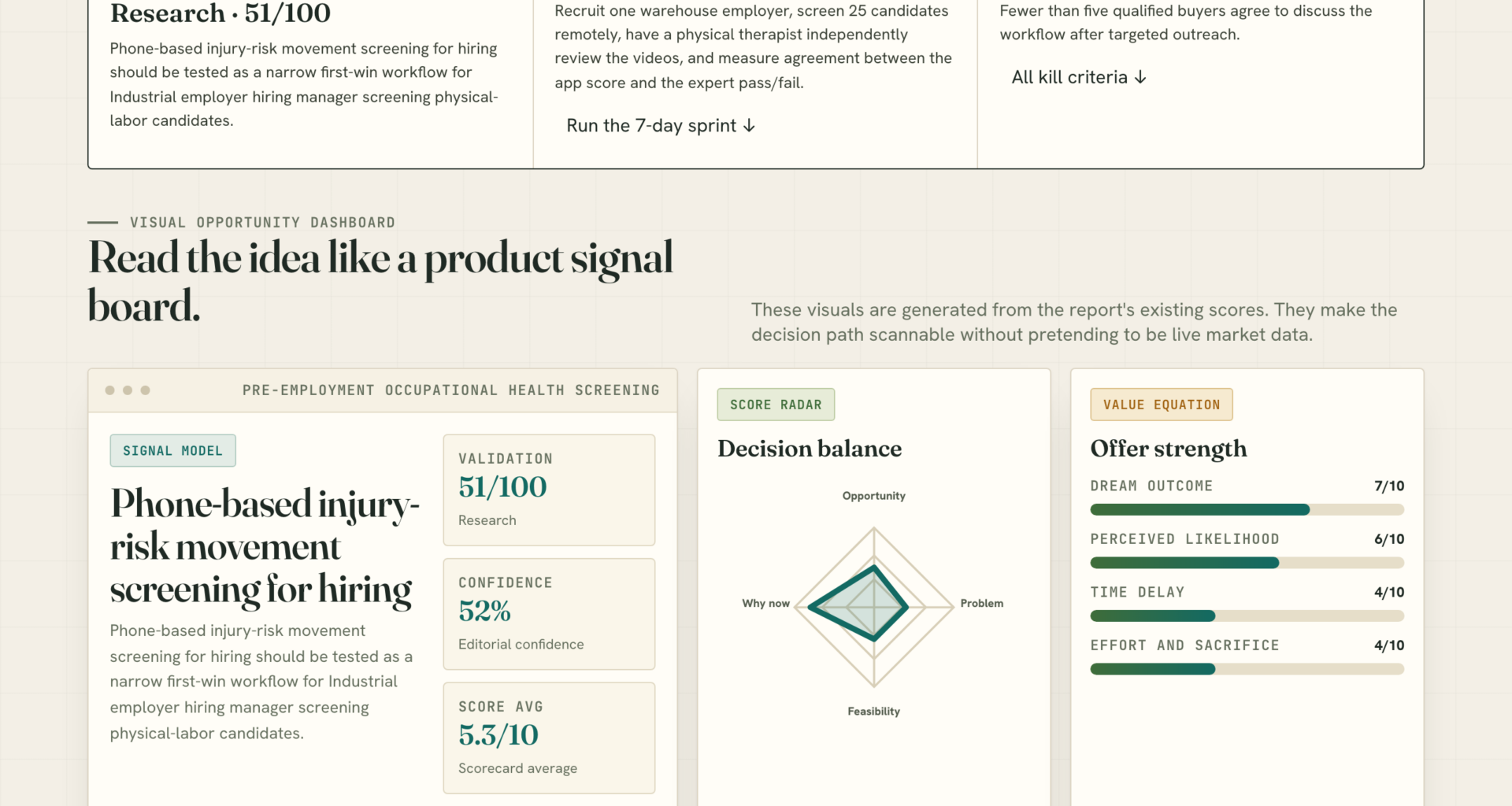

📊 Full opportunity report: Phone-based injury-risk movement screening for hiring on IdeaNavigator AI — validation score, market gap, and execution plan.

Get business pricing on office and shipping supplies
- Business-only prices and quantity discounts
- Tax-exempt purchasing
- Multiple users, one account, clear invoices
TL;DR

A pilot program is testing a phone-based movement screening tool for pre-employment injury risk assessment in industrial hiring. It uses phone cameras and pose estimation to evaluate candidates remotely, offering a faster, cheaper alternative to clinic assessments. The initiative aims to improve injury prevention and reduce workers’ compensation costs.
A pilot program is underway to test a phone-based movement screening tool designed for pre-employment injury risk assessment in industrial hiring. This approach leverages phone cameras and pose estimation technology to evaluate candidates remotely, aiming to reduce costly injuries and streamline screening processes.
The proposed movement screening involves candidates performing 5 to 7 standardized physical movements—such as squats, reaching, lifting simulation, and balance holds—while recording themselves on their phones. The system then analyzes these videos using pose estimation algorithms to generate a pass/fail injury risk score within 24 hours, at a cost of approximately $30 to $50 per candidate. This method is intended to serve as a quick, scalable alternative to traditional clinic assessments, which can cost between $200 and $400 and often delay hiring decisions.
According to initial plans, a warehouse employer will recruit 25 candidates for remote screening, with physical therapists reviewing a subset of videos to validate the app’s scoring accuracy. The goal is to measure agreement between the app-generated risk scores and expert assessments, establishing the tool’s reliability for pre-employment screening.
Potential Impact on Industrial Hiring and Injury Prevention
If successful, this phone-based screening could significantly lower the costs and time associated with pre-employment physical assessments, enabling faster hiring processes. More importantly, it could help identify injury risks before candidates start work, potentially reducing costly on-the-job injuries and workers’ compensation claims. This innovation aligns with rising industry pressures to improve safety and reduce costs through more proactive screening methods.
As an affiliate, we earn on qualifying purchases.
Emergence of Remote Movement Screening Technologies
Traditional injury-risk assessments for physically demanding roles are typically conducted in clinics or on-site, often involving manual evaluations by health professionals. These assessments are costly and time-consuming, leading many employers to skip them or delay hiring. Recent advances in mobile phone cameras and pose estimation algorithms have made remote movement analysis feasible, opening new possibilities for scalable, cost-effective pre-employment screening. This initiative builds on the growing trend of leveraging AI and mobile technology to enhance occupational health practices.
“Using phone cameras and pose estimation, we can remotely evaluate candidates’ movement mechanics at a fraction of the cost and time of traditional assessments.”
— an anonymous researcher
remote injury risk assessment tool
As an affiliate, we earn on qualifying purchases.
As an affiliate, we earn on qualifying purchases.
Validation and Reliability of Phone-Based Screening
It is not yet confirmed how accurately the app’s risk scores will align with expert assessments across diverse candidate populations. The pilot program is still in the planning stage, and results from initial testing are pending. Questions remain about the system’s ability to handle edge cases, such as candidates with limited phone camera quality or atypical movement patterns, and whether it can reliably predict injury risk in real-world settings.
As an affiliate, we earn on qualifying purchases.
Upcoming Pilot and Validation Studies
The next step is to conduct the planned pilot with a warehouse employer, recruiting 25 candidates for remote screening. Physical therapists will review a subset of videos to compare with app scores, aiming to establish reliability. Results from this pilot will determine whether the tool can be scaled for broader use in pre-employment screening, with further validation studies likely to follow.
pre-employment movement screening software
As an affiliate, we earn on qualifying purchases.
As an affiliate, we earn on qualifying purchases.
Key Questions
How does the phone-based movement screening work?
Candidates perform a series of standardized movements while recording themselves on their phones. The app analyzes the videos using pose estimation algorithms to assess injury risk and provides a pass/fail score within 24 hours.
What are the advantages over traditional assessments?
The phone-based method is faster, cheaper, and scalable. It reduces the need for in-person clinic visits, cuts costs from around $200-$400 to approximately $30-$50 per candidate, and can be integrated into existing hiring workflows.
What are the limitations or concerns?
It is still unclear how accurately the app can predict injury risk across diverse populations and scenarios. The reliability of remote assessments compared to in-person evaluations remains to be validated through pilot results.
When will this screening method be available for widespread use?
The pilot program is planned to begin soon, with results expected in the coming months. If validated, broader deployment could follow within a year or two.
Source: IdeaNavigator AI
Fall Picks
fall essentials
As an affiliate, we earn on qualifying purchases.