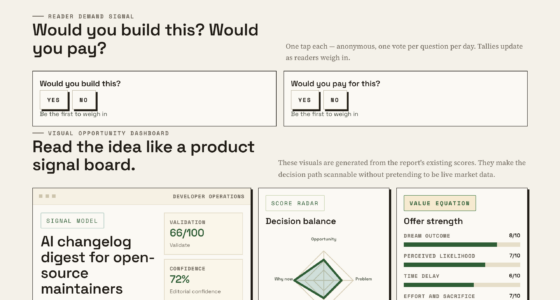
📊 Full opportunity report: World Model Readiness: Are You Ready for AI That Acts? on ThorstenMeyerAI.com — validation score, market gap, and execution plan.

Get business pricing on office and shipping supplies
- Business-only prices and quantity discounts
- Tax-exempt purchasing
- Multiple users, one account, clear invoices
TL;DR
A new diagnostic tool evaluates how ready organizations are for AI systems that build internal models of the environment and predict consequences of actions. Major AI labs are rapidly developing world models, signaling a shift from descriptive to action-oriented AI. Readiness involves data, supervision, and understanding failure modes.
Organizations and AI developers are increasingly focused on the transition from large language models that describe to those that predict and act. A new diagnostic tool called World Model Readiness has been introduced to evaluate how prepared entities are for this shift, which is gaining momentum among major AI labs and industry players.
The shift from models that generate language or summaries to those that understand and predict environmental changes is well underway. Companies like Meta and Google DeepMind have introduced advanced world models capable of real-time, photorealistic simulations and environmental predictions. Yann LeCun has founded AMI Labs with a billion-dollar investment to develop such models, emphasizing the importance of internal environment understanding.
The diagnostic, designed as a mirror rather than a seller of technology, assesses whether organizations have the necessary data, supervision, and understanding to deploy these models safely and effectively. It focuses on practical questions: Do you have the right data? Can your processes be represented as states and dynamics? Are you prepared for the potential failure modes, such as the gap between simulation and real-world performance?
Current world models are still data- and compute-intensive, with significant limitations in physical reasoning and real-world generalization. Experts warn that readiness is about posture, not panic, emphasizing the importance of honest assessment over hype-driven adoption.
World Model Readiness — are you ready for AI that acts?
LLMs describe. World models predict and act. The next AI shift isn’t “have we adopted a chatbot” — it’s whether you’d know what to do with a model that anticipates consequences.
Independent commentary, produced with AI assistance under human editorial oversight. The views are the author’s own and may change. World Model Readiness is an early, positioning-stage diagnostic — an assessment framework, not a prediction, guarantee, or technical advice; its conclusions depend on the framework’s assumptions. “World models” are an emerging, rapidly-evolving area of AI; statements about the field reflect publicly reported developments as of mid-2026 and may quickly date. References to companies, labs, and products describe public reporting and imply no affiliation, endorsement, or verification. Product, model, and company names are trademarks of their respective owners.
Implications of Transition to Action-Oriented AI
This shift to AI systems capable of predicting and acting could revolutionize industries by enabling automation that understands consequences, not just suggestions. However, it also introduces risks—errors in predictions could lead to costly or dangerous outcomes. The diagnostic helps organizations identify whether they are truly prepared for this transition, potentially avoiding costly missteps and ensuring safe deployment.
AI diagnostic tools for organizations
As an affiliate, we earn on qualifying purchases.
As an affiliate, we earn on qualifying purchases.
Rapid Advances in World Model Development
Over the past three years, AI research has moved from focusing solely on large language models to developing world models that predict environmental states and consequences. Notable milestones include Meta’s V-JEPA 2, DeepMind’s Genie 3, and investments by Yann LeCun’s AMI Labs. These efforts aim to create systems that perceive, understand, and act within complex environments, marking a significant evolution in AI capabilities.
The industry recognizes this as a potential turning point, with the framing shifting from incremental improvements to a possible end of dominance for language models alone. Yet, the technology remains in early stages, with performance gaps and safety concerns still unresolved.
“Building true world models is the next frontier for AI, and it’s a billion-dollar effort to make it happen.”
— Yann LeCun
As an affiliate, we earn on qualifying purchases.
Unresolved Challenges in Deploying World Models
While development accelerates, significant uncertainties remain. The main issues include the performance gap between simulations and real-world environments, the calibration of models to avoid confidently wrong predictions, and the safety and oversight mechanisms needed for action-oriented AI. It is not yet clear how quickly organizations can overcome these hurdles or how the technology will be integrated into operational settings.
AI environment simulation software
As an affiliate, we earn on qualifying purchases.
As an affiliate, we earn on qualifying purchases.
Next Steps for Organizations and AI Developers
Organizations should begin conducting world model readiness assessments using the new diagnostic to identify gaps in data, supervision, and safety protocols. Industry leaders are expected to continue advancing the technology, with pilot deployments and safety frameworks emerging over the next 12-18 months. Monitoring these developments will be essential to understanding when and how these systems can be safely adopted at scale.
predictive AI systems for business
As an affiliate, we earn on qualifying purchases.
As an affiliate, we earn on qualifying purchases.
Key Questions
What is a world model in AI?
A world model is an AI system that builds an internal representation of how an environment works, allowing it to predict future states and the consequences of actions, rather than just describing or summarizing information.
Why is readiness for world models important now?
As AI systems evolve from descriptive to predictive and action-capable, organizations need to assess whether they have the necessary data, supervision, and safety measures in place to deploy these powerful tools responsibly and effectively.
What are the main challenges in deploying world models?
Key challenges include the performance gap between simulations and real-world environments, calibration to avoid overconfidence, and establishing safety and oversight mechanisms to prevent costly or dangerous errors.
How does the diagnostic tool work?
The World Model Readiness diagnostic evaluates an organization’s data, processes, supervision, and understanding of failure modes to determine their preparedness for adopting action-oriented AI systems.
When can organizations expect to deploy these systems at scale?
While development is rapid, widespread deployment depends on overcoming technical and safety challenges. Industry estimates suggest meaningful adoption could occur within the next 1-2 years, contingent on successful pilot testing and safety validation.
Source: ThorstenMeyerAI.com
Halloween Picks
halloween
As an affiliate, we earn on qualifying purchases.