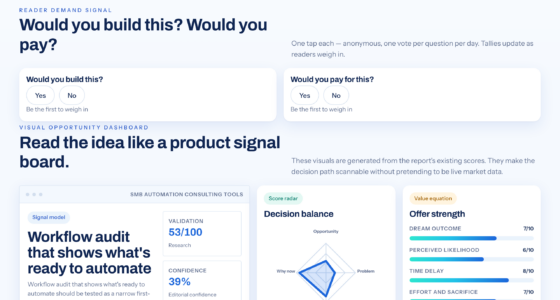
📊 Full opportunity report: Streamlining Vital Records Work For Funeral Directors on IdeaNavigator AI — validation score, market gap, and execution plan.

Get business pricing on office and shipping supplies
- Business-only prices and quantity discounts
- Tax-exempt purchasing
- Multiple users, one account, clear invoices
TL;DR

A proposed workflow tool for funeral homes would track death-certificate status, coordinate follow-ups with certifiers and alert staff to approaching deadlines. The idea has not been tested; a 60-day pilot with five funeral homes in Michigan or Virginia is proposed to measure its effects.
IdeaNavigator AI has outlined a proposed death-certificate tracking tool for independent funeral homes and small multi-location groups, aimed at organizing follow-ups with physicians and medical examiners who must certify records. The concept includes a case-tracking board, scheduled reminders and family status updates, but there is no evidence it has been built or tested.
The proposed system would give a funeral home a shared view of each death record’s certification status, including which cases are waiting on a certifier. Staff could enter statuses manually or use electronic death registration system data where a state makes that information available. Each certifier’s office contact details and preferred communication channel would also be stored.
Under the concept, reminders would go out by email, fax and text message on a schedule tied to applicable state deadlines. The system would log each contact attempt, flag cases nearing a deadline, provide families with plain-language updates and generate a monthly report identifying slow certification patterns. The proposed commercial model is a monthly subscription per funeral home location, with discounted bulk access through state funeral directors associations.
The idea is framed as a way to address a manual administrative burden, not as a confirmed service or proven fix. No product, customer results, pricing or participating funeral homes are identified in the proposal. Its suggested first test is a 60-day pilot involving five funeral homes in Michigan or Virginia, comparing certification times and staff follow-up minutes with each home’s preceding 60 days.
Streamlining vital records work for funeral directors
A proposed tool would organize death-certificate follow-ups and alert staff to approaching deadlines. It has not been built or tested.
What the tool would do
A shared case view could help staff see what is pending and what follow-up has happened.
See each case status
Record certification progress manually or use state system data where available.
Coordinate follow-ups
Schedule messages to certifiers, log contact attempts and flag approaching deadlines.
Share plain updates
Give families a clearer view of status when certification affects arrangements or claims.
Why certification matters
Delays can affect both funeral-home operations and families waiting on documentation.
- Burial or cremation permits depend on certification.
- Insurance claims or benefit payments may require documentation.
- Separate calls, faxes and informal tracking take follow-up time.
- Missed deadlines can be harder to spot without a shared view.
A small trial is proposed
The concept suggests testing the workflow with funeral homes in Michigan or Virginia.
Define record entry, state deadlines, reminders and the data the trial will collect.
Track time from death to medical certification and staff minutes spent chasing signatures.
Compare pilot results with each home’s preceding 60 days and report the limits.
State rules shape the idea
The proposal points to state-specific requirements as a reason for deadline-based monitoring.
| State | Rule cited in proposal | Potential workflow need |
|---|---|---|
| Michigan | House Bills 4077 and 4078; certification within 48 hours | Track deadline and case status |
| Virginia | House Bill 156; tutorial requirement for certain clinicians | Account for state-specific processes |
How Certification Delays Affect Families
Death-certificate delays can hold up more than paperwork. The proposal says a burial or cremation permit depends on certification by a physician or medical examiner. When that step is late, funeral arrangements may be delayed, and families may also wait to pursue life-insurance claims or benefit payments that require documentation.
For funeral-home staff, a shared case board could replace separate phone calls, faxes and informal tracking with a record of what is pending and what follow-up has occurred. That could make it easier to identify cases at risk of missing a deadline and explain the status to families. These are potential benefits, however; the proposal provides no measured evidence that the tool would shorten certification times or reduce workload.
The suggested pilot’s measurements—elapsed time from death to medical certification and staff minutes spent chasing signatures—would help establish whether the system changes day-to-day operations. Comparing results with each home’s prior 60 days could offer an initial signal, though a small trial would not by itself establish that the tool would work across different states or funeral homes.
Products Worth Considering

FLEXISPOT ErgoX Ergonomic Office Chair with Footrest, Black

Logitech MX Keys Combo for Business Keyboard and Mouse – Graphite

Dell XPS 13 9350 Copilot+ Laptop, 13.4-inch 120Hz Display, Intel Core Ultra 7 256V, 16GB RAM, 512GB SSD, Ubuntu Linux 24.04 LTS
As an affiliate, we earn on qualifying purchases.
State Rules Shape the Proposal
The concept is tied to two state policy changes described in the proposal. It says Michigan House Bills 4077 and 4078, signed March 17, 2026, require death certificates to be certified within 48 hours through the state’s secure web-based system. It also says Virginia House Bill 156 of 2026 requires physicians, advanced practice registered nurses and physician assistants who expect to sign death certificates to complete the state’s electronic death registration system tutorial as part of licensing.
The proposal treats these rules as a reason to test deadline-based reminders and monitoring. The practical reach of that approach depends on state requirements, how deadlines are calculated and whether funeral homes can access status data from each state’s electronic system. The proposed tool would use manual entry where system status is not available, leaving staff responsible for keeping those records current.
The initial target is deliberately narrow: independent funeral homes and small groups, rather than a broad rollout across the funeral-services sector. No participating association, software integration or state agency partnership is named.
Product and Pilot Details Remain Open
It is not clear whether development has begun, whether any funeral homes have agreed to test the idea or whether a product team has confirmed that reminders can be connected to state-specific deadlines. The proposal does not identify a company, release schedule, subscription price or technical arrangements for accessing electronic registration systems.
The stated rules and their application would also need to be checked against current state guidance before a product relied on them. The concept does not explain how it would handle exceptions, incomplete records, disputed responsibility for a delay or changes to a certifier’s contact preferences. It also does not specify how family updates would be approved or how sensitive personal information would be protected.
Most importantly, there are no results showing that a tracking tool reduces delays. A pilot could measure changes at participating homes, but the proposed comparison with the previous 60 days would not rule out other explanations, such as differences in case volume or certifier availability.
A Five-Home Trial Is Proposed
The next step set out in the concept is a 60-day test with five funeral homes in Michigan or Virginia. Participating homes would record the time between death and medical certification, along with staff minutes spent following up with certifiers, then compare those figures with their own prior 60-day periods.
No start date or participating homes have been announced. Before such a test could begin, organizers would need to establish how records are entered, how state deadlines are represented, what reminders are sent and what data the trial collects. Any later report would need to distinguish measured changes from anecdotal feedback and explain the limits of a small, short-term comparison.
If tested, the concept’s usefulness would depend on whether staff can maintain accurate case information and whether certifiers respond to the reminders. Until a pilot is documented, the proposal remains an operational idea rather than a demonstrated service.
Source: IdeaNavigator AI
Key Questions
What is the proposed tool meant to do?
It would track the certification status of death records, log follow-ups with certifiers, send scheduled reminders and flag cases nearing a state deadline. It has not been established that a product is available.
Who would use the system?
The concept targets funeral directors or office managers at independent funeral homes and small multi-location groups. A discounted association plan is also proposed, but no association has been named as a partner.
What state rules are cited?
The proposal cites Michigan House Bills 4077 and 4078, described as requiring certification within 48 hours, and Virginia House Bill 156, described as requiring certain clinicians to complete an electronic death registration system tutorial. The proposal does not provide evidence of how a tool would implement those rules in practice.
Has the tool shown that it reduces delays?
No results are reported. A 60-day pilot with five funeral homes is suggested, using certification time and staff follow-up minutes as measures.
Source: IdeaNavigator AI