
📊 Full opportunity report: Review Your Business Processes To Find Automation Candidates on IdeaNavigator AI — validation score, market gap, and execution plan.

Get business pricing on office and shipping supplies
- Business-only prices and quantity discounts
- Tax-exempt purchasing
- Multiple users, one account, clear invoices
TL;DR
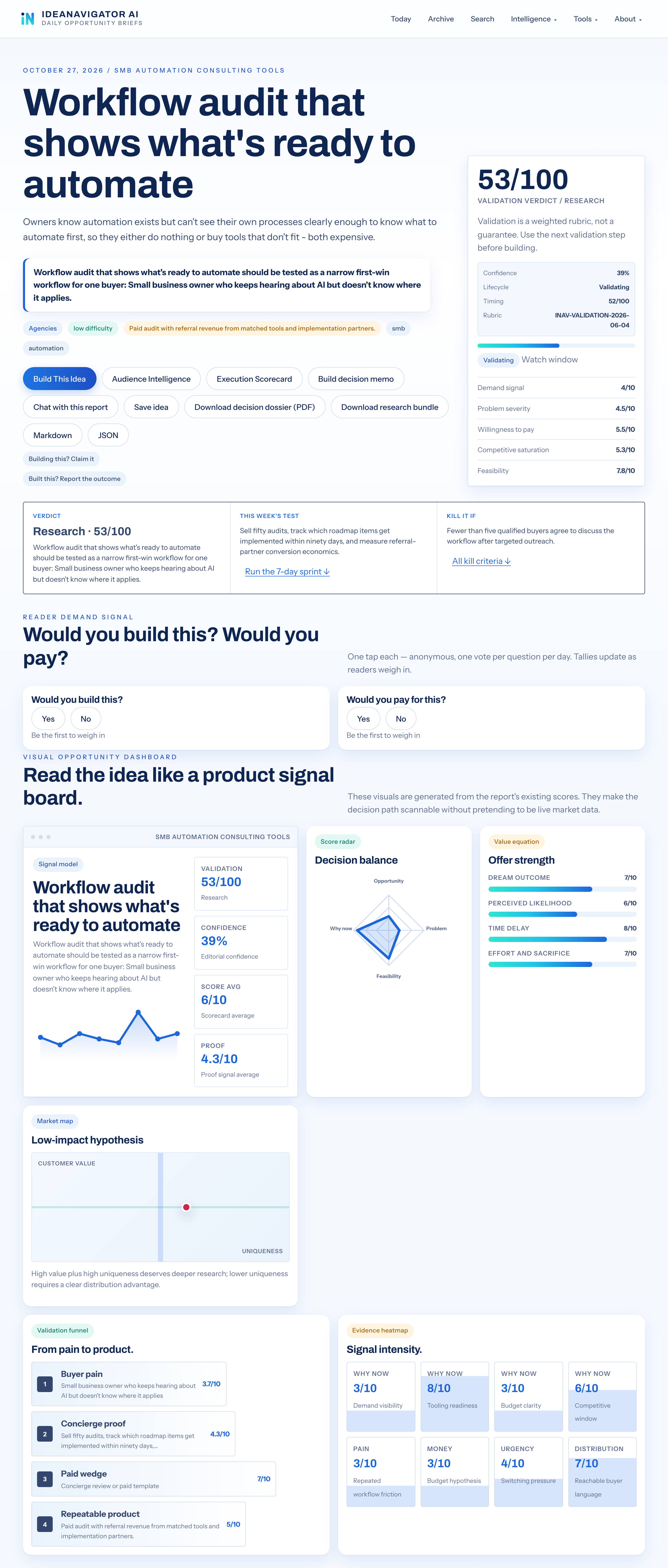
A proposed product for small businesses would interview owners about daily operations, then map processes and rank potential automation projects by readiness, return and difficulty. The concept has not been shown to be a launched service or a validated business; its proposed test is to sell 50 audits and track implementation and referrals over 90 days.
IdeaNavigator AI has outlined a proposed workflow audit that would help small-business owners identify which processes may be suitable for automation and what to tackle first. The concept responds to owners’ difficulty seeing how their operations fit together amid a growing range of AI tools, but the available details describe a product idea and validation plan—not a confirmed launch or proven results.
The proposed service would use a guided interview to ask an owner about business operations and turn the answers into a process map, a process that could be informed by AI automation tools for small businesses. It would then score each process for automation readiness, potential return and difficulty, and provide suggested tools matched to individual steps.
The proposed output also includes a sequenced 90-day roadmap, giving owners an order in which to evaluate or implement changes rather than simply presenting a list of software options, including AI automation software platforms. No scoring method, sample audit, pricing, or specific tools are identified in the proposal.
The business model would combine a paid audit with referral revenue when customers choose matched tools or implementation partners, such as business marketing automation tools. To test demand and commercial viability, the proposal calls for selling 50 audits, then tracking which roadmap recommendations are implemented within 90 days and measuring conversion economics for referral partners. Those figures are proposed test criteria, not reported outcomes.
A Route From AI Interest to Process Choices
For a small-business owner, the practical question is not simply which AI product is available, but whether a specific task is sufficiently repeatable, documented and valuable to change. A process map could make those decisions more concrete by connecting a proposed tool to a particular step in the business and showing the difficulty and expected return alongside it.
The proposal also addresses two risks described in its rationale: owners may postpone automation because they cannot identify a starting point, or purchase tools that do not fit their processes. If an audit helps customers compare work in a consistent way, it could make automation decisions easier to sequence. That is a potential benefit, not an established result; no customer evidence or measured savings are provided.
There is a commercial question as well. Referral income could help support a low-cost audit, but it may also create an incentive to recommend products or partners. The proposal does not explain how recommendations would be selected or how referral relationships would be disclosed. Those details would matter to owners assessing whether the roadmap serves their needs.
Products Worth Considering

Dell UltraSharp 32 U3226QER 4K Thunderbolt Hub Monitor

Apple iPad Air (2025) 13‑inch Wi‑Fi 256 GB – Space Gray (M3 chip)

Apple Mac mini Desktop Computer with M5 Pro Chip (2026)
As an affiliate, we earn on qualifying purchases.
Why Process Mapping Is Proposed Now
The concept is framed around a surge in AI tools that has left some small-business owners aware of automation but unsure where it applies in their own operations. Its premise is that a broad menu of products can create decision paralysis when owners lack a clear account of the tasks they perform and the order those tasks depend on.
IdeaNavigator AI also argues that guided process interviews may be automatable with large language models. That is the rationale for a product that interviews an owner and generates a structured map, rather than relying solely on a conventional consulting engagement. The proposal does not provide test results showing how accurately an AI-generated map captures business operations, or how much human review it might need.
The suggested first step is deliberately narrow: test the audit with one buyer group, small-business owners uncertain about where AI applies. The plan is to assess not only whether owners will pay for an audit, but whether they act on its recommendations and whether referrals produce sustainable economics. No completed pilot, customer count or implementation rate is reported.
Pilot Results and Product Details Remain Open
No launch, sales or pilot results are confirmed in the available description. It does not say whether the 50-audit test has begun, when it might take place, or whether any owners have received or acted on a roadmap.
It is also unclear how the service would calculate readiness, return and difficulty, what information owners would need to provide, or how sensitive business data would be handled. The proposal gives no audit price, implementation costs, named software partners or criteria for matching tools. Without those details, owners cannot evaluate the service’s accuracy, affordability or independence.
The proposed 90-day tracking period would offer an early indication of whether recommendations lead to action, but the plan does not specify how success would be defined or how results would account for differences among businesses. Referral conversion alone would not establish that a recommended tool improved operations. Those questions remain open until a test produces evidence.
The Proposed 50-Audit Validation Test
The next stated milestone is a test involving 50 paid audits. The planned measures are whether customers implement roadmap items during the following 90 days and whether referrals to tools or implementation partners convert on workable terms. No timetable or confirmation that the test is underway has been provided.
If the test proceeds, useful results would include the share of customers who implement at least one recommendation, which kinds of processes are selected, and how owners assess the quality of the map and suggestions. Pricing, data practices and the basis for tool recommendations would also help customers judge the offer. Until those details and results are available, the audit remains a proposed approach to a documented decision problem, rather than evidence that automation outcomes will improve.
Source: IdeaNavigator AI
Key Questions
What is the proposed workflow audit?
It is a proposed service that would interview a small-business owner about operations, map processes, score them for automation readiness, potential return and difficulty, and suggest a sequenced 90-day plan.
Has the audit launched or been tested?
The available description does not confirm a launch or completed pilot. It proposes selling 50 audits and tracking implementation and referral results over 90 days.
How would the proposed service make money?
The plan combines payment for the audit with possible referral revenue from matched software tools and implementation partners. Prices and referral terms are not provided.
What should small-business owners look for before using a service like this?
Owners may want to understand how recommendations are scored, what business data is collected and protected, how referral relationships are disclosed, and whether suggestions account for implementation costs. The proposal does not yet provide those details.
Source: IdeaNavigator AI