

📊 Full opportunity report: How To Track Trust Assets Before Estate Administration on IdeaNavigator AI — validation score, market gap, and execution plan.

Get business pricing on office and shipping supplies
- Business-only prices and quantity discounts
- Tax-exempt purchasing
- Multiple users, one account, clear invoices
TL;DR
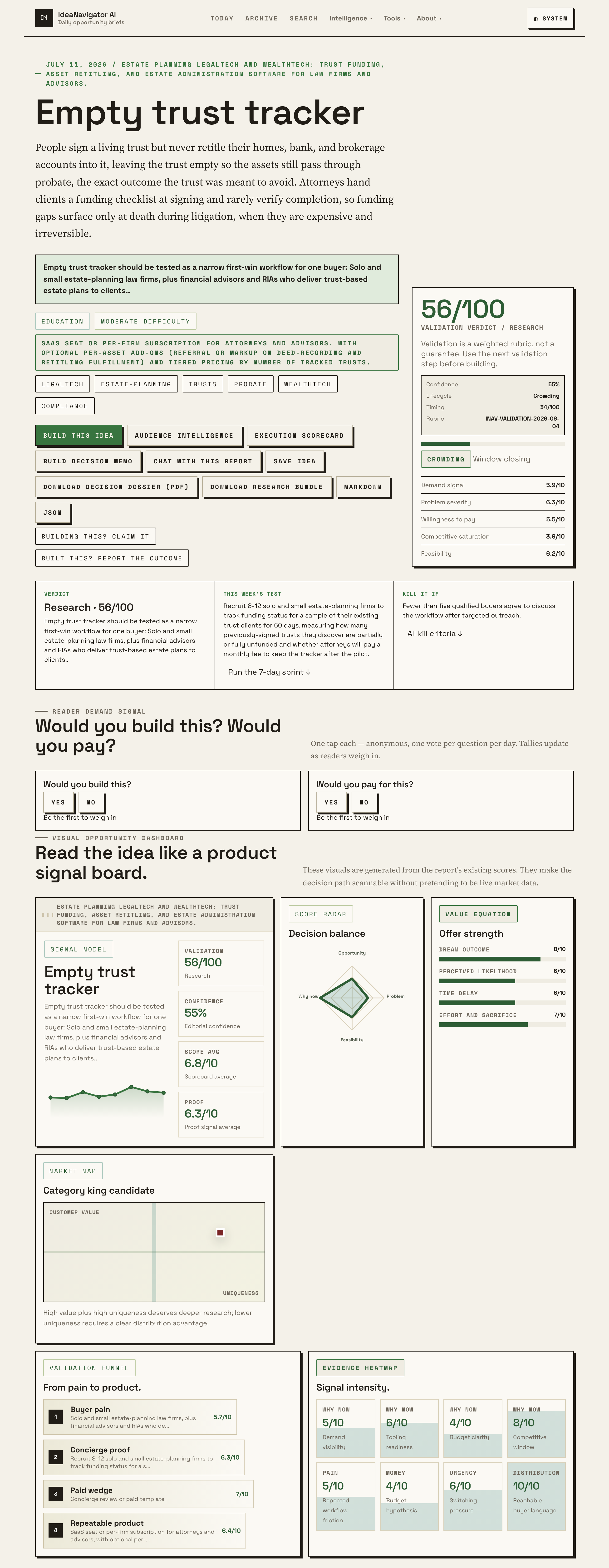
A proposal from IdeaNavigator AI for an “empty trust tracker” would let law firms and financial advisors monitor whether clients transfer assets into their living trusts. It remains an untested product concept. IdeaNavigator AI proposes a 60-day pilot with 8 to 12 firms to measure how often trusts are underfunded and whether firms would pay for tracking.
IdeaNavigator AI has proposed a client-by-client tracker to help small estate-planning law firms and financial advisors check whether assets have been transferred into clients’ living trusts. The concept targets a practical gap between signing trust documents and completing the asset transfers needed for the trust to hold property; IdeaNavigator AI’s proposal reports no pilot results.
According to the IdeaNavigator AI proposal, the product would let a firm create a checklist for each trust, covering assets such as real estate, bank and brokerage accounts, business interests and beneficiary designations. Staff or clients could mark each item as pending, in progress or confirmed funded, attach evidence such as a recorded deed or updated account statement, and receive automated reminders.
The proposal says a dashboard would show the funding status across a firm’s trusts, including the share of listed assets confirmed transferred. It targets solo and small estate-planning practices, as well as financial advisors and registered investment advisers that include trust-based estate plans in client services. The proposed business model uses subscriptions by seat or firm, with pricing tiers based on the number of trusts tracked and optional per-asset services related to deeds or retitling.
To test demand, IdeaNavigator AI suggests recruiting 8 to 12 small firms for a 60-day pilot. Participants would review a sample of existing trust clients, count how many trusts appear partly or fully unfunded, and assess whether they would pay a monthly fee to keep using the tracker. The proposal identifies no recruited firms, pilot findings or pricing commitments.
The Gap Between Signing and Funding
A trust document alone does not transfer ownership of every asset into the trust. If a home or account remains titled in an individual’s name, it may not be governed by the trust as intended. That can leave families facing probate for assets the plan was meant to address, though the outcome depends on the asset, applicable law and the person’s broader estate arrangements.
The proposed tracker would make follow-up visible to both the firm and client. A record of pending items and supporting documents could help staff spot incomplete transfers while a client can still act. IdeaNavigator AI’s proposal says firms often provide a checklist at signing but do not routinely verify that each step is completed; it offers no independent data on how common that practice is or how often funding gaps lead to disputes.
For advisors and law firms, the commercial question is whether ongoing monitoring solves enough of a workflow problem to justify a recurring fee. The pilot proposed by IdeaNavigator AI is designed to test both the frequency of incomplete funding among participating clients and firms’ willingness to pay. Those results would indicate demand among the firms involved, but would not by themselves establish market-wide adoption.
Why Trust Funding Needs Follow-Up
A living trust is commonly used as part of an estate plan, but creating and signing it is distinct from transferring property into it. Real estate may require a deed and recording; financial accounts may require changes to account ownership or registration. Requirements vary by asset and institution, and some assets may instead be addressed through beneficiary designations or other planning documents.
IdeaNavigator AI’s proposal says about 11% of Americans hold a trust, but does not provide a survey date, methodology or definition of “hold a trust.” It also describes estate-planning adoption and digital tools as growing in 2026 without presenting supporting figures. These claims provide the proposal’s market rationale, but the available details do not establish the size of the addressable market or how many signed trusts remain unfunded.
The proposal points to deed-funding services priced from $250 as evidence of a paid market for help with trust funding. It does not identify providers or explain which services that figure covers. A tracking product could sit alongside such fulfillment services, but the proposed business model and potential referral or markup revenue remain untested.
Pilot Results and Legal Details
IdeaNavigator AI reports no operating product or pilot findings. Its proposal does not explain how firms would verify each asset’s status, how often clients would need to supply documents, or whether banks and brokerages would provide information in formats the tracker can use. It also does not specify how the product would handle sensitive financial records, access controls, retention or errors in status reporting.
The proposal’s reported 11% figure lacks a stated baseline and measurement period, and it offers no evidence for the claim that funding gaps surface mainly at death or lead to costly litigation. The legal effect of an unfunded asset also varies with the asset and jurisdiction. A tracker could record documentation and follow-up, but the concept does not establish that it can determine whether a trust is legally complete or prevent probate.
A 60-Day Demand Test
IdeaNavigator AI’s proposed next step is a 60-day trial with 8 to 12 solo and small firms. The firms would check funding status for a sample of existing clients and record how many trusts are partly or fully unfunded. They would also be asked whether the service merits a monthly subscription after the pilot.
Any reported results would need to clarify how participating firms and client samples were selected, what counted as “confirmed funded,” and whether firms continued using the tracker after the trial. Until those details and findings are available, the tracker remains a product hypothesis rather than a demonstrated service.
Key Questions
What is the proposed empty trust tracker?
IdeaNavigator AI proposes a dashboard for firms to track whether listed client assets, such as property and financial accounts, have been transferred into a living trust. It would record statuses and allow evidence and reminders to be attached.
Does signing a living trust automatically transfer assets into it?
No. Signing trust documents and changing ownership or account records are separate steps for many assets. The steps required depend on the asset and relevant institutions.
Who is the tracker intended for?
IdeaNavigator AI’s proposal targets solo and small estate-planning law firms, financial advisors and registered investment advisers that provide trust-based estate plans.
Has the tracker been tested?
No pilot results are reported in IdeaNavigator AI’s proposal. The company proposes a 60-day test with 8 to 12 small firms to measure incomplete funding among a sample of existing trust clients and gauge firms’ willingness to pay.
Source: IdeaNavigator AI
Fall Picks
fall essentials
As an affiliate, we earn on qualifying purchases.