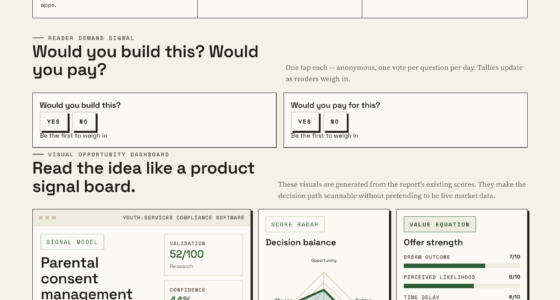

📊 Full opportunity report: Europe Regulated the Interface and Forgot to Build the Engine on ThorstenMeyerAI.com — validation score, market gap, and execution plan.

Get business pricing on office and shipping supplies
- Business-only prices and quantity discounts
- Tax-exempt purchasing
- Multiple users, one account, clear invoices
TL;DR
Europe has focused on regulating digital interfaces, such as cookie banners, but has neglected building and funding its core AI technology. This shift hampers its global competitiveness and technological sovereignty.
Europe has largely focused its regulatory efforts on superficial aspects of digital technology, such as cookie banners, while failing to invest in or develop the underlying AI infrastructure needed for global competitiveness. This divergence highlights a strategic failure that could diminish Europe’s influence in the emerging AI-driven geopolitical landscape.
Despite establishing comprehensive laws like the AI Act, Europe has not produced a leading AI model or secured significant capital for AI development. Its sole notable lab, Mistral, remains mid-tier, with capabilities trailing behind American and Chinese models. The continent’s AI ecosystem suffers from limited funding, with Mistral raising only around $3-4 billion — far less than American giants like OpenAI, which has secured over $122 billion in valuation.
Meanwhile, China is rapidly advancing by releasing open-weight models like Zhipu’s GLM 5.2, which outperform some of Europe’s best efforts at a fraction of the cost. The U.S. maintains a front-runner position with models such as GPT-5.5 and Anthropic’s Claude Opus 4.8, which are considered state-of-the-art and are tightly controlled for national security purposes. Europe’s regulatory approach, focused on superficial interface rules, has not translated into technological leadership or investment, leaving the continent behind in the AI race.
Europe regulated the interface and forgot the engine
The cookie banner is the most-used European software of the decade. While Brussels perfected the consent pop-up, the frontier was built elsewhere — and now, in H2 2026, Europe wants to buy back in without changing what put it on the outside.
This isn’t about whether privacy or safety matter — they do. It’s that Europe mistook regulating the interface for having a seat at the table. You can’t grant your way out of a structural problem while keeping the structure — the laws, the capital gaps, the energy costs, the talent drain all left untouched. The fix isn’t another framework: it’s open weights as a product, sovereign compute on affordable power, real capital plumbing — and to stop mistaking a check for a strategy.
Implications of Europe’s AI Development Shortfall
This situation threatens Europe’s strategic independence and economic future in the AI era. Without leading models or substantial investment, Europe risks becoming a regulatory authority without the technological sovereignty to back it up. The failure to build a domestic AI infrastructure diminishes its influence in global tech and security negotiations, and could lead to dependency on foreign technology, especially from China and the U.S.
As an affiliate, we earn on qualifying purchases.
Europe’s Regulatory Strategy vs. Technological Investment
Europe’s approach to digital regulation has prioritized superficial controls like cookie banners and privacy laws, exemplified by the GDPR and the Digital Omnibus proposal. While these measures aim to protect citizens, they have also created friction and failed to foster innovation. Simultaneously, the continent’s AI ecosystem has been hampered by fragmented markets, limited capital, and regulatory burdens that discourage large-scale investment. The AI Act, introduced before the technology matured, exemplifies this regulatory overreach without accompanying technological development.
In contrast, the U.S. and China have aggressively invested in AI research, producing models that lead in capability and open access. China, in particular, has released several high-capacity models freely, gaining a significant edge. Europe’s lack of a comparable ecosystem means it remains a regulatory observer rather than a technological leader.
“Our AI labs are mid-tier at best, and the capital simply isn’t there to compete with the U.S. or China.”
— A European AI industry insider
As an affiliate, we earn on qualifying purchases.
Unclear Impact of Future Regulatory Changes
It is not yet clear whether upcoming regulatory reforms in Europe will prioritize fostering innovation or continue focusing on superficial controls. The effectiveness of Brussels’ efforts to “buy back” influence without changing the underlying infrastructure remains uncertain, as does Europe’s ability to attract significant AI investment in the near future.
enterprise AI infrastructure tools
As an affiliate, we earn on qualifying purchases.
As an affiliate, we earn on qualifying purchases.
Next Steps for Europe’s AI and Regulatory Strategy
Europe may attempt to recalibrate its approach by investing more directly in AI research and infrastructure or by easing regulatory burdens to attract capital. However, given current trends, significant progress appears unlikely without a fundamental shift in strategy. Monitoring upcoming policy proposals and funding initiatives will clarify whether Europe can bridge the gap or remain a regulatory observer.
As an affiliate, we earn on qualifying purchases.
Key Questions
Why has Europe focused so much on regulating interfaces instead of developing AI technology?
Europe prioritized user privacy and control, exemplified by GDPR and cookie banners, but this focus diverted attention and resources away from building the core AI infrastructure needed for global competitiveness.
What are the consequences of Europe’s lack of advanced AI models?
Without leading models, Europe risks falling behind in technological innovation, economic influence, and strategic independence, becoming a regulatory authority rather than a technological leader.
Can Europe’s current regulatory approach be changed to foster innovation?
It remains uncertain. While reforms are possible, current trends suggest that without significant investment and strategic shifts, Europe’s regulatory framework will continue to lag behind the rapid advancements in AI technology elsewhere.
How does China’s open AI model strategy affect Europe?
China’s release of high-capacity, freely available models like GLM 5.2 provides a technological edge that Europe cannot match through funding alone, further widening the gap.
Source: ThorstenMeyerAI.com
Fall Picks
fall essentials
As an affiliate, we earn on qualifying purchases.