
The debate between flywheel and funnel models centers on different approaches to customer growth. Funnels focus on guiding prospects through steps to make quick conversions, ideal for immediate results. Flywheels prioritize ongoing customer engagement, loyalty, and referrals for long-term growth. If you aim for sustained momentum and deeper relationships, the flywheel suits you better. Curious about how to apply each model effectively? Keep exploring to find the best fit for your business goals.
Key Takeaways
- The funnel focuses on linear customer acquisition and quick conversions, while the flywheel emphasizes ongoing engagement and long-term loyalty.
- Funnels are suitable for short-term goals; flywheels support sustained growth through customer retention and advocacy.
- Success metrics differ: funnels track conversion rates; flywheels measure retention, repeat purchases, and referrals.
- The funnel model ends after purchase; the flywheel creates a self-sustaining cycle driven by satisfied customers.
- Transitioning from funnel to flywheel involves deepening relationships, encouraging ongoing engagement, and leveraging customer feedback.
What Are the Main Differences Between the Funnel and Flywheel?
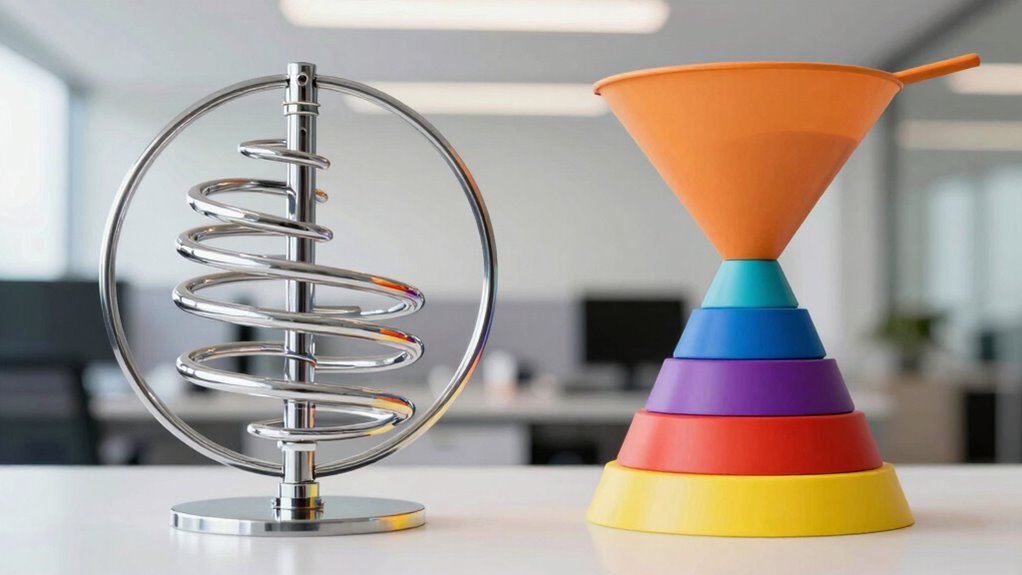
The main difference between the funnel and flywheel models lies in how they approach customer engagement. With the funnel, your focus is on guiding prospects through a linear process—awareness, consideration, and conversion. Once a customer makes a purchase, the process often ends, making customer retention and brand loyalty secondary priorities. In contrast, the flywheel emphasizes ongoing engagement, where happy customers keep the wheel spinning. This model prioritizes building strong relationships that foster customer retention and inspire brand loyalty. Instead of a one-time transaction, the flywheel encourages continuous value delivery, turning satisfied customers into advocates. This approach creates a self-sustaining loop that fuels growth, making retention and loyalty central to your long-term success. Additionally, understanding projector technology can help businesses craft more engaging and immersive experiences that enhance customer satisfaction and loyalty.
How Does the Sales Funnel Help You Attract and Convert Customers?

A well-designed sales funnel guides your prospects through a clear path from initial awareness to making a purchase. This structured sales process nurtures potential customers at each stage, making them feel understood and valued. It helps you:
- Ignite curiosity and grab attention early in the customer journey.
- Build trust through targeted messaging and value propositions.
- Overcome objections, turning hesitation into confidence.
- Drive action, converting leads into loyal buyers.
Additionally, understanding the water for therapeutic benefits can help you tailor your marketing messages to emphasize safety and professionalism, appealing to customers who prioritize health and cleanliness. Recognizing the importance of caregiver support can also strengthen your messaging by highlighting reliability and compassion in your services. Incorporating smart home technology concepts like automation and personalized routines can further enhance customer engagement and trust in your offerings.
Why the Flywheel Model Focuses on Customer Engagement and Growth?

Unlike traditional sales funnels that focus primarily on guiding prospects toward a single purchase, the flywheel model emphasizes continuous customer engagement and growth. You aim to keep customers satisfied and involved, which boosts customer retention and encourages repeat business. This ongoing relationship helps turn satisfied customers into brand advocates, strengthening brand loyalty. Instead of viewing a transaction as an endpoint, the flywheel approach sees each interaction as an opportunity to add value, deepen trust, and motivate customers to promote your brand. As your customers stay engaged, they generate positive word-of-mouth, fueling further growth. This cycle creates momentum that sustains your business over time, making customer engagement not just a tactic but a core driver of your overall growth strategy. Incorporating sanitation and maintenance guides ensures that customer experiences remain positive and safe, further enhancing loyalty and trust. Recognizing the importance of customer feedback can help refine your engagement strategies and optimize your growth, especially when aligned with best practices in natural pool maintenance. Moreover, focusing on analytical thinking allows businesses to interpret customer data effectively, leading to more targeted and effective engagement strategies. Furthermore, emphasizing cloud infrastructure security is essential for maintaining trust and safeguarding customer data in today’s digital environment.
Which Model Fits Your Business Goals: Funnel or Flywheel?

Think about your business goals—are you aiming for rapid growth or building lasting customer relationships? The funnel emphasizes quick conversions, while the flywheel focuses on engagement and loyalty over time. Your choice depends on whether you prioritize short-term results or a long-term strategy. Incorporating customer loyalty into your approach can significantly influence your sustained success, especially when understanding the growth model that aligns with your vision. By understanding how to master customer engagement, you can better tailor your strategy to support either model effectively. Recognizing how simple systems can streamline your processes will also help you maintain momentum and foster ongoing growth. Focusing on long-term customer relationships can create a more sustainable path to success in either model.
Business Growth Focus
Deciding which model aligns best with your business goals depends on how you prioritize growth and customer engagement. If your focus is on long-term success, the flywheel emphasizes customer retention and brand loyalty, creating momentum that sustains growth. Conversely, a funnel suits businesses aiming for rapid acquisition and quick conversions. Consider these factors:
- You want to build lasting relationships that keep customers coming back.
- Your goal is to cultivate brand loyalty that fuels organic growth.
- You’re focused on creating a seamless, ongoing customer experience.
- You prefer a steady, sustainable growth trajectory over quick wins.
- Recognizing the importance of content marketing can enhance customer engagement and support either model. Additionally, understanding customer lifecycle management helps tailor strategies to fit your chosen growth approach.
- Staying informed about emerging vaping innovations can give your business a competitive edge in aligning your growth strategy.
Choosing the right model aligns with your vision for sustainable growth, where customer retention and brand loyalty become central pillars. Your decision shapes how you prioritize long-term engagement versus immediate results.
Engagement and Loyalty
Choosing between the funnel and flywheel models directly impacts how your business fosters engagement and builds loyalty. With the funnel, customer retention can be limited because the focus is on converting prospects rather than nurturing ongoing relationships. In contrast, the flywheel emphasizes continuous engagement, encouraging satisfied customers to become brand advocates. This approach boosts loyalty by creating a cycle where happy customers generate new leads through positive word-of-mouth. The flywheel’s emphasis on relationship-building helps you retain customers longer, strengthening loyalty and encouraging repeat business. Additionally, the ongoing nature of the flywheel model supports the development of ongoing customer relationships, which are crucial for sustained growth. Meanwhile, the funnel’s linear process risks losing potential clients after purchase. If your goal is long-term engagement and fostering brand advocacy, the flywheel offers a more sustainable, loyalty-driven approach that keeps your customers actively involved with your brand. Incorporating vintage design elements can also enhance customer experience by creating a memorable and authentic brand identity that resonates over time.
Long-Term Strategy
To align your business with long-term goals, it’s essential to evaluate which model—funnel or flywheel—best supports sustained growth and customer relationships. The flywheel emphasizes continuous customer retention and building brand loyalty, fueling ongoing momentum. In contrast, the funnel focuses on converting prospects quickly, risking short-term gains. Consider these key points:
- Does your business prioritize deep customer relationships over time?
- Are you aiming for steady growth through repeat business?
- Will nurturing customer loyalty lead to organic referrals?
- Is long-term stability more valuable than immediate sales?
- Implementing seasonal checklists for cleaning and maintenance can help maintain customer satisfaction and reinforce loyalty. Recognizing the importance of customer experience can further enhance your long-term strategy.
If you value enduring customer retention and brand loyalty, the flywheel offers a sustainable approach. It keeps your customers engaged, transforming them into advocates and ensuring consistent growth. Choose the model that aligns with your vision for lasting success.
When Should You Use a Funnel Strategy in Marketing?

Use a funnel strategy when you have clear lead generation goals and want to guide prospects toward quick conversions. It works best for short-term campaigns that target specific high-conversion opportunities. If you need immediate results and focused efforts, a funnel approach can be highly effective.
Clear Lead Generation Goals
Ever wonder when a funnel strategy makes the most sense for your lead generation efforts? If your goals focus on quick wins, boosting brand awareness, or nurturing existing relationships, a funnel can be highly effective. It helps you:
- Target specific audiences and guide them step-by-step.
- Achieve measurable results quickly with clear conversion points.
- Build customer retention by focusing on nurturing leads at each stage.
- Create a sense of urgency that motivates prospects to act now.
Using a funnel is ideal when your priority is generating immediate interest, especially if you need to reinforce brand awareness or deepen customer relationships. It’s all about clarity and focus, guiding prospects toward a specific goal efficiently.
Short-Term Campaign Focus
When you need to generate quick results and capitalize on immediate interest, a funnel strategy can be highly effective. It’s ideal when your goal is to boost brand awareness fast or address customer churn by quickly engaging prospects. Funnels focus on targeted campaigns that guide prospects through a clear path, encouraging swift conversions. This approach helps you concentrate resources on short-term gains, making it easier to measure success and adjust tactics promptly. If your campaign’s purpose is to rapidly increase visibility or recover lost customers, a funnel allows you to create urgency and drive action. Keep in mind, this strategy is less suited for sustained growth but excellent for short-term wins and filling your sales pipeline quickly.
High Conversion Opportunities
Funnel strategies excel when your goal is to maximize conversions from interested prospects. If you’re ready to turn warm leads into loyal customers, a funnel is your best bet. Focus on content optimization to craft compelling messaging that guides prospects smoothly toward action. Guarantee branding consistency across all touchpoints to build trust and recognition. Consider a funnel when:
- You have a targeted audience ready to buy.
- You need to streamline the customer journey for quick results.
- You want to optimize content for maximum impact.
- Your goal is to generate measurable, immediate conversions.
This approach sparks urgency and clarity, making it ideal when quick wins are essential. Use funnels strategically to seize high-conversion opportunities and accelerate growth efficiently.
When Is the Flywheel the Better Choice for Growth?

The flywheel approach becomes the better choice for growth when your business benefits from sustained momentum and long-term customer relationships. If you’re focused on increasing customer retention and building brand loyalty, the flywheel helps you maintain continuous engagement. Unlike funnels, which chase new leads, the flywheel leverages existing customers to generate referrals and repeat business, creating a self-reinforcing cycle. This model is ideal if your goal is to develop deep connections and foster trust over time. As the flywheel gains speed, it becomes easier to attract new customers through positive word-of-mouth and brand advocacy. Choose the flywheel when your success depends on nurturing relationships and creating a cycle of ongoing growth driven by your loyal customer base.
How to Transition From a Funnel to a Flywheel : Key Steps?

Shifting from a funnel to a flywheel mindset requires a strategic approach that emphasizes nurturing existing relationships and encouraging ongoing engagement. To do this effectively, focus on strengthening customer retention and building brand loyalty. Here are four key steps:
- Deepen Customer Relationships: Personalize interactions to foster trust and loyalty.
- Encourage Ongoing Engagement: Use content and experiences that keep customers returning.
- Leverage Feedback: Actively listen to customer input to improve offerings.
- Celebrate Loyalty: Recognize and reward repeat customers to reinforce their commitment.
Key Metrics to Track Success in Funnel and Flywheel Strategies?

Are you measuring the right indicators to gauge your marketing success? For a funnel strategy, focus on metrics like conversion rates at each stage, lead generation, and sales volume. These reveal how well your funnel attracts and converts prospects. In a flywheel model, customer retention becomes critical; track repeat purchases, customer lifetime value, and referral rates. Brand awareness metrics, such as social media engagement and website traffic, are valuable for both models, indicating overall reach and visibility. Ultimately, a successful strategy balances these indicators, emphasizing not just acquisition but ongoing engagement. Monitoring these key metrics helps you identify strengths and weaknesses, guiding adjustments to optimize growth whether you’re refining your funnel or fueling your flywheel.
Practical Tips for Choosing the Right Growth Model for Your Business?

Choosing the right growth model depends on understanding your business’s goals, customer behavior, and resources. To make the best choice, consider these practical tips:
- Focus on customer onboarding—if creating seamless, engaging experiences is your priority, a flywheel approach emphasizes continuous customer satisfaction.
- Use content personalization to deepen engagement; if tailoring interactions keeps your audience hooked, a flywheel can foster loyalty.
- Evaluate your resources—funnels require strategic campaigns, while flywheels demand ongoing engagement and optimization.
- Reflect on your growth goals—if your aim is rapid acquisition, funnels might serve better; for sustainable, long-term growth, the flywheel model shines.
Frequently Asked Questions
Can a Business Effectively Use Both Models Simultaneously?
Yes, you can effectively use both models simultaneously by integrating marketing strategies that focus on customer retention and acquisition. The funnel guides prospects through awareness to conversion, while the flywheel emphasizes ongoing engagement and loyalty. Combining these approaches helps you attract new customers and keep existing ones satisfied, creating a seamless experience that boosts growth and sustains momentum. This integrated marketing approach guarantees you optimize each stage of the customer journey.
How Do Costs Compare Between Implementing Funnel and Flywheel Strategies?
You’ll find that the cost comparison between funnel and flywheel strategies varies. Funnels often require higher upfront expenses for paid advertising and lead generation, leading to a significant initial investment. Conversely, flywheel strategies focus on long-term engagement and customer satisfaction, which may lower ongoing expenses but demand continuous effort. An expense analysis shows that funnels can be more costly initially, while flywheels tend to be more sustainable over time.
What Industries Benefit More From the Flywheel Approach?
In the retail sector and manufacturing industry, you’ll find the flywheel approach particularly beneficial. It helps you build momentum through ongoing customer engagement, fostering loyalty and repeat business. As you focus on delivering exceptional experiences and quality, the flywheel’s continuous cycle accelerates growth. This model suits industries where long-term relationships and repeat sales matter, enabling you to capitalize on customer satisfaction and referrals for sustained success.
How Long Does It Typically Take to See Results From Each Model?
You can typically see results within 3 to 6 months for funnels, while flywheels often take 6 to 12 months to show significant ROI expectations. Interestingly, 70% of companies report faster growth when adopting a flywheel approach over traditional funnels. Your implementation timeline depends on your business complexity, but staying consistent and optimizing will accelerate outcomes. Patience and continuous effort are key to revealing each model’s full potential.
Are There Specific Tools Recommended for Managing Either Model?
You should consider tools that integrate CRM and content management systems to effectively manage either model. For a flywheel, look for platforms like HubSpot or Salesforce that streamline CRM integration and automate content delivery. For funnels, tools like ClickFunnels or Leadpages help optimize lead capture and sales. Prioritize solutions that allow seamless content management and CRM integration, ensuring smooth customer journeys and data-driven decision-making.
Conclusion
Choosing between a funnel and a flywheel is like deciding whether to push a swing or let it spin freely. I once saw a business shift from a linear funnel to a flywheel approach, and its growth skyrocketed—because it kept customers engaged and turned them into advocates. Remember, the right model fuels your momentum. So, analyze your goals, and don’t be afraid to give your growth engine a little push in the right direction.