
The OGSM framework helps you cut through strategy confusion by providing a clear, focused plan that aligns your team around shared goals. It emphasizes defining measurable, SMART objectives, selecting actionable strategies, and tracking progress regularly. By maintaining clarity, simplifying decision-making, and ensuring every effort supports your core goals, you keep everyone on the same page. Continue exploring to discover how to implement and sustain this powerful planning tool effectively.

Get business pricing on office and shipping supplies
- Business-only prices and quantity discounts
- Tax-exempt purchasing
- Multiple users, one account, clear invoices
Key Takeaways
- The OGSM framework aligns teams with clear, measurable objectives to eliminate confusion and keep strategy focused.
- It integrates actionable strategies and success metrics, simplifying decision-making and prioritization.
- Regular reviews and progress tracking ensure ongoing alignment and adaptability to market changes.
- Visual tools like dashboards and tracking tables make the OGSM plan transparent and dynamic.
- Connecting OGSM with other tools and market insights enhances strategic clarity and organizational focus.
Products Worth Considering

HP Sprocket Photo Booth Machine Instant Color Photo Printer with 10.1 Touchscreen, LED Ring Light, 250+ Frames, 3×4 ZINK Paper, QR Code Shar

Dell UltraSharp 27 Thunderbolt Hub Monitor (U2726DER)

Samsung 27-inch Odyssey OLED G6 QD-OLED QHD Gaming Monitor
As an affiliate, we earn on qualifying purchases.
Why Your Team Needs an OGSM Framework
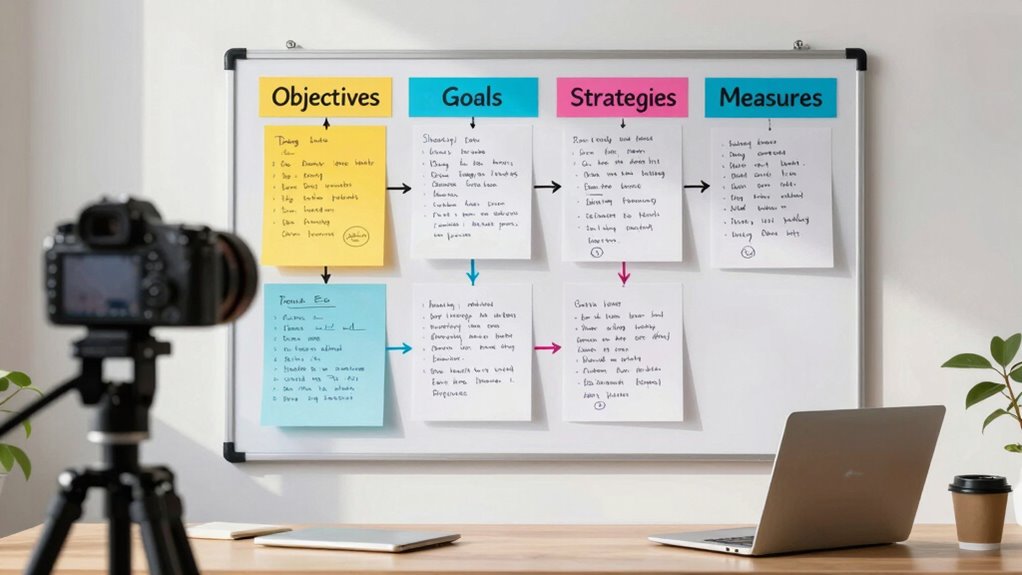
Implementing an OGSM framework helps your team stay focused and aligned on common goals. In today’s fast-changing business environment, understanding market trends is vital for making strategic decisions. An OGSM provides clarity on where your organization is headed, enabling you to adapt to shifts in the marketplace. It also supports different leadership styles by fostering transparency and accountability, regardless of whether your leaders are collaborative or directive. With clear objectives, strategies, and measures, your team can prioritize efforts effectively, avoiding confusion or duplicated work. This structure ensures everyone moves in the same direction, making it easier to respond swiftly to market changes and capitalize on emerging opportunities. Additionally, integrating clear communication about your goals and progress enhances team cohesion and motivation. Recognizing the importance of contrast ratio can help teams better understand how to evaluate project success and improve overall performance. Understanding the market environment is crucial for aligning your OGSM with evolving industry standards and customer expectations. Being aware of strategic adaptability can further enable your team to pivot quickly when necessary. Incorporating market trend analysis into your planning process can help your team anticipate shifts and stay ahead of competitors. Ultimately, an OGSM strengthens your team’s ability to navigate complex environments confidently.
Understanding the Key Parts of OGSM
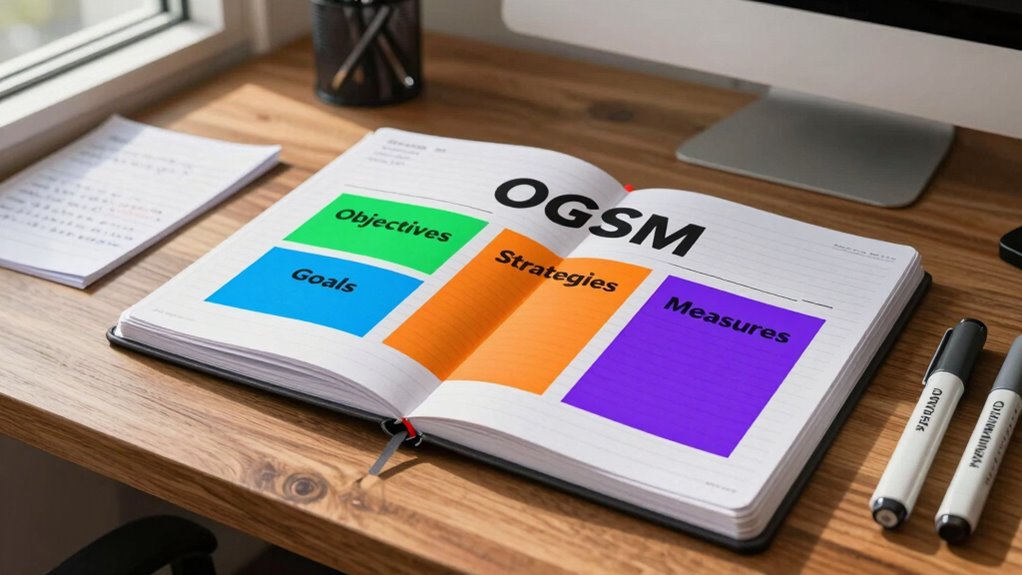
To understand the OGSM framework, you need to focus on its key parts: defining a clear objective, aligning strategic priorities, and setting measurable success indicators. These elements work together to keep your team focused and on track. By mastering these components, you’ll make sure your strategy is both actionable and results-driven.
Clear Objective Definition
Have you ever wondered what makes a strategic goal truly effective? It starts with clear objective definition. Your objective needs to be a SMART goal—specific, measurable, achievable, relevant, and time-bound. This clarity helps guarantee everyone understands exactly what you aim to accomplish. Without a well-defined goal, efforts become scattered, and progress stalls. By focusing on vision clarity, you align your team around a shared purpose, making it easier to measure success. A clear objective guides decision-making and prioritizes actions, preventing confusion and misdirection. When your goal is precisely articulated, it becomes a powerful tool that drives focus and accountability, ultimately transforming vague aspirations into actionable outcomes.
Strategic Priorities Alignment
Understanding how to align strategic priorities is essential for the success of your OGSM framework. It guarantees that your corporate culture supports your goals and promotes leadership development. To achieve this, focus on:
- Clarifying how your strategic priorities reinforce your company’s core values and culture.
- Ensuring leadership development initiatives are aligned with these priorities to foster growth.
- Communicating the priorities clearly across teams to build unified commitment.
- Regularly reviewing and adjusting priorities to stay responsive to cultural shifts or leadership insights.
Measurable Success Indicators
Clear success indicators are essential for tracking progress and ensuring your OGSM framework stays on course. By defining key performance and success metrics, you create measurable benchmarks that reveal whether your strategies are effective. These indicators should be specific, quantifiable, and aligned with your objectives, making it easier to evaluate progress objectively. Success metrics might include sales growth, customer satisfaction scores, or operational efficiency rates, depending on your goals. Regularly monitoring these indicators allows you to adjust your actions proactively, maintaining momentum. Without clear success indicators, you risk losing sight of your priorities or misinterpreting progress. Ultimately, precise key performance measures keep your team focused and ensure your OGSM plan delivers tangible results. Incorporating performance tracking into your process helps ensure continuous improvement and alignment with your strategic objectives. Understanding effective strategies for goal setting can further enhance your ability to set meaningful benchmarks and measure success more accurately. Additionally, utilizing key performance indicators related to your specific industry or project can provide more targeted insights into your progress.
How to Create an Effective OGSM for Your Business
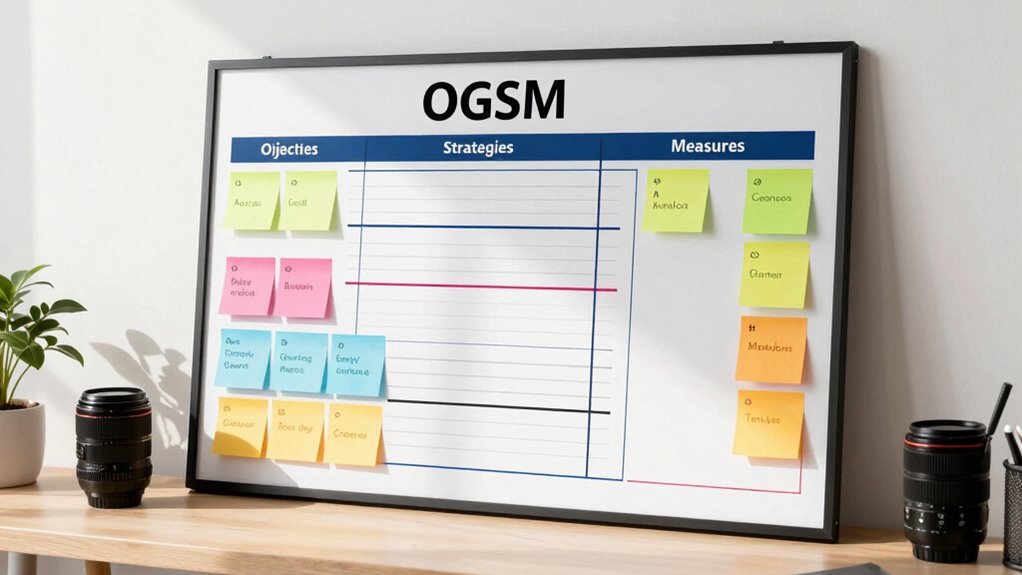
Wondering how to craft an OGSM that truly drives your business forward? Start by clearly defining your Objectives, ensuring they align with your overall vision. Next, set specific, measurable Goals that focus on key areas like marketing strategies and customer engagement. Then, identify the Strategies you’ll use—these should be actionable steps that support your Goals, such as targeted campaigns or new channels. To evaluate progress effectively, establish the Metrics to track success, like customer retention rates or campaign ROI. Keep your OGSM simple, focused, and aligned with your business priorities. Regularly review and adjust it to stay on course, ensuring your efforts consistently push toward your objectives. An effective OGSM keeps everyone aligned and focused on what truly matters. Incorporating clear communication can also enhance understanding and execution across your team. Additionally, understanding water-related activities can inspire strategies for team wellness and engagement initiatives, especially since regular maintenance and seasonal checklists are essential for sustaining home comfort and efficiency. Recognizing the importance of visual and auditory cues can further streamline communication and implementation of your strategic plans. Leveraging insights from content quality and topical authority can help ensure your objectives remain relevant and credible in the eyes of your audience.
Strategies to Keep Your OGSM Clear and Focused
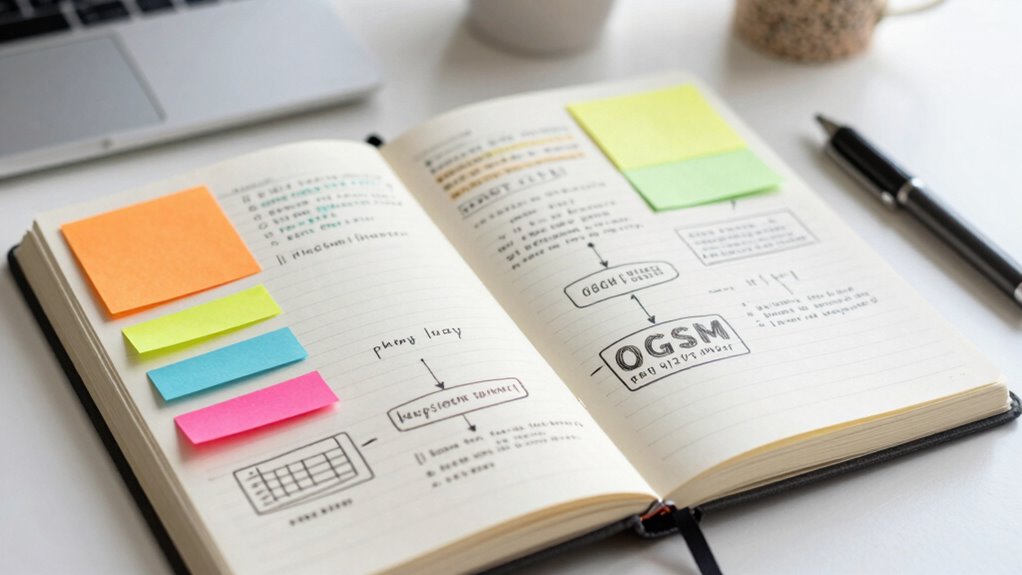
To keep your OGSM clear and focused, you need to maintain strong, targeted objectives that guide your efforts. Regularly reviewing your progress helps you stay on track and make adjustments as needed. Ensuring your team’s efforts are aligned with the OGSM keeps everyone focused and moving in the same direction. Incorporating simplified decision-making principles can further reduce confusion and improve overall clarity. Additionally, fostering a shared understanding of concepts like sound healing science can enhance team cohesion and innovation. Recognizing the importance of natural elements in creating a cohesive environment can also support your strategic clarity. Understanding how essential oils influence well-being can inspire new approaches to team wellness and productivity, especially when considering psychological manipulation techniques that can subtly impact motivation and focus.
Maintain Focused Objectives
How can you guarantee your OGSM stays focused and effective? First, regularly revisit your objectives to ensure they align with your overall strategy. Second, prioritize your marketing tactics that directly contribute to these goals, avoiding distractions. Third, keep your team motivated by clearly communicating objectives and celebrating progress, which maintains focus. Fourth, limit the number of objectives to avoid dilution and confusion. By doing this, you prevent your OGSM from becoming cluttered or drifting off course. Staying disciplined in your focus helps you allocate resources efficiently and maintain momentum. Additionally, incorporating strategy alignment ensures that all activities support your core objectives. Remember, clarity in your objectives fuels team motivation and sharpens your strategic direction, making sure your efforts drive measurable results without unnecessary complexity.
Regularly Review Progress
Regularly reviewing your progress is essential to keeping your OGSM clear and focused. It helps you stay aware of how well your team motivation aligns with objectives and ensures resource allocation remains effective. Use regular check-ins to assess milestones and identify obstacles early. This ongoing process fosters continuous improvement and keeps your strategy adaptable. It also encourages team engagement, which is vital for maintaining momentum. Additionally, monitoring progress can help you recognize personality traits that influence team dynamics and decision-making. Regular evaluation also supports adaptive planning, allowing adjustments to be made before small issues become major setbacks. It keeps everyone accountable and maintains momentum. To visualize progress, consider this simple tracking table:
| Goal Area | Progress Update |
|---|---|
| Market Penetration | 50% of target achieved |
| Customer Satisfaction | Improved by 10% over last quarter |
| Product Development | On schedule for launch in Q3 |
| Resource Allocation | Adjusted to address bottlenecks |
| Team Motivation | High, with recent team feedback |
This approach keeps your OGSM dynamic, focused, and adaptable.
Align Team Efforts
Aligning your team efforts guarantees everyone stays focused on the OGSM’s objectives. To do this effectively, consider these steps:
- Clearly communicate the OGSM so team members understand their roles and how they contribute.
- Foster team motivation by recognizing progress and celebrating milestones, which keeps energy high.
- Ensure resource allocation coincides with priorities, preventing wasted effort and maintaining focus.
- Regularly check in on progress, adjusting tasks to keep efforts aligned with strategic goals.
- Incorporate performance measurement to track progress accurately and make informed adjustments.
Common Mistakes to Avoid When Using OGSM

Are you aware of the common pitfalls that can undermine your OGSM framework? One mistake is including unrelated topics or goals that don’t align with your core strategy. This can lead to scattered efforts and confusion among your team. Additionally, drifting into off-topic discussions during planning sessions dilutes focus and wastes valuable time. Avoid setting vague or overly ambitious objectives that lack clear measurement criteria, as these can hinder progress and accountability. Another trap is neglecting to regularly review and update your OGSM, which can cause your plan to become outdated. Stay disciplined by sticking to relevant goals, maintaining focus, and ensuring every element directly supports your strategic vision. Clear boundaries and continuous review are key to maximizing OGSM’s effectiveness.
Integrating OGSM With Other Planning Tools

Integrating OGSM with other planning tools can substantially enhance your strategic execution by creating a cohesive framework. This process promotes digital integration and fosters cross-functional collaboration. To succeed, consider these steps:
- Map OGSM objectives to your project management platforms to streamline tracking.
- Use digital dashboards to visualize progress and identify gaps quickly.
- Coordinate with teams across departments to align goals and ensure consistent messaging.
- Incorporate feedback loops that connect OGSM with performance metrics for real-time adjustments.
This integration helps break down silos, improves communication, and ensures everyone is working toward shared objectives. By leveraging digital tools and encouraging cross-functional collaboration, you create a unified approach that drives effective strategy execution.
Real Business Examples of Successful OGSM Use

Have you ever wondered how businesses turn strategic plans into tangible results? Successful OGSM implementation offers clear examples. For instance, Company A aligned its sales goals with evolving market trends, using OGSM to adapt quickly. Company B’s leadership style fostered accountability, driving innovation through measurable objectives. Company C integrated customer insights into their OGSM, staying ahead of industry shifts. Here’s a snapshot:
| Company | Focus Area | Key Success Factor |
|---|---|---|
| Company A | Market trend adaptation | Agile planning with OGSM |
| Company B | Leadership-driven execution | Clear objectives and accountability |
| Company C | Customer-centric strategies | Data-driven goal setting |
These examples demonstrate OGSM’s power to translate strategic intent into measurable outcomes, regardless of leadership style or market dynamics.
Frequently Asked Questions
How Often Should I Review and Update My OGSM?
You should review and update your OGSM regularly, ideally every three to six months, to make certain your performance metrics stay aligned with your goals. As you track progress, you can identify any shifts needed to stay on course. Frequent reviews help you adapt quickly, maintain goal alignment, and keep your strategies relevant. This proactive approach boosts accountability and keeps your team focused on achieving key objectives efficiently.
Can OGSM Work for Small Businesses or Startups?
Small businesses and startups can successfully utilize OGSM to foster flexibility and focus. This framework supports startup adaptability by aligning objectives, goals, strategies, and measures, fueling small business growth. With clear, concise planning, you can adapt quickly to market changes, streamline decision-making, and stay on course. OGSM’s simplicity makes it a powerful, practical tool for startups aiming to stay strategic, structured, and scalable in a competitive landscape.
What Tools or Software Can Facilitate OGSM Creation?
You can use various software tools and planning apps to facilitate OGSM creation. Programs like Microsoft Excel, Google Sheets, or specialized planning apps like Trello, Asana, and Notion help you organize goals, strategies, and metrics effectively. These tools let you visualize your OGSM framework, collaborate with your team, and track progress easily. They’re flexible, accessible, and ideal for small businesses or startups looking to streamline their strategic planning process.
How Do I Align OGSM With Company Culture?
To align your OGSM with company culture, start by ensuring your objectives reflect core company values. Engage leadership early, fostering leadership alignment to reinforce cultural priorities. Communicate openly about how each goal supports those values, encouraging team buy-in. Regularly review and adjust your OGSM to stay aligned with evolving cultural nuances, making sure your strategic plans embody and promote the company’s foundational principles.
Is OGSM Suitable for Long-Term Strategic Planning?
You might think OGSM isn’t suited for long-term planning, but research shows it actually enhances strategic flexibility and supports a clear long-term vision. By breaking down big goals into actionable steps, OGSM keeps your strategy adaptable over time. It encourages continuous review and realignment, making it perfect for evolving environments. So, yes, OGSM effectively helps you maintain focus on your long-term goals while staying flexible to change.
Conclusion
Think of your OGSM as a GPS for your business journey. When you stay focused on your map, you’re less likely to get lost or make wrong turns. I once saw a team double their results simply by sticking to their OGSM and adjusting course when needed. With clear goals and strategies, you’ll navigate challenges smoothly and reach your destination faster. Keep your OGSM aligned, and success will follow like a well-guided traveler.