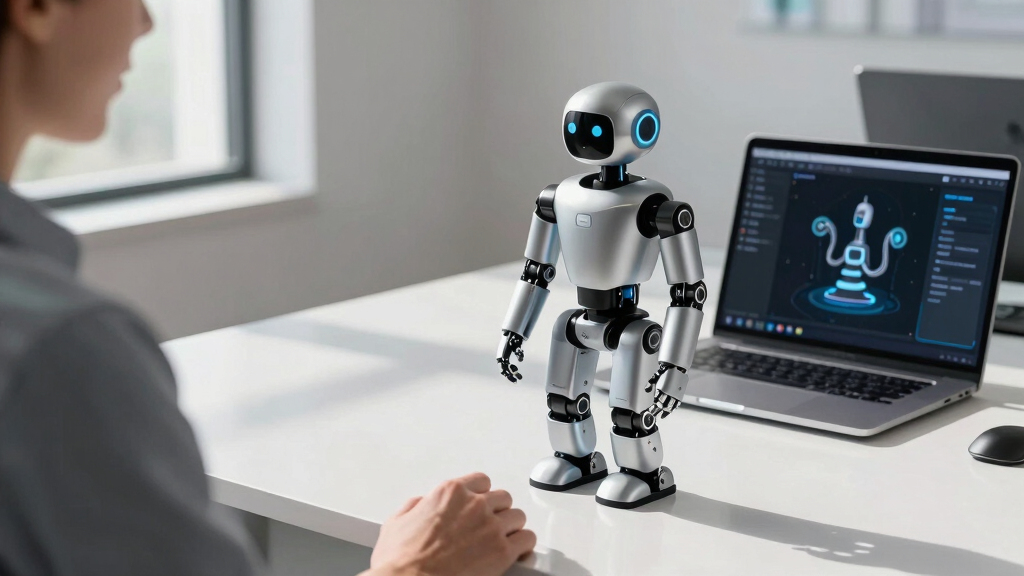

📊 Full opportunity report: The Humanoid Robotics Reality Check: Q2 2026 Pilot-to-Production Status on ThorstenMeyerAI.com — validation score, market gap, and execution plan.

Get business pricing on office and shipping supplies
- Business-only prices and quantity discounts
- Tax-exempt purchasing
- Multiple users, one account, clear invoices
TL;DR
In Q2 2026, humanoid robotics are shipping at large volumes in China, while Western companies focus on pilot projects. Production costs and deployment scale remain key uncertainties.
Humanoid robotics companies are at a pivotal point in Q2 2026, with Chinese manufacturers reaching mass production volumes while Western firms focus on pilot deployments, marking a significant shift from prototype to scaled-up manufacturing.
Unitree in China shipped over 5,500 humanoids in 2025 and targets 10,000 to 20,000 units in 2026, representing the highest production volume globally. Meanwhile, Western companies such as Tesla, Figure AI, and Apptronik are progressing from pilot projects to potential mass production, but their deployment remains largely limited to industrial and prestige pilots. Tesla’s Optimus Gen 3 is expected to begin production at Fremont in late July or August, while Figure AI demonstrated a fully autonomous humanoid running 24/7 in their latest showcase. Despite these advances, most Western deployments are measured in dozens of units, not thousands, indicating a transitional phase rather than full-scale commercialization. The Chinese market’s scale contrasts sharply with the Western focus on high-profile pilot programs, reflecting structural differences in manufacturing and deployment strategies.
12 companies. One inflection.
Pilot to production. The “year of shipping” reality check, region by region.
Beijing marathon win April 19. Tesla Optimus Gen 3 starting July. Figure 03 BotQ scaling to 12K. Unitree shipped 5,500+ humanoids in 2025. Capability demonstration ≠ deployment readiness. The bifurcation between Chinese mass production and Western prestige pilots is structural.
Twelve companies. Three regions. Where each one stands.
Production scale, regional position, real deployment, current status. Chinese mass-producers (Unitree, AgiBot) are at production volumes Western companies haven’t matched. Western flagships are prestige pilots — measured in dozens, not thousands.
Three strategies. Three segments.
Each region has a structural strategy. Not directly competitive on every dimension; each region serves segments where its position is structurally advantageous.
- Engineering qualityStrong AI integration.
- Premium pricingIndustrial customers at $50K+.
- Limited volumeDozens to low hundreds 2025-2026.
- VC runwayFigure $675M, Apptronik $350M.
- Tesla wild cardMass-production ambition could shift positioning.
- Mass scale alreadyUnitree 5,500+ · AgiBot 1-3K.
- Aggressive pricingG1 starts $16K vs Western $50K+.
- State-coordinatedNational Humanoid Robot Innovation Center.
- Sovereign supplyDomestic actuators, sensors, batteries.
- Capability gapsEdge cases vs Western top-tier.
- Specialty focusCollaborative human-robot environments.
- EU regulatoryAI Act + machinery directive aligned.
- Limited capitalSmaller scale than US peers.
- 1X consumerNEO world’s first home humanoid pre-orders.
- NEURA German industryStrong manufacturing customer base.
Three trajectories. One question.
25/55/20 probability allocation reflects production-ramp execution uncertainty. Industrial / logistics economics are real and incentivize deployment. Consumer market difficulty is structurally intractable on the 2027-2028 timeline.
- 500K-1M annual globalMultiple companies at 100K+ each.
- Industrial 50K+ deployedLogistics scaling fast.
- Consumer market begins$10-15K credible products.
- Capital costs decline$15-20K consumer · $30-50K industrial.
- Outcome: Productivity impact measurable.
- 50-150K industrial 2028Logistics steady growth.
- Consumer pilot onlyGenuine market 2029-2030.
- Tesla rampsExternal lags internal.
- Chinese dominate volumeWestern frontier capability.
- Outcome: Bifurcation hardens through 2028.
- Cost targets missed$50K+ floor for non-Chinese.
- Tesla slipsBeyond 2027.
- Pilot-stuck WesternSingle-digit unit deployments.
- Hype → disappointment2027-2028 cycle.
- Outcome: Mass market deferred 2030+.
Humanoid robotics in May 2026 is at the same inflection that AI agents were at in late 2024. Capability is real, production is starting, the hype cycle is overshooting near-term reality. Companies and investors who pace to the structural reality will benefit; those who pace to the peak face the disappointment-cycle correction in 2027-2028.
Four assignments. By role.
Distinguish demonstration from deployment.
Marathon wins are engineering capability statements; production deployments at industrial customers are revenue indicators. Position long deployment-credible names (Apptronik, Figure, Agility); cautiously on demonstration-only names. Chinese mass-producers genuine production but face geopolitical risk for Western customers.
Begin pilot deployments now.
2026-2027 is the right window for structured-task workloads. Logistics / sortation / repetitive assembly are credible categories. Integration cost is binding constraint; partner with systems integrators rather than running integration internally. Multi-vendor sourcing strategy reduces lock-in risk.
Begin retraining for 2027-2028 displacement.
Industrial / logistics labor displacement begins meaningfully in 2027-2028. Concentrated in warehousing, automotive manufacturing, sortation. Policy lag of 24-36 months is historical pattern; current preparation appropriate timing. Consumer / home displacement deferred to 2029-2030+.
Treat robotics timing as capex risk factor.
$725B 2026 hyperscaler capex thesis depends partially on robotics inference demand materializing through 2027-2028. Update infrastructure-revenue models accordingly. Bifurcation between industrial-deployable (real) and consumer-deployable (delayed) is the central distinction to model.
Implications of Regional Deployment Strategies
This status update underscores a bifurcation in the humanoid robotics ecosystem: China’s mass manufacturing capacity versus Western focus on prestige pilots. The progress in Chinese volume production suggests a pathway toward more affordable, scalable robots, which could accelerate adoption in consumer and industrial markets. Conversely, Western companies’ focus on pilot deployments indicates ongoing technological refinement and validation, but delays in scaling could impact the broader industry’s growth and the anticipated $725 billion AI infrastructure investment in 2026. The pace at which Western firms transition from pilot to mass production will influence global competitiveness and the timeline for widespread robot deployment, affecting supply chains, labor automation, and AI integration strategies.humanoid robot industrial automation
As an affiliate, we earn on qualifying purchases.
As an affiliate, we earn on qualifying purchases.
Regional Manufacturing and Deployment Trends
Throughout 2025 and into 2026, Chinese manufacturers like Unitree and AgiBot have achieved production volumes exceeding 5,000 units annually, matching or surpassing Western pilot projects. Western companies such as Tesla, BMW, and Hyundai have demonstrated humanoids in limited pilot settings, with some beginning initial production runs or ramp-ups. Tesla’s Optimus Gen 3, announced in early 2026, is set to begin production at Fremont in late July or August, aiming for scale but still in early stages. The focus remains on refining cost targets, with mass production in China serving as a benchmark. The broader industry narrative emphasizes that while the ‘year of shipping’ is partly true, the majority of Western deployments are still at pilot or early commercial stages, and achieving cost-effective mass production remains a key challenge.
“Production of Optimus Gen 3 will commence in late July or August at Fremont, marking a significant step toward scaling.”
— Tesla spokesperson
As an affiliate, we earn on qualifying purchases.
Unconfirmed Aspects of Cost and Deployment Speed
It remains unclear whether Western companies will achieve the targeted production costs at scale within 2026 or if deployment will remain limited to pilots for longer. The actual pace of transitioning from pilot to mass production, especially for Tesla and Apptronik, is still uncertain, as is the precise timeline for broader commercial adoption. Additionally, the impact of regional manufacturing differences on global supply chains and market penetration is still being evaluated.
As an affiliate, we earn on qualifying purchases.
Upcoming Milestones and Industry Movements
Key next steps include Tesla’s late July/August start of Optimus Gen 3 production, further scaling of Chinese mass-produced humanoids, and Western companies expanding pilot deployments. Industry analysts will closely monitor cost reductions, production ramp-ups, and the transition from pilot to full-scale manufacturing. The industry’s ability to meet the 2026 capex expectations for AI and robotics will depend heavily on these developments, shaping the future landscape of humanoid automation.
As an affiliate, we earn on qualifying purchases.
Key Questions
When will Tesla’s Optimus Gen 3 be available at scale?
Production is expected to begin in late July or August 2026 at Tesla’s Fremont facility, with mass deployment likely following in subsequent months.
Are Western companies close to achieving mass production costs?
It is not yet confirmed whether Western firms will meet their cost targets in 2026; most are still in pilot or early production phases, with cost reductions being a key challenge.
How does Chinese mass production compare to Western pilot projects?
Chinese manufacturers like Unitree are shipping over 5,000 units annually, a volume Western companies are only beginning to approach in pilot stages, indicating a significant regional manufacturing gap.
What are the main challenges remaining for humanoid robotics deployment?
Major challenges include reducing production costs at scale, ensuring reliable autonomous operation in diverse environments, and transitioning from pilot to fully commercialized, mass-produced robots.
What does this mean for the future of humanoid robots?
While Chinese mass production suggests affordability and scalability are achievable, Western companies’ progress in pilot deployment indicates that widespread commercial use may still be several years away, depending on technological and economic breakthroughs.
Source: ThorstenMeyerAI.com
Halloween Picks
halloween
As an affiliate, we earn on qualifying purchases.