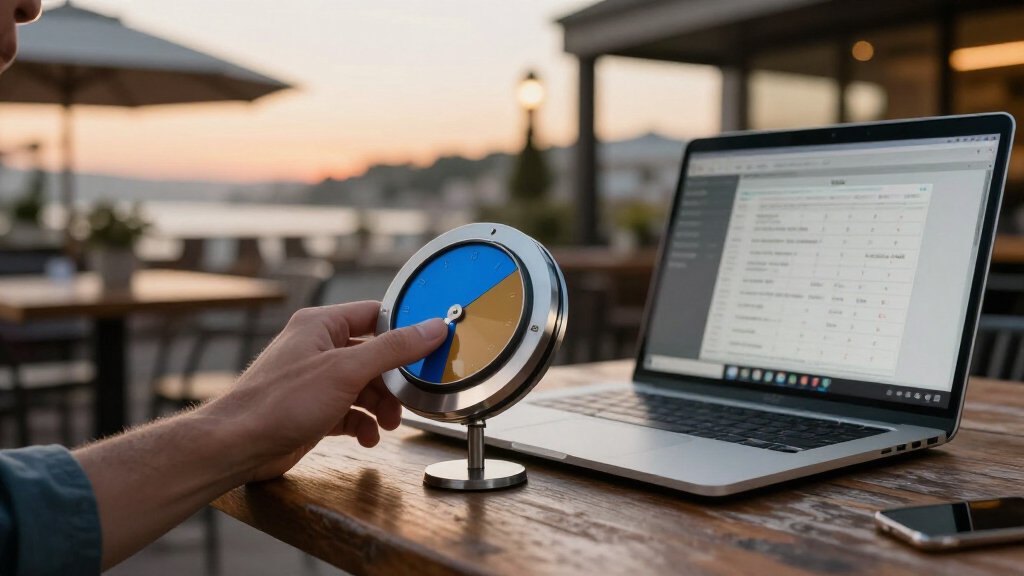

🔍 Read the full analysis: What AI Can Learn From A Twilight Dial For NLC Watching on ThorstenMeyerAI.com

Get business pricing on office and shipping supplies
- Business-only prices and quantity discounts
- Tax-exempt purchasing
- Multiple users, one account, clear invoices
TL;DR
ThorstenMeyerAI.com describes “Noctilucent — NLC Watch at 83 km,” a fictional exhibition website built around an interactive twilight dial. The piece uses real noctilucent-cloud science as its subject, but it is not a live observing service or a scientific instrument.
ThorstenMeyerAI.com has presented “Noctilucent — NLC Watch at 83 km,” an AI-built exhibition website that uses an interactive solar-depression dial to demonstrate how high-altitude clouds can remain sunlit after the ground is dark, as detailed in the original project analysis. The project is a fictional field journal, not a real observing network, live scientific service or source of current cloud sightings.
The website’s central control represents the Sun’s position from 6 to 16 degrees below the horizon. As a visitor moves the dial, the scene changes across several linked elements: sky brightness, shadow depth, cloud glow, ambient color, grain and horizon flare. The source describes the most expressive point as near 11 degrees below the horizon. These effects are a designed simulation, rather than measurements from the atmosphere.
Other elements extend the same idea through the page. A procedural Canvas rendering creates the twilight sky, stars and layered wave paths; cloud forms respond to the shared lighting state, with different patterns for billows, whirls and bands. Inline SVG supplies diagrams, while CSS adds visual details such as instrument edges and grain. The project says it uses no image assets, and its visual scenes are generated in the browser.
A later interaction asks visitors to hold a control as ground-level haze recedes and the cloud band becomes clearer. Releasing early lets the simulated sighting fade. The source says the interaction supports pointer, keyboard and touch-like input. The overall presentation shifts between electric cyan and deep violet imagery and a cream-colored field-log section, pairing the visual demonstration with written explanations and invented observer logs.
A Dial Makes Twilight Interactive
The project’s central design choice is to let one variable affect the whole scene instead of confining it to a decorative control. Visitors can see how changing simulated solar depression alters the sky, cloud rendering and supporting diagrams together. That makes the site’s explanation of twilight more experiential than a static illustration, while still requiring readers to distinguish the visual model from actual observations.
The subject has a real scientific basis: noctilucent clouds are high-altitude ice clouds that can catch sunlight when observers below are in darkness. The exhibition places their altitude at about 83 kilometres. Its interactive approach may help visitors grasp the contrast between a darkened ground-level sky and illuminated clouds, but the source does not report user testing or claim that the experience has been scientifically validated as an educational tool.
The project also provides a documented example of browser-based visual design. According to the source, it uses visibility-aware animation, stopping animation when the document is hidden and avoiding continuous painting of offscreen scenes. It also describes a still state for reduced-motion settings. Those implementation choices show how the effect is intended to work across different viewing conditions, though no independent performance or accessibility results are provided.
As an affiliate, we earn on qualifying purchases.
From Cloud Science to Interface
The page combines a fictional observing project with real noctilucent-cloud subject matter. Its design brief calls for observations around the summer solstice, several weeks on either side, and latitudes of 55–65 degrees. It also names invented locations near Kiruna and the Shetland Islands. Those details set the scene for the exhibition; they are not evidence of real stations or a functioning observation calendar.
The source describes a three-pass design process: building the room, reviewing it for clarity and interaction, and carrying out an art-director review. It also points to a construction guide covering the lighting model, procedural graphics and animation behavior. No independent review, third-party critique, or technical test results are included in the supplied material, so the process is best understood as the project’s account of its own development.
““a fictional field journal for a fictional observing project, not a real company or live scientific service.””
— ThorstenMeyerAI.com project description
night sky telescope for astrophotography
As an affiliate, we earn on qualifying purchases.
As an affiliate, we earn on qualifying purchases.
Simulation, Not Live Observation
The supplied description does not identify a publication date, provide a live site address in usable form, or say whether the exhibition remains available. It also gives no source data, equations or validation details for the simulated lighting model. The dial should not be treated as a forecast, an observation, or a scientific instrument.
There are no reported measurements of visitor response, accessibility testing, browser performance or independent scientific review. The source describes design and implementation features, including reduced-motion handling and pausing animation when a tab is hidden, but does not provide test results that would establish how well those features perform in practice.
As an affiliate, we earn on qualifying purchases.
The Design Guide and Live Room
The source directs readers to the exhibition’s live room and a separate design guide with implementation notes. It does not give a dated launch schedule, future update plan or scientific observing program. Any next step is therefore to inspect the website and its guide directly, if they remain available, while treating the project as an interactive design work rather than a source of current sky conditions.
interactive twilight sky simulation
As an affiliate, we earn on qualifying purchases.
As an affiliate, we earn on qualifying purchases.
Key Questions
Is NLC Watch a real cloud-observing service?
No. ThorstenMeyerAI.com describes it as a fictional field journal for a fictional observing project. It is not a live scientific service or real company.
Are noctilucent clouds real?
Yes. The project describes them as high-altitude ice clouds that can remain sunlit after the ground below has entered darkness. The exhibition’s website is fictional; its subject is real.
What does the solar-depression dial change?
The dial moves through a simulated range from 6 to 16 degrees below the horizon. The page uses its setting to change lighting effects such as sky brightness, cloud glow, shadow depth and ambient color.
Does the dial show actual sky conditions?
No. The source describes a designed, browser-based visual simulation, not live atmospheric measurements or a cloud forecast.
How was the visual scene made?
According to the project description, Canvas generates the sky and cloud forms, inline SVG provides diagrams, and CSS handles additional visual effects and layout. The source says the experience uses no image assets.
Source: ThorstenMeyerAI.com
Fall Picks
fall essentials
As an affiliate, we earn on qualifying purchases.