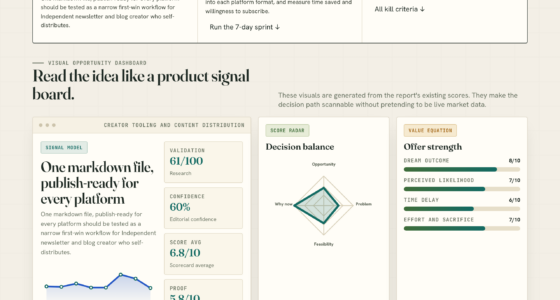

📊 Full opportunity report: Mobilised, Not Spent: What’s Left of Europe’s €200 Billion AI Offensive on ThorstenMeyerAI.com — validation score, market gap, and execution plan.

Get office and shipping supplies delivered free — and shop member deals
- Fast, free delivery on millions of items
- Access to Prime Big Deal Days deals on October 6–7
- Prime Video, Amazon Music and more included
TL;DR
The European Commission announced a plan to mobilize €200 billion for AI development, but only a small part is committed and available now. The majority of funds are hypothetical, and Europe’s AI lag persists due to structural issues.
The European Commission has announced a plan to ‘mobilize’ €200 billion for artificial intelligence development, but only a fraction of that sum is currently allocated or available for immediate use. This initiative aims to position Europe as a major player in AI, yet experts and analysts warn that the actual impact remains uncertain, given the largely hypothetical nature of the funding and the structural challenges Europe faces in AI competitiveness.
The headline figure of €200 billion is misleading; the Commission specifies that only about €50 billion is real public money, with roughly €20 billion earmarked for AI gigafactories that will build large-scale compute facilities. Of this, Brussels commits only a few billion euros directly, with the rest depending on member states and private investors to match the funds, aiming for a leverage ratio of approximately 1:10.
However, the actual funds are not flowing immediately. The call for proposals for the gigafactories is scheduled for July 2026, with facilities expected to become operational between 2027 and 2028. Currently, only one site in Norway is under construction, and several smaller projects are underway using existing supercomputers. This slow pace contrasts sharply with US tech giants, which are investing hundreds of billions annually in AI infrastructure, such as Microsoft’s $10 billion data center in Portugal and Amazon’s planned $200 billion expenditure in 2026.
The core issues underlying Europe’s AI lag—such as high electricity costs, lengthy permitting processes, fragmented capital markets, talent drain, and dependence on US cloud services—are not addressed by the funding plan. The accompanying ‘Technological Sovereignty Package’ mainly comprises laws and frameworks, not additional funds, and does not solve these structural barriers.
Mobilised, not spent
The EU is selling a €200 billion AI offensive. But the decisive word is “mobilised” — not “spent.” Work through the number and the headline shrinks dramatically before it reaches any effect.
2027–28 data centres expected to run
1 SITE under construction so far (Norway)
Late, slow, and not yet built.
A small, late, partly hypothetical cheque — without touching expensive energy, fragmented capital markets, slow permits, or the talent drain. The EU mistakes a funding pot for a strategy.
Impact of Europe’s AI Funding Strategy on Competitiveness
The announced €200 billion figure, heavily reliant on private investment, underscores Europe’s attempt to catch up in AI, but the slow, limited, and mostly hypothetical funding raises questions about its effectiveness. Without addressing fundamental issues like infrastructure, energy costs, and market integration, Europe’s AI sector is unlikely to close the gap with US tech giants, which spend vastly more annually on infrastructure and talent acquisition. This funding strategy, being largely aspirational, risks delaying Europe’s AI ambitions further and widening the technology gap.
As an affiliate, we earn on qualifying purchases.
Europe’s AI Funding and Structural Challenges
Europe’s AI ambitions are hampered by multiple systemic issues: electricity prices roughly double those in the US, lengthy grid connection and permitting processes, lack of deep late-stage funding, and talent migration to US companies. The €200 billion ‘InvestAI’ plan is announced as a headline figure but, in reality, only a small portion is committed and immediately accessible. The US tech giants like Microsoft, Amazon, and Meta are investing hundreds of billions annually, creating a stark contrast with Europe’s slow progress. The plan’s emphasis on gigafactories and frameworks does not yet translate into tangible results or address core structural weaknesses.
“Taxpayers cannot foot this bill alone — Europe ‘urgently’ needs private capital.”
— Ursula von der Leyen, European Commission President
high performance supercomputers for AI
As an affiliate, we earn on qualifying purchases.
As an affiliate, we earn on qualifying purchases.
Unclear Impact and Implementation Timeline
It remains uncertain whether the announced funds will materialize at the scale and pace needed to significantly impact Europe’s AI competitiveness. The actual flow of money is delayed, and structural issues like energy costs, permitting, and market fragmentation are not addressed directly. The timeline for project completion extends into 2027–2028, raising questions about immediate impact and effectiveness.
As an affiliate, we earn on qualifying purchases.
Next Steps in Europe’s AI Funding and Development
The European Commission plans to open calls for proposals for AI gigafactories in July 2026, with projects expected to be operational by 2027–2028. Monitoring how private investment responds to these calls and whether structural reforms progress will be critical. Additionally, Europe’s policymakers may need to accelerate efforts to address core barriers to competitiveness, beyond funding, to truly catch up with US leaders in AI infrastructure and innovation.
As an affiliate, we earn on qualifying purchases.
Key Questions
Is the €200 billion funding for AI already available?
No, only about €50 billion is considered real public money, with most of the remaining funds relying on private investment that has not yet been committed or mobilized.
What are the main obstacles Europe faces in AI development?
High electricity prices, lengthy permitting processes, fragmented capital markets, talent migration, and dependence on US cloud services are key structural barriers.
Will the funding plan help Europe catch up with US tech giants?
Given the slow pace, limited immediate funds, and unresolved structural issues, the plan’s impact on closing the AI gap remains uncertain.
When will the AI gigafactories be operational?
The call for proposals is scheduled for July 2026, with facilities expected to be built and operational between 2027 and 2028.
Does the funding plan address Europe’s energy and infrastructure challenges?
Not directly. While energy and infrastructure are acknowledged issues, the plan mainly focuses on frameworks and small-scale projects, not systemic reforms.
Source: ThorstenMeyerAI.com
Evergreen bestsellers Picks
bestsellers
As an affiliate, we earn on qualifying purchases.