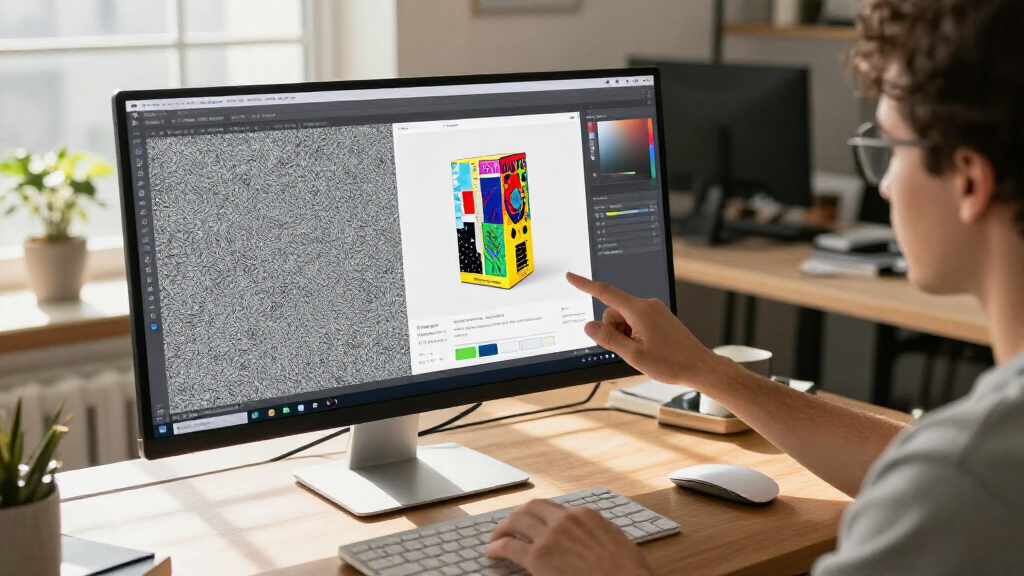
🔍 Read the full analysis: How Image Generation Works In AI Diffusion Models on ThorstenMeyerAI.com

Get business pricing on office and shipping supplies
- Business-only prices and quantity discounts
- Tax-exempt purchasing
- Multiple users, one account, clear invoices
TL;DR
Diffusion image models are trained to predict noise added to images, then generate new pictures by repeatedly removing noise from a random starting point. A source explainer published Nov. 23 describes how compressed image representations and text guidance make the process practical, while also noting limits in lettering, object placement and possible training-image memorization.
AI image generators built on diffusion models create pictures by starting with random noise and repeatedly removing some of it, guided by a text prompt. A Nov. 23 explainer from ThorstenMeyerAI.com describes how the method works, why it can produce convincing images and why tasks such as spelling and precise object placement remain difficult.
The process has two stages. During training, a model takes real images and adds noise in small increments until their original content is almost entirely obscured. A neural network is then trained to predict the noise added at a given step. The 2020 paper “Denoising Diffusion Probabilistic Models,” by Jonathan Ho, Ajay Jain and Pieter Abbeel, used 1,000 steps in its experiments and made this approach practical.
Generation runs the learned process in reverse. The system begins with random values, estimates the noise in the current image and subtracts some of it, repeating until an image takes shape. Ho, Jain and Abbeel wrote that large-scale features appear before details: composition and broad shapes come earlier, while edges and texture are refined later. Later methods can use fewer steps; the source says one widely used open-source pipeline runs 50 steps by default.
Many systems do not perform this work directly on every pixel. Latent diffusion first compresses an image into a smaller representation, reducing the amount of computation needed. In Stable Diffusion v1, a 512-by-512 image is represented with 48 times fewer numbers, according to the source. A text encoder converts the prompt into numerical representations, and guidance steers the denoising process toward those words. Stronger guidance can improve prompt alignment, but the source says it can come at a cost to image quality.
Why Prompted Images Still Go Wrong
Understanding the mechanics helps explain why an image generator can produce a convincing scene yet miss a simple instruction. The model repeatedly estimates and removes noise; it is not assembling a picture from a reliable inventory of objects or following a symbolic plan. As a result, lettering, counting and spatial relationships can be unreliable. A prompt asking for one object on top of another may yield the right objects but the wrong arrangement.
The design also matters for debates about training data. The source notes that researchers have extracted images closely resembling training examples from some models. That does not mean every output is a copy, but it shows that learning to predict noise does not, by itself, settle questions about memorization or reproduction. For users and creators, the practical distinction is between a system that generally synthesizes images and cases where it may reproduce a particular training image.
Products Worth Considering

Samsung Odyssey G55C 32-Inch QHD 1000R Curved Gaming Monitor

Logitech MX Master 4 for Mac

Dell UltraSharp U4025QW 40-Inch Curved 5K2K WUHD LED Monitor
As an affiliate, we earn on qualifying purchases.
From Noise Experiments to Latent Diffusion
The underlying idea predates today’s consumer image generators. In 2015, Jascha Sohl-Dickstein and colleagues proposed gradually destroying structure in data and learning a reverse process that restores it. The 2020 DDPM paper developed a practical training method, describing the forward stage as a Markov chain that adds noise until the original signal is destroyed.
Text-to-image systems add language processing to that image-generation framework. A text encoder turns words into numerical information, while attention mechanisms help connect parts of the prompt to parts of the image process. Latent diffusion reduces the computation by doing denoising in a compressed space. The source uses Stable Diffusion v1 as an example and says its training included subsets of the public LAION-2B(en) image dataset. These details describe a particular model family, not every image generator.
“The loss is a reconstruction objective between the noise that was added to the latent and the prediction made by the UNet.”
— Stable Diffusion v1-4 model card, as quoted by ThorstenMeyerAI.com
Limits and Copyright Questions Remain
The explainer identifies recurring technical limits, but it does not quantify how often they occur across models or prompts. Results vary with the model, settings and wording, and the account’s 50-step figure is a default for one widely used pipeline, not a universal standard. The effects of stronger prompt guidance also depend on the particular system.
Questions about training-image reproduction and copyright are not resolved by the denoising explanation. The source says a UK court found in 2025 that Stable Diffusion itself was not an “infringing copy,” while other questions remained open. That statement should not be read as a ruling on every output, use of training material or legal claim. The supplied account gives no further details about the case or the scope of unresolved disputes.
What Model Users Should Watch
The next developments are likely to be technical and legal rather than a single milestone described in the source. Newer sampling methods and model designs can change how many denoising steps are needed and how closely results follow prompts. Readers comparing systems should check which model and settings were used; a step count or result for one pipeline does not establish performance across all systems.
On the legal side, further court decisions and disputes may clarify how training data and generated images are treated. For now, the source’s account supports a clear technical description but does not settle those broader questions. The basic process remains: a model learns to estimate noise from examples, then uses repeated estimates to turn random input into an image shaped by text.
Key Questions
Does a diffusion model search for an existing image?
Not in the process described here. It starts with random noise and repeatedly removes estimated noise to generate an image. Separate concerns about memorizing or reproducing training images remain relevant.
Why do image models often misspell words?
Diffusion models generate visual patterns through iterative denoising rather than constructing letters as text characters. The source identifies lettering as a common weakness, alongside counting and precise object placement.
How does a prompt affect the result?
A text encoder converts the prompt into numerical information, and guidance steers the denoising steps toward it. The source says more guidance can improve alignment with the prompt, sometimes at a cost to image quality.
Do all diffusion models use 1,000 steps?
No. The 2020 DDPM paper used 1,000 steps in its experiments, while later methods can generate images with fewer. The source cites a 50-step default for one widely used open-source pipeline, not a rule for all models.
Does the described UK court ruling settle AI image copyright?
No. The source says a UK court found in 2025 that Stable Diffusion itself was not an “infringing copy,” but also says other questions remain open. That account does not establish a universal legal rule for generated images or training data.
Source: ThorstenMeyerAI.com