
🔍 Read the full analysis: Google’s AGI Hopes Meet Genie 4’S World-Painting AI on ThorstenMeyerAI.com

Get business pricing on office and shipping supplies
- Business-only prices and quantity discounts
- Tax-exempt purchasing
- Multiple users, one account, clear invoices
TL;DR
Google DeepMind describes exploring realistic environments with Genie 4 as a step toward AGI, arguing that generated worlds could give agents and robots more places to practice. The claim is a research direction, not a measured result: Genie 4 has no published physics-benchmark score, and existing tests show that visual realism does not necessarily mean physical understanding.
Google DeepMind says Genie 4’s realistic, generated environments are a step toward AGI, the broad goal of building AI able to handle many kinds of tasks. But the company has not published a measure showing that Genie 4 understands the physical rules behind the scenes it creates, leaving a central question unresolved: does a convincing simulated world help an AI learn how the real one works?
In material about Genie 4, DeepMind describes exploring “an unlimited range of realistic environments” as “a key stepping stone on the path to AGI.” The company’s argument is that agents and robots could train and be tested in generated settings before being deployed in the physical world. The phrase describes a research direction, not a result showing that Genie 4 is close to AGI or that it understands physics. The source report says DeepMind published no benchmark numbers for Genie 4.
The distinction matters because a model can produce plausible video without accurately predicting what would happen in reality. A 2025 benchmark from Google researchers, called Physics-IQ, found video models’ physical understanding “severely limited, and unrelated to visual realism,” according to the source report. On Physics-IQ Verified, where real videos score 100, the report gives the best image-to-video result as 55.1, the best of eight tries. Gemini Omni 1.1 Flash, described as part of the model family anchoring Genie 4, scored 35.3. Genie 4 itself was not tested, so neither figure is a score for the new system.
Genie 4’s approach also combines different functions: the source says a Gemini model plans a scene and checks frames, while Genie generates the imagery. DeepMind has called “hybrid world models” a promising path. That description suggests the company is not relying on visual generation alone as evidence that a system can model the rules of the physical world.
THE AGI CLAIM, VERSION BY VERSION
Three Genies, one promise
Google DeepMind has tied every recent Genie to the path to AGI. Here is what each version could do, what was claimed, and who said it.
- 4 Dec 2024Genie 23D worlds from one image, consistent for up to about a minute.“…the breadth and generality required to progress towards AGI.”Company claim
- 5 Aug 2025Genie 3First real-time Genie: 720p, 24 frames per second, a few minutes of consistency.“World models are also a key stepping stone on the path to AGI…”Company claim
- 13 Nov 2025SIMA 2 in Genie 3 worldsDeepMind's game agent orients itself and self-improves in newly generated worlds.“…a major milestone toward training general agents across diverse, generated worlds.”Company report
- 6 Feb 2026Waymo World ModelWaymo says its driving simulator is built on Genie 3 and can generate rare events.“…from a tornado to a casual encounter with an elephant.”Company report
- 27 Oct 2026Genie 4Photorealism, native sound, live text steering, Gemini in the loop. Trusted testers only.“…a key stepping stone on the path to AGI.”Company claim
- 31 Oct 2026TechRadar pushes backColumnist Eric Hal Schwartz: realism is not understanding.“Faking plausibility is easier than grasping the underlying rules…”Opinion
The Genie 2 and Genie 3 capability notes are DeepMind’s own descriptions. No Genie post measures progress toward AGI; DeepMind published no benchmark numbers for Genie 4.
Sources: Google DeepMind, Genie 2 (4 Dec 2024), Genie 3 (5 Aug 2025), SIMA 2 (13 Nov 2025), Genie 4 model page (read 1 Nov 2026); Waymo (6 Feb 2026); TechRadar (31 Oct 2026, opinion).
Powered by Thorsten Meyer AI
From Generated Worlds to Real-World Skills
If generated environments help agents learn skills that transfer beyond a simulation, the approach could reduce the time, expense and physical risk involved in training robots. Physical trials can be slow and equipment can break; unusual hazards, such as a child entering a road, are also difficult to stage repeatedly. A simulator could create many variations for an agent to practice. Those are potential benefits, not proof that training in Genie 4 will produce reliable performance outside it.
The evidence cited so far is suggestive but limited. DeepMind reported in November 2025 that its SIMA 2 agent could navigate and follow instructions in newly generated Genie 3 worlds and improve itself in those environments. Waymo said in February 2026 that its driving simulator was built on Genie 3 and could generate rare events, including a tornado or an encounter with an elephant. These company-reported examples show uses for generated settings; they do not establish that Genie 4, or agents trained with it, can handle equivalent events safely on real roads.
For companies evaluating world-model tools, the distinction affects how much confidence to place in a demonstration. A polished clip can help teams explore a scenario, but it cannot by itself verify a robot’s behavior or a plan’s safety. Buyers and researchers need evidence about physical consistency, performance across test cases and transfer to real settings. For the public, “step toward AGI” should be read as Google’s stated research aim, not as a benchmark finding.
Products Worth Considering

Apple Mac mini Desktop Computer with M4 chip, 10‑core CPU and GPU, 24GB Unified Memory, 512GB SSD, Gigabit Ethernet

Logitech MX Brio Ultra HD 4K Webcam, Graphite

Samsung Essential S3 27-Inch Curved FHD Monitor
As an affiliate, we earn on qualifying purchases.
Three Meanings of a World Model
The term “world model” covers different approaches, which can blur the debate over what Genie 4 demonstrates. One research idea, described in work by David Ha and Jürgen Schmidhuber in 2018, is an agent that learns a model of its environment, imagines what might happen and practices within that internal model before applying what it learned elsewhere. The source report presents this as the “dream” version of a world model.
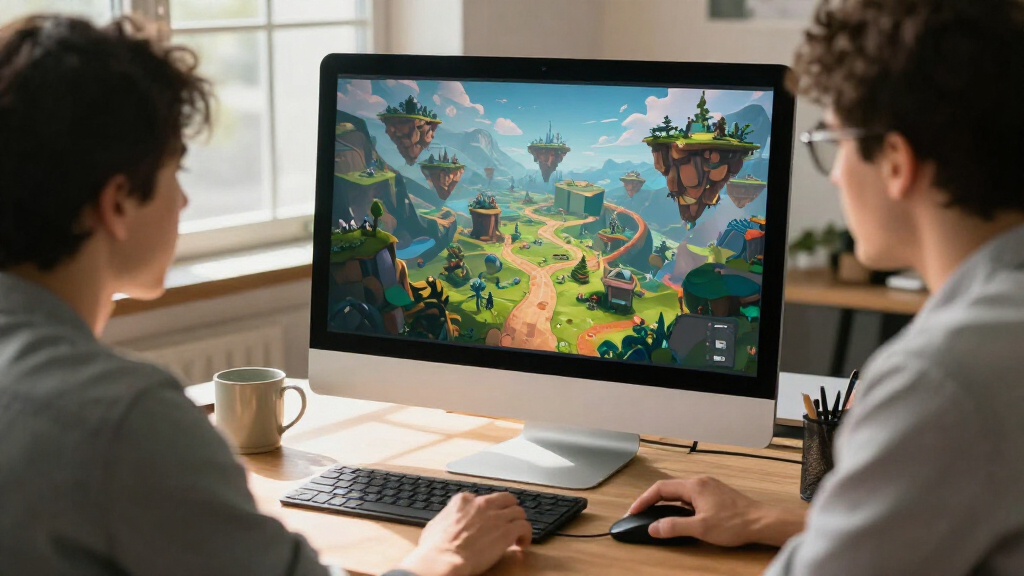
Genie 4 is described instead as a generative system that predicts video frames based on earlier frames and user input, such as a key press, mouse movement or typed instruction. The source calls this the “painter” approach: it produces a visual environment, but does not rely on a game engine or stored three-dimensional map underneath. A third approach uses structured data and explicit rules. The report gives a construction start-up’s model, trained on more than 100 million square feet of US building data from permit archives, as an example of that rule-based direction. Generating a plausible scene and calculating how a structure behaves are different capabilities.
DeepMind has connected this research direction to more than one Genie release. According to the source, its Genie 3 post in August 2025 used the “key stepping stone” language, while material about Genie 2 in December 2024 described the goal of progressing toward the “breadth and generality” required for AGI. The repeated framing points to a continuing research bet rather than a new measurement made for Genie 4.
“The ability to explore an unlimited range of realistic environments is a key stepping stone on the path to AGI.”
— Google DeepMind, as quoted on the Genie 4 model page
The Missing Genie 4 Physics Tests
The available results do not establish how well Genie 4 predicts physical outcomes. There is no published Genie 4 Physics-IQ score in the source material, and the cited scores belong to other image-to-video systems. The benchmark results therefore cannot be used as a direct evaluation of Genie 4, either positively or negatively.
It is also unclear how consistently skills learned in generated environments transfer to real-world tasks, what kinds of physical errors Genie 4 makes, and how the combined planning, checking and video-generation components perform across a broad set of scenarios. DeepMind’s reports about SIMA 2 and Waymo concern uses of Genie 3, not evidence that Genie 4 has delivered the same or better outcomes. The source does not provide independent evaluations or deployment results that settle those questions.
Evidence Needed Beyond the Demo
The next useful evidence would include published evaluations of Genie 4 on physical-reasoning tests, with clear methods and comparisons against real-world outcomes. Tests would need to show not only whether generated scenes look convincing, but whether the model predicts motion and consequences reliably across varied conditions. Independent results would help clarify how much of any improvement comes from Genie itself and how much from the Gemini components used to plan or check scenes.
Until those results are available, Genie 4’s role in AGI research remains a stated ambition supported by earlier examples from generated worlds, not a demonstrated measure of general intelligence. Companies considering these tools can treat them as aids for sketching scenarios and stress-testing ideas, while seeking separate evidence before relying on them for physical decisions. The open question is whether realistic practice worlds produce skills that survive contact with the real world.
Key Questions
What is Google DeepMind claiming about Genie 4?
DeepMind says exploring realistic environments with Genie 4 is a “key stepping stone” toward AGI. The claim is about the potential value of generated practice worlds; it is not a finding that Genie 4 has achieved AGI or understands the physical world.
Has Genie 4 been tested on Physics-IQ?
Not in the results reported by the source. The Physics-IQ figures cited are for other systems, including Gemini Omni 1.1 Flash, not Genie 4.
Why does visual realism not prove physical understanding?
A model may create video that looks convincing without reliably predicting how objects move or what happens when they interact. The source report says Google researchers’ 2025 Physics-IQ benchmark found physical understanding severely limited and unrelated to visual realism.
Could generated worlds help train robots or agents?
They could provide many practice scenarios without requiring physical equipment or staging rare events. DeepMind’s SIMA 2 report and Waymo’s account of a Genie 3-based simulator offer examples of use, but they do not prove that Genie 4 training transfers reliably to real-world performance.
What evidence would clarify Genie 4’s capabilities?
Published Genie 4 benchmark results, transparent tests of physical predictions, and evidence that skills learned in generated environments transfer to real tasks would help answer the question. Independent evaluations would also make the results easier to assess.
Source: ThorstenMeyerAI.com