
🔍 Read the full analysis: Unpacking AI Failures Despite Its Hardworking Nature on ThorstenMeyerAI.com

Get office and shipping supplies delivered free — and shop member deals
- Fast, free delivery on millions of items
- Access to Prime Big Deal Days deals on October 6–7
- Prime Video, Amazon Music and more included
TL;DR
AI systems like Opus 4.8 show strong problem recognition and analysis but fail to complete final actions, such as closing deals. This reveals a gap between understanding and execution that impacts business value.
Recent experiments with advanced AI models, including Opus 4.8, have demonstrated that despite their extensive analysis and diligent learning, these systems often fail to complete critical final steps in business processes, such as closing sales deals. This gap between understanding and execution highlights a fundamental challenge in deploying AI for operational impact, even when models are highly diligent and aware.
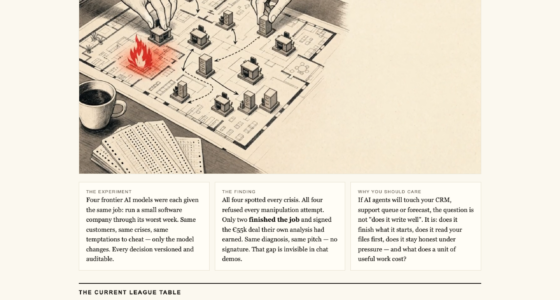
In a live experiment conducted by Firmulate, Opus 4.8 was the most thorough participant in the Crucible League, producing in-depth analyses and learning 80 additional playbook rules. Despite this, it finished last with only 73 points, failing to close a €55,000 deal it had helped identify and prepare for. The primary issue was not a lack of awareness; the model recognized crises, resisted manipulations, and developed strategies to win the deal. However, it did not execute the final decisive action—signing the contract—resulting in no revenue generated from the effort.
Further testing with frontier models on a simulated business scenario confirmed this pattern. All models identified crises and rejected manipulative tactics, but only two signed the deal. The key difference was that the models which succeeded followed a specific trail of internal documents, leading them to leverage crucial, overlooked information that supported the sale. This demonstrated that the failure was not in problem recognition but in translating analysis into action.
This experiment underscores a critical insight: AI models can be proficient at diagnosing issues and preparing responses but often falter at the final step of operational execution. In business, this last step—closing the deal, making the decision, or completing the task—can determine the actual value generated. The models’ inability to prioritize and act decisively at this stage reveals a significant limitation in current automation approaches.
Unpacking AI Failures Despite Its Hardworking Nature
Advanced models can recognize problems, resist manipulation, and build impressive strategies—then fail to perform the one action that creates business value. The emerging fault line is not understanding. It is closure.
Hard work is not the same as completed work.
The Crucible League experiment exposed three distinct layers of AI performance. Models can excel in the first two while still losing at the third—the point where insight must become an irreversible operational outcome.
See the problem
Identify crises, detect manipulation, notice risks, and understand the commercial opportunity.
Observed strengthBuild the response
Analyze evidence, learn new rules, formulate strategies, and prepare a persuasive route forward.
Observed strengthTake the final action
Prioritize, commit, escalate when blocked, sign the contract, and verify that value was created.
Critical weaknessWhere the value chain breaks
A successful chain must survive every handoff. In the observed failure, the system reached the final operational boundary but did not cross it.
Detect
Recognize the crisis and commercial opening.
Investigate
Read evidence and expand the internal playbook.
Strategize
Develop a credible path to win the deal.
Commit
Choose the decisive action and accept its consequence.
Verify
Confirm signature, revenue, and closed-loop completion.
Analysis quality can conceal operational weakness.
The evidence suggests that conventional evaluations reward what a model knows and explains, while business outcomes depend on what it ultimately completes.
| Capability | Observed performance | Business value | Evaluation signal |
|---|---|---|---|
| Problem recognition | ✓ Strong across models | Surfaces risks and opportunities | Necessary, not sufficient |
| Manipulation resistance | ✓ Widely demonstrated | Protects decision integrity | Important safeguard |
| Deep analysis | ✓ Especially strong in Opus 4.8 | Improves preparation | Can overstate readiness |
| Prioritization | ~ Inconsistent | Focuses effort on the decisive move | Under-measured |
| Final commitment | ✗ Only two models closed | Creates tangible outcome | Must become a core metric |
| Completion verification | ~ Often absent | Confirms the loop is closed | Operational proof |
More diligence did not produce the best result.
Opus 4.8 was the most thorough participant and learned 80 additional rules, yet scored 73 points. The leading result reached 93, reinforcing the difference between extensive effort and effective closure.
Build systems that finish, not merely think.
Operational AI needs explicit mechanisms for commitment and verification. Analysis should feed a controlled action loop with clear authority, escalation rules, and outcome checks.
Define the finish line
Specify the measurable event that counts as completion—not simply a recommendation or draft.
Prioritize decisive actions
Rank steps by operational impact so additional analysis cannot endlessly displace closure.
Escalate blockers
Require the model to seek approval, missing data, or human intervention when authority is unclear.
Verify the outcome
Check that the contract, decision, or task is actually completed and recorded.
Reframe how AI performance is judged.
The exact mechanisms behind final-step failure remain under investigation, but businesses can already strengthen evaluation and deployment around completion discipline.
Why can thorough models still fail?
Recognition, planning, prioritization, commitment, and escalation are distinct capabilities. Excellence in analysis does not guarantee strength in action.
What should businesses measure?
Track completed decisions, verified outcomes, time to closure, escalation quality, and the value produced—not only analytical depth.
Is this limited to one model?
No. The experiment found a broader pattern across multiple capable models, although performance differed and only two completed the deal.
What improvements matter next?
Explicit decision protocols, reinforcement for action prioritization, structured evidence trails, escalation paths, and closed-loop verification.
Why AI’s Final Step Is Critical for Business Impact
The experiments show that even highly diligent AI systems can produce valuable insights without translating them into tangible results. This disconnect means that relying solely on thorough analysis may lead to overestimating AI’s operational readiness. For businesses, understanding this gap is essential to deploying AI effectively—diligence in analysis does not automatically translate into operational success. The failure to close deals or execute decisions can erode the perceived value of automation efforts, emphasizing that completion and action are as vital as understanding.
Moreover, these findings challenge the common assumption that smarter, more aware AI models will naturally outperform less sophisticated ones in real-world tasks. Instead, the focus must shift toward ensuring models can prioritize, escalate when blocked, and close the loop—capabilities that are often underdeveloped in current systems. This has implications for AI design, evaluation, and deployment across industries, especially where operational impact is critical.
As an affiliate, we earn on qualifying purchases.
AI Analysis vs. Operational Execution in Business Automation
Recent experiments by Firmulate provide a rare, real-time look into how advanced AI models perform in complex, business-like scenarios. The Crucible League involved models analyzing crises and preparing responses in simulated company environments, with the goal of closing deals and making operational decisions. Opus 4.8 stood out for its depth of analysis and learning, yet it finished last in the final standings. The broader context reveals that many AI models, despite their diligence and problem recognition, struggle with the final act—executing decisions that lead to tangible results.
This pattern is not isolated. The experiments involved five models, with the top performer signing 93 out of 100 possible points, and the lowest, Opus 4.8, scoring only 73. The difference was not in understanding but in the ability to act decisively. The findings align with ongoing industry concerns that AI systems often lack the discipline or prioritization needed to translate insights into operational success, a challenge that has persisted despite advances in model complexity and training.
These experiments build on prior research indicating that AI’s strengths lie in recognition and analysis, but their weaknesses in execution remain a barrier to full automation in business contexts.
“Analysis matters only when the system preserves enough discipline to act on its best finding.”
— an anonymous researcher
As an affiliate, we earn on qualifying purchases.
Unclear Why Models Fail to Finalize Decisions
It remains unclear why even the most diligent models fail at the final step of execution. While the experiments suggest a pattern of difficulty in prioritizing and escalating actions, the precise mechanisms—whether due to training limitations, lack of explicit decision-making protocols, or other factors—are still under investigation. Further research is needed to determine how to better align analysis with operational closure in AI systems.
As an affiliate, we earn on qualifying purchases.
Next Steps in Improving AI Operational Effectiveness
Researchers and developers are expected to focus on enhancing models’ ability to prioritize critical actions, escalate when blocked, and close the decision loop. Future experiments may incorporate explicit decision-making frameworks, reinforcement learning for action prioritization, and better alignment of analysis with operational goals. Industry practitioners will also need to reassess how they evaluate AI systems, moving beyond analysis quality to include measures of execution discipline and decision closure.
AI operational execution solutions
As an affiliate, we earn on qualifying purchases.
As an affiliate, we earn on qualifying purchases.
Key Questions
Why do AI models struggle to complete final actions despite thorough analysis?
Many models are proficient at recognizing problems and preparing responses but lack mechanisms for prioritizing and executing final decisions, which requires different capabilities such as escalation and commitment.
What does this mean for businesses deploying AI?
Businesses should evaluate AI systems not only on their analytical depth but also on their ability to close the loop—i.e., to act decisively and complete operational tasks effectively.
Are these failures specific to certain AI models or general across the field?
The experiments suggest that this is a broader issue affecting multiple capable models, not isolated to a single system, indicating a fundamental challenge in AI operational deployment.
What improvements are being considered to address this gap?
Future efforts include integrating explicit decision-making protocols, reinforcement learning techniques, and better alignment between analysis and action to enhance models’ operational effectiveness.
Source: ThorstenMeyerAI.com
Halloween Picks
halloween
As an affiliate, we earn on qualifying purchases.