📊 Full opportunity report: Lab Results, Symptoms, And TRT: What To Keep Track Of on IdeaNavigator AI — validation score, market gap, and execution plan.

Get business pricing on office and shipping supplies
- Business-only prices and quantity discounts
- Tax-exempt purchasing
- Multiple users, one account, clear invoices
TL;DR
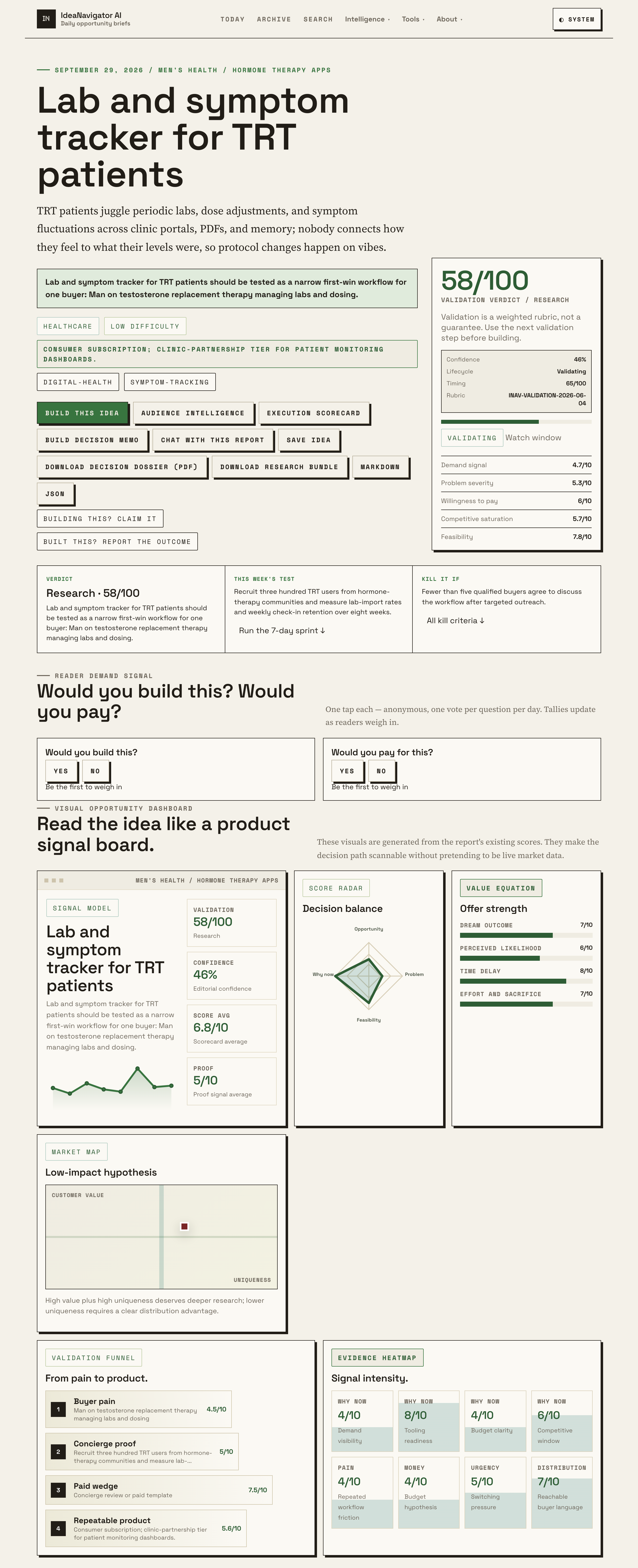
A product proposal from IdeaNavigator AI identifies a gap in care for men on testosterone replacement therapy: hormone panels, dose changes and symptoms sit in disconnected clinic portals and PDFs. The proposed app would chart labs against dose changes and daily symptom check-ins and flag out-of-range values.
A newly published product proposal from IdeaNavigator AI targets a specific and growing patient group: men on testosterone replacement therapy (TRT) who currently manage periodic lab work, dose adjustments and symptom fluctuations across disconnected clinic portals, PDFs and memory. The proposed app would import lab results, chart hormone panels over time against dose changes and daily symptom check-ins, and flag values drifting outside target ranges.
According to the proposal, the core problem is fragmentation. TRT patients receive periodic blood work through their prescribing clinics, but the results often arrive as PDFs or sit inside portal accounts that do not talk to each other. Because no single record connects how a patient feels to what his hormone levels actually were, the proposal argues, protocol changes end up being made on loose impressions rather than correlated data.
The minimum viable product outlined in the concept has four functions: importing lab PDFs; charting hormone panels over time alongside dose changes and daily symptom check-ins; generating trend summaries that patients can bring to clinic visits; and flagging values that drift outside target ranges. The app is designed for a single buyer persona — a man on TRT managing labs and dosing — rather than for clinics or general consumers first.
The proposed business model has two parts: a consumer subscription for individual patients, and a clinic-partnership tier that would give providers patient-monitoring dashboards. The target market is described as men’s health and hormone therapy apps.
Why Fragmented TRT Care Matters
The proposal is grounded in a stated market shift: TRT prescriptions and telehealth clinics have surged, creating what the concept describes as a large self-managing patient population whose care is fragmented across multiple providers “by design.” Men who start therapy through one telehealth service may switch providers, use a local lab for blood draws, and consult an endocrinologist separately — with no shared longitudinal record of hormone levels, doses and symptoms.
If the gap is real, the stakes are practical rather than cosmetic. Testosterone dosing is typically adjusted based on lab values such as total testosterone, hematocrit and estradiol, alongside patient-reported outcomes like energy, mood and libido. Without a tool that correlates these two streams, both patient and clinician may rely on recall. The proposal positions this as a narrow “first-win” workflow — a deliberately small product that solves one problem well for one buyer.
How the Validation Plan Would Work
The concept includes a concrete validation step before any build. The proposed method: recruit 300 TRT users from hormone-therapy communities and measure two metrics over eight weeks — the rate at which users import their lab results, and weekly check-in retention. These metrics would test whether patients actually adopt the core workflow of uploading labs and logging symptoms, rather than just expressing interest.
The framing follows a common early-stage product logic: pick a single persona, solve a narrow recurring workflow, and prove engagement with measurable retention before expanding into clinic-facing features. The proposal explicitly identifies the TRT patient managing labs and dosing as that first persona.
Unproven Demand and Open Questions
Nothing in the proposal has been built or tested. The app exists only as a concept, and its central assumptions — that TRT patients will import lab PDFs reliably and complete weekly symptom check-ins over two months — remain unverified until the proposed eight-week validation runs.
Several practical questions are also unresolved in the concept. It does not specify how lab PDFs from different clinics and laboratories would be parsed, an acknowledged hard technical problem. It does not detail how “target ranges” would be set — whether from published clinical guidelines, individual prescriber instructions, or user input. It also does not address regulatory or privacy questions that arise when a consumer app stores hormone panels and health symptoms, which in many jurisdictions would bring it under health-data protection rules.
Finally, the claim that TRT prescriptions have surged is presented as the rationale for timing but is not sourced to specific prescription data within the concept.
From Concept to Validated Workflow
The stated next step in the proposal is validation: recruiting 300 TRT users from hormone-therapy communities and running the eight-week measurement of lab-import rates and weekly check-in retention. Strong results on both metrics would support building out the MVP — PDF import, trend charting, visit summaries and range-flagging — followed by the consumer subscription and clinic-partnership tiers.
If retention proves weak, the concept implies the workflow would need to be narrowed further or rethought before any build. No development timeline, pricing or partnership commitments are included in the proposal, so any dates attached to a launch remain unknown.
Source: IdeaNavigator AI
Key Questions
Does a TRT lab and symptom tracker app currently exist?
No product has been built. What has been published is a product concept by IdeaNavigator AI describing a proposed app, its target user, business model and validation plan.
What would the proposed app actually do?
According to the concept, it would import lab PDFs, chart hormone panels over time against dose changes and daily symptom check-ins, generate trend summaries for clinic visits, and flag values drifting outside target ranges.
How would anyone know whether TRT patients want this?
The proposal outlines a validation test: recruit 300 TRT users from hormone-therapy communities and measure lab-import rates and weekly check-in retention over eight weeks. This test has not been run.
Is the app aimed at patients or clinics?
The initial target is a single buyer: a man on TRT managing labs and dosing. A clinic-partnership tier with patient-monitoring dashboards is proposed as a second revenue stream.
What are the main open risks?
Unproven demand, unresolved technical questions about parsing lab PDFs from different sources, unclear definition of target ranges, and unaddressed health-data privacy and regulatory requirements.
Source: IdeaNavigator AI
Columbus Day / Indigenous Peoples' Day Picks
long weekend sales
As an affiliate, we earn on qualifying purchases.