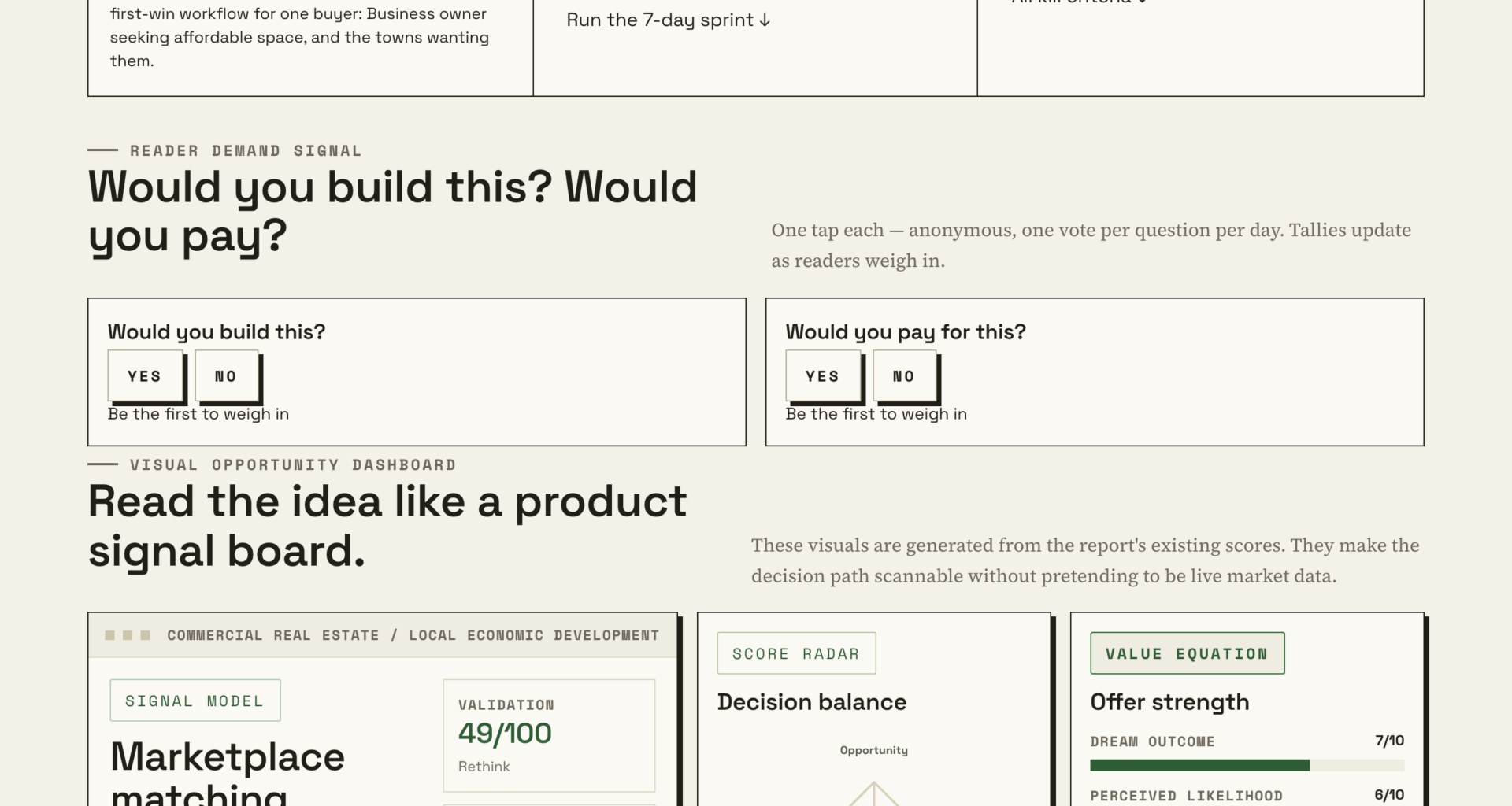
📊 Full opportunity report: A Marketplace For Small-Town Commercial Real Estate on IdeaNavigator AI — validation score, market gap, and execution plan.

Get office and shipping supplies delivered free — and shop member deals
- Fast, free delivery on millions of items
- Access to Prime Big Deal Days deals on October 6–7
- Prime Video, Amazon Music and more included
TL;DR
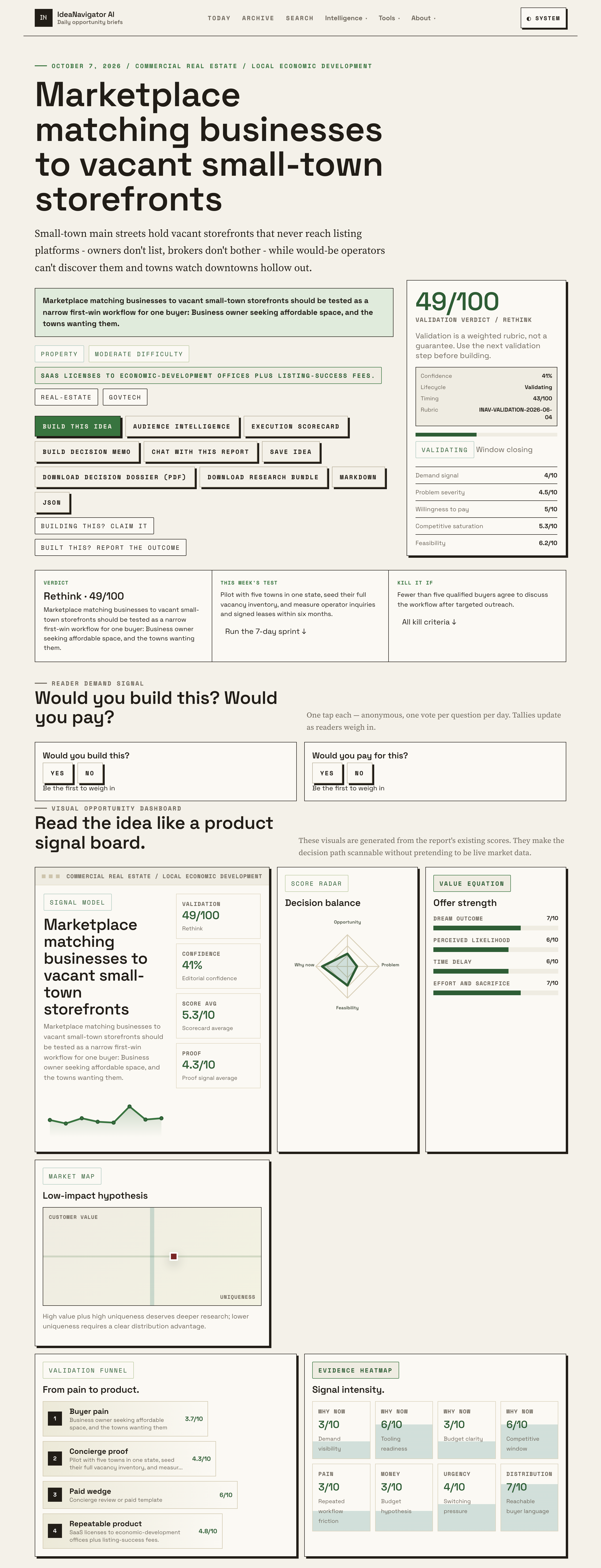
IdeaNavigator AI has proposed a marketplace to connect business operators with vacant storefronts in small towns, routing potential matches to local economic-development offices and available grant programs. The concept is a proposal, not a reported launch; a five-town pilot and six-month measurement period are suggested, but no participating towns, funding, or results are confirmed.
IdeaNavigator AI has proposed a marketplace that would connect business operators seeking affordable commercial space with vacant storefronts in small towns, while directing potential matches to local economic-development offices. The concept calls for a pilot in five towns in one state, but no launch, participating communities, or operating results have been reported.
The proposed service would let property owners and towns list storefronts with photographs, floor area, rent, and information about incentive programs. Operators could search by town profile and foot-traffic data, then send inquiries through a process that routes possible matches to the relevant development office. The proposal says available grants could be attached to those referrals.
Its intended users are business owners looking for affordable space and communities trying to attract them. The idea is aimed at a visibility gap: some vacant properties are not posted on commercial listing platforms, while potential operators may not know that the spaces exist. The proposal describes the result as a problem for both parties, with towns unable to connect available properties to prospective businesses.
For a minimum viable test, IdeaNavigator AI suggests gathering a town’s full vacancy inventory in five communities in one state. The proposed evaluation period is six months, using operator inquiries and signed leases as measures. The suggested business model combines software licenses for economic-development offices with fees tied to successful listings. These are proposed design and revenue elements, not evidence that the marketplace has been built or that customers have agreed to pay.
Connecting Vacant Shops With Operators
If tested, a shared marketplace could make previously hard-to-find spaces easier for prospective businesses to discover. Centralized listings may reduce the effort required to identify available storefronts, while details such as rent, size, and incentives could help operators judge whether a space merits an inquiry.
The proposal also places local development offices in the matching process rather than treating a property listing as the end point. Those offices could direct operators toward available grants and local information. That could make the service useful to towns seeking new occupants as well as to owners seeking tenants. The actual effect on leasing, business openings, or downtown activity remains untested.
The suggested fee structure raises a practical question for communities: whether the service produces enough useful inquiries or completed leases to justify a software license. For operators and property owners, the value would depend on accurate, current listings and whether the advertised incentives and terms apply to their situation. The six-month pilot metric is intended to begin answering those questions, but no benchmark or target results are specified.
commercial real estate listing software
As an affiliate, we earn on qualifying purchases.
As an affiliate, we earn on qualifying purchases.
The Proposed Pilot and Its Premise
IdeaNavigator AI frames the opportunity around vacant small-town commercial properties that may not appear on established listing platforms. It says owners may not list the spaces and brokers may not pursue them, leaving prospective operators without a straightforward way to find them. That description is the proposal’s account of the problem; no inventory figures or independent market research are provided.
The concept also argues that remote-work migration has renewed interest in small towns and that economic-development offices have grant funding for this kind of matching effort. The proposal does not identify particular towns, grant programs, amounts, or dates. Those points are presented as reasons to test the idea, rather than as quantified findings about current demand or funding availability.
The suggested test is deliberately local: choose five towns in one state, collect their vacant-storefront listings, and track inquiries and signed leases over six months. That setup would offer a basic test of whether owners and municipalities can supply listings and whether operators respond. It would not, on the information available, establish how the model performs in other regions or over longer periods.
As an affiliate, we earn on qualifying purchases.
Pilot Status and Market Demand
The proposal does not say whether development is underway, who would operate the marketplace, or whether any towns, property owners, or businesses have committed to participate. It also gives no launch date, budget, software specifications, or confirmed grant partners.
Demand is likewise unverified. No current storefront count, operator inquiry data, lease outcomes, or comparison with existing commercial-property services is provided. The proposal does not define what qualifies as a successful listing, how foot-traffic data would be collected, or how current rents and incentives would be checked. It is also unclear how listing-success fees would be calculated and who would pay them.
portable digital camera for property photos
As an affiliate, we earn on qualifying purchases.
As an affiliate, we earn on qualifying purchases.
Evidence Needed From a Test
The next stated step is a five-town pilot in one state, with participating communities’ vacant storefronts entered into the service. If that test proceeds, the proposed six-month review would count operator inquiries and signed leases. Those measures could show whether the marketplace generates activity, though the proposal does not specify a target number of either outcome or a method for attributing leases to the platform.
Before results can be assessed, organizers would need to identify participating towns and confirm how listings, rent details, incentive information, and foot-traffic data will be maintained. No timetable for those decisions or for a pilot announcement has been provided. Until a test is launched and outcomes are reported, the marketplace remains a concept rather than a demonstrated service.
Source: IdeaNavigator AI
business grant application guidebook
As an affiliate, we earn on qualifying purchases.
As an affiliate, we earn on qualifying purchases.
Key Questions
Has the small-town storefront marketplace launched?
No launch is confirmed. The proposal describes a possible marketplace and a suggested pilot, but does not name an operating service or launch date.
Who would use the marketplace?
Its proposed users are business operators seeking affordable commercial space, property owners with vacant storefronts, and local economic-development offices involved in matching and incentives.
What would the listings include?
The proposed listings would include photos, space size, rent, and incentive-program information. Operators would also be able to browse using town profiles and foot-traffic data.
How would the idea be tested?
IdeaNavigator AI suggests a pilot in five towns in one state, with a six-month measurement period tracking operator inquiries and signed leases. No participating towns or results have been reported.
How might the marketplace make money?
The proposed model combines software licenses sold to economic-development offices with fees tied to successful listings. Pricing and customer commitments are not specified.
Source: IdeaNavigator AI
Halloween Picks
halloween
As an affiliate, we earn on qualifying purchases.