

🔍 Read the full analysis: Small Businesses In 2027: 15 AI Automation Tools To Know on ThorstenMeyerAI.com

Get business pricing on office and shipping supplies
- Business-only prices and quantity discounts
- Tax-exempt purchasing
- Multiple users, one account, clear invoices
TL;DR
This is a buyer’s guide to 15 books for small-business owners learning about AI automation, not a report that 15 new software tools have launched. ThorstenMeyerAI.com ranks guides by their stated focus, but says the limited source information does not establish specific contents, integrations, or results.
The roundup names AI Automation for Small Businesses: A Practical Guide to Automating Marketing, Sales, Customer Service, Operations, and Everyday Work as its best overall pick, based on the broad range of business functions named in its title. It presents AI Automation Made Simple for Small Business as a beginner-oriented option associated with no-code workflows, and ChatGPT for Business: The 10X Playbook as a guide emphasizing workflow ideas that readers may adapt.
The other 12 titles named by the source are AI for Small Business: A Practical Guide to Getting Started; AI for Small Business Owners; The AI-Powered Small Business; AI Advantage for Entrepreneurs; Small Business, Big AI; Automate Your Business with AI; The Small Business AI Playbook; AI Automation for Entrepreneurs; ChatGPT for Small Business; AI and Automation for Small Business; The 30-Day AI Business Plan; and AI Tools for Small Business Growth. The source gives their roles in broad terms, based on the wording and promised formats of the titles, rather than providing a detailed evaluation of each book’s contents; readers choosing software can also consult this guide on how to choose AI automation software.
ThorstenMeyerAI.com says it compared the books as business learning resources, giving weight to practical workflow coverage, beginner accessibility, and relevance to common business functions. The source advises readers to check descriptions or sample pages and verify software compatibility before treating a suggested workflow as ready to implement, a step that aligns with comparing AI automation software options.
The 15 picks
- 1
 Smart AI for Small Business: 50 Simple Hacks to Grow Revenue, Cut Costs, and…View on Amazon →
- 2
 The Small Business Owner’s AI Handbook: How to Use Artificial Intelligence to…View on Amazon →
- 3
 AI Tools for Small Business: A Practical Guide to Automation, Saving Time, an…View on Amazon →
- 4
 AI-Powered Automation and Workflows for Small Business OwnersView on Amazon →
- 5
 ChatGPT for Business: The 10X Playbook — 100 AI Workflows to Save Time, Grow…View on Amazon →
- 6
 AI Automation for Small Businesses: Build Smarter Workflows, Save Time, Reduc…View on Amazon →
- 7
 Claude AI Made Practical: A Beginner’s Guide to Everyday Work, Small-Business…View on Amazon →
- 8
 AI Automation for Small Businesses: A Practical Guide to Save Time, Work Smar…View on Amazon →
- 9
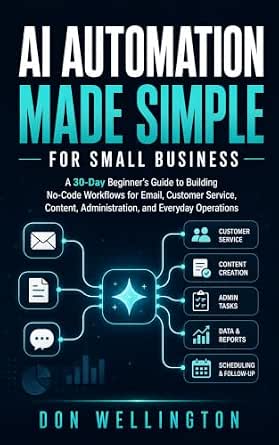 AI Automation Made Simple for Small Business: A 30-Day Beginner’s Guide to No…View on Amazon →
- 10
 AI Automation for Small Business: Simple AI Workflows for Everyday TasksView on Amazon →
- 11
 AI Automation for Small Business: A Practical Guide to Automating Marketing,…View on Amazon →
- 12
 AI for Small Business, Volume I: Getting Started — Set It Up Yourself, No Tec…View on Amazon →
- 13
 AI for Small Business: From Marketing and Sales to HR and OperationsView on Amazon →
- 14
 AI Automation for Small Businesses: Build Semi-Passive Income Systems Without…View on Amazon →
- 15
 AI for Entrepreneurs and Small Business Owners: How to Compete with Larger Bu…View on Amazon →
Choosing a Guide Before Automating
The distinction between learning about automation and buying automation software matters for owners budgeting time and money. A book can suggest ways to rethink repetitive work, but implementing a process still requires selecting and configuring the relevant AI and business applications. The roundup does not establish that any of its titles include software access or that following a guide will produce particular savings.
For a small business, a mismatch between a guide and the real task can lead to wasted effort. The source recommends starting with a recurring process that consumes time, documenting how it currently works, and matching the learning resource to that need. It also urges owners to account for human review when automated outputs affect customers, business records, or sensitive information.
Products Worth Considering

Logitech MX Mechanical Wireless Illuminated Keyboard, Tactile Quiet, Graphite

HP LaserJet M234sdw Monochrome Laser Printer All-in-One

Dell UltraSharp U4025QW 40-Inch Curved 5K2K WUHD LED Monitor
As an affiliate, we earn on qualifying purchases.
How the 15 Books Were Compared
The source frames its list as a comparison of book-based learning paths, not a ranking of automation apps. It says the available information was limited, so it used each title’s stated audience, format, and topics to infer its likely focus. That means labels such as “beginner-friendly” or “broad coverage” are characterizations based on those signals, not independently confirmed assessments of every chapter.
Its main comparison is between wide-ranging guides and more focused approaches. The former appear to address several business functions; the latter signal a no-code route, a plan, or an emphasis on ChatGPT. The source’s central caveat is that title-level information cannot verify specific instructions, integrations, or outcomes.
““These are learning resources, not automation platforms.””
— ThorstenMeyerAI.com
What the Roundup Cannot Verify
The supplied material does not include publication dates for the individual books, prices, editions, author details, sample chapters, or a full description of each title. It also does not verify which AI services, integrations, or setup steps the books cover, whether their instructions remain current, or whether readers achieved the outcomes implied by their titles. The source says these details should be checked against book descriptions, sample pages, and software providers.
It is also unclear from the material how the 15 books were independently reviewed beyond the stated title-based criteria. The “best overall” designation is the roundup’s judgment, not a finding supported here by reported testing or measured business results.
Checks to Make Before Buying
Readers can compare the books’ current descriptions and sample pages, then check whether the indicated learning style matches their needs and technical confidence. Before acting on a workflow, owners should list the business software they already use and confirm compatibility with the relevant providers rather than assuming an AI tool will connect automatically.
The source also recommends defining approval rules for customer-facing messages and other sensitive outputs before putting an automated process into use. The next practical step is to select one repetitive task, document its current steps, and evaluate whether a guide offers enough detail to support a small, reviewable trial. The roundup provides no launch schedule or further testing results.
Key Questions
Are these 15 AI automation tools software products?
No. ThorstenMeyerAI.com describes the picks as books and learning resources that teach automation concepts. Readers still need to select and configure the software used to run workflows.
Which book does the roundup rank highest?
The roundup’s best overall pick is AI Automation for Small Businesses: A Practical Guide to Automating Marketing, Sales, Customer Service, Operations, and Everyday Work. That assessment is based on its stated broad scope, not reported software testing or measured results.
Which options are presented as beginner-friendly?
The source points to AI Automation Made Simple for Small Business for its no-code framing and to titles that signal a beginner plan or structured learning path. It cautions that titles alone cannot confirm how detailed the instructions are.
Will these books work with my business software?
The supplied material does not confirm compatibility with particular email, calendar, customer database, payment, or task-management services. Check the book’s description and verify integration details with the relevant software provider.
What should a small business automate first?
The source recommends identifying a frequent, time-consuming task, documenting its existing steps, and choosing a guide that matches that process. Set human review rules before automating customer-facing or sensitive work.
Source: ThorstenMeyerAI.com