🔍 Read the full analysis: When Nearly Everyone Farmed, Work Looked Different on ThorstenMeyerAI.com

Get business pricing on office and shipping supplies
- Business-only prices and quantity discounts
- Tax-exempt purchasing
- Multiple users, one account, clear invoices
TL;DR
A November 3 article from ThorstenMeyerAI.com examines how farming’s share of work fell over two centuries as tools, fertilizer and crop breeding increased output. It reports that about 928 million people still work in agriculture worldwide, while a forecast that automation could reach 90% of a sector is the author’s thesis, not an established outcome.
Thorsten Meyer published the second installment of his Work After Work series on November 3, tracing how farming shifted from the main source of employment in many societies to a small share of the workforce in countries including the United States. The account links that change to successive advances in tools, fertilizer and crop breeding, and argues that farming offers a historical case study for debates about automation and work.
Meyer cites an estimate by economic historian Stanley Lebergott, published by the U.S. Census Bureau, that 1.4 million of the 1.9 million people in the American labor force in 1800 worked in agriculture: 73.7%. The series covers people aged 10 and older and includes about 530,000 enslaved people. Because the figures before 1840 are estimates rather than census counts, Meyer describes the proportion as roughly three in four. Today, he says, fewer than two in every hundred U.S. workers are farmers.
The historical examples extend beyond the United States. Meyer cites economic historians’ estimates that about 85% of Japan’s gainfully occupied population worked in the primary sector in 1872, and official figures showing agriculture and forestry accounted for 43.4% of German workers in 1882. China’s official series recorded 83.5% in the primary sector in 1952; India’s 1951 census counted cultivators and agricultural laborers as 69.7% of workers. These measures are not identical: some include forestry and fishing, and the underlying sources differ.
The article describes agricultural change as a sequence rather than a single invention. It points to John Deere’s steel plough, made in 1837, and to fertilizer made possible by industrial ammonia synthesis. It also discusses short-straw wheat associated with the Green Revolution. India’s wheat harvest rose from 12.3 million tonnes in 1964-65 to 26.4 million tonnes in 1971-72, according to figures cited by Meyer. He reports that global cereal production grew 4.2-fold from 1961 while population grew 2.7-fold, and that U.S. farm output in 2023 was nearly three times its 1948 level with only a small increase in total inputs.
Rising Output, Fewer Farm Workers
The account challenges the assumption that a declining farming workforce necessarily means less food. Meyer points to growing cereal harvests and U.S. output as evidence that agricultural production can rise even as fewer people work directly on farms. The distinction matters because employment shares alone do not show how much a sector produces or how its productivity changes.
Farming’s history also offers a concrete reference point in discussions about automation elsewhere. The transformation took place over generations, and it involved technical, biological and chemical changes, not just machines replacing workers. Meyer argues that the experience can inform how readers think about businesses and future employment. That application is interpretation, not a measured forecast about how quickly other sectors will change.
The transition also did not happen uniformly. Meyer cites about 928 million agricultural workers worldwide, roughly one in four workers, using an International Labour Organization estimate for 2025. He gives agriculture’s employment share as 43% in India, about 1.5% in the United States and about 1% in Germany. The figures underline the difference between countries and the fact that farming remains a major source of work globally.
Products Worth Considering

Dell XPS 13 9350 Copilot+ Laptop, 13.4-inch 120Hz Display, Intel Core Ultra 7 256V, 16GB RAM, 512GB SSD, Ubuntu Linux 24.04 LTS

Samsung 27-inch Odyssey G5 QHD Gaming Monitor (G51F)

Logitech MX Keys S Wireless Keyboard, Graphite
As an affiliate, we earn on qualifying purchases.
From Muscle to Modern Agriculture
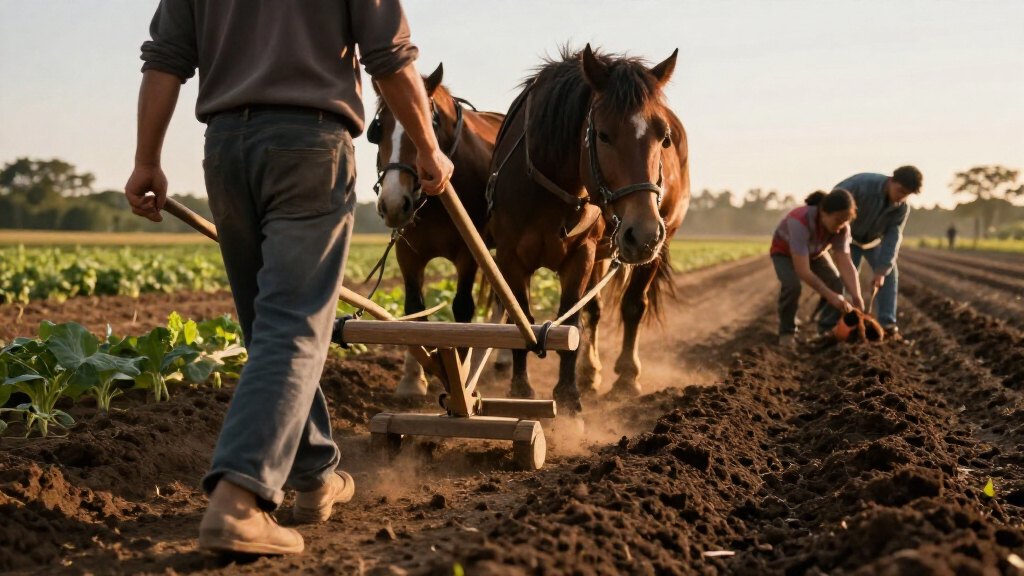
Before high-yield seeds, synthetic fertilizer and mechanized equipment, the account says, food production depended heavily on human and animal labor. Hand tools, draft animals and weather limited what a household could grow. A large share of the population therefore had to produce food rather than work in manufacturing or services.
Meyer highlights several stages in the change. Deere & Company dates its steel plough to 1837; the polished steel helped shed sticky soil that clung to earlier ploughs. In 1908, chemist Fritz Haber filed a patent for synthesizing ammonia from its elements, a process later developed for industrial production. In the 1960s, breeders associated with Norman Borlaug helped introduce dwarf wheat to India and Pakistan. Its shorter, sturdier stalks could support more grain, especially when combined with fertilizer and irrigation, according to the Nobel Foundation material cited by Meyer.
The article also cautions against reading a falling percentage as an immediate fall in the number of farm workers. In the United States, Meyer says, the number continued rising until about 1910, when it reached 11.8 million. In Germany, the agricultural share fell from 43% to 25% between 1882 and 1939 while the number of farm workers remained between 8 million and 10 million. The shift in employment shares came before the absolute headcount decline.
“The share fell long before the headcount.”
— Thorsten Meyer, author of the article
Limits of the Historical Comparisons
Several early employment figures are historical estimates, not direct counts. The U.S. series before 1840 is estimated, Japan’s 1872 figure is a reconstruction, and the German 1882 census is described as undercounting women who helped on family farms. Country comparisons also use differing definitions: some figures cover the broader primary sector, while others count agricultural occupations more narrowly.
The article’s projections should be kept separate from its historical data. Meyer’s suggestion that automation could reach as much as 90% of a sector within a decade or a few decades is explicitly presented as his thesis. The source does not specify a particular sector, a method for measuring that share, or evidence that establishes the timeline. It also does not detail exactly how former farm workers moved into other occupations in each country.
The supplied source ends during its discussion of industrial ammonia production, so it does not provide a complete account of that process or all subsequent developments. The production and employment statistics are attributed to sources in Meyer’s article, but their underlying datasets and definitions are not reproduced in full here.
The Series Turns to Machinery
Meyer’s article identifies the next installment, Episode 3, as a look at mechanical reapers, threshers and tractors. That episode is intended to continue the series’ account of how farming changed from labor-intensive work to higher-output production with fewer workers.
The broader question raised by this installment is how far farming’s experience can be applied to other sectors. The historical pattern is documented in the article, but the speed and scale of future automation remain uncertain. Readers can distinguish the series’ next historical topic from its larger thesis: the former concerns machinery’s role on farms, while the latter is a forecast about possible future changes in work.
Key Questions
How many Americans worked in agriculture around 1800?
The U.S. Census Bureau’s historical series, based on estimates by Stanley Lebergott, puts the share at 73.7%: about 1.4 million of a 1.9 million labor force. The pre-1840 figures are estimates, and the labor-force measure includes enslaved people.
Why did farming require so many workers?
According to Meyer’s account, food production relied on human and animal muscle, hand tools and the weather. Those limits meant most people had to work on the land to produce enough food.
No. Meyer says the U.S. farm-worker count continued to rise until about 1910, reaching 11.8 million. A sector’s share of all workers can fall before its absolute workforce shrinks.
How many people work in agriculture worldwide?
Meyer cites an International Labour Organization estimate for 2025 of 928 million people, or about one in four workers worldwide. The article also reports substantially different national shares, including 43% in India and about 1.5% in the United States.
Is the prediction that automation could reach 90% confirmed?
No. Meyer presents that possibility as his thesis, not as a confirmed projection. The article’s historical examples do not establish which sectors might reach that level or when.
Source: ThorstenMeyerAI.com