
📊 Full opportunity report: The City That Watches Itself: The Living Digital Twin, And The God’s-Eye View We’re Building on ThorstenMeyerAI.com — validation score, market gap, and execution plan.
TL;DR
Urban areas are building real-time, dynamic digital twins that integrate sensors, satellite data, and AI to monitor and simulate city functions. This development enhances planning but also raises privacy and sovereignty issues.
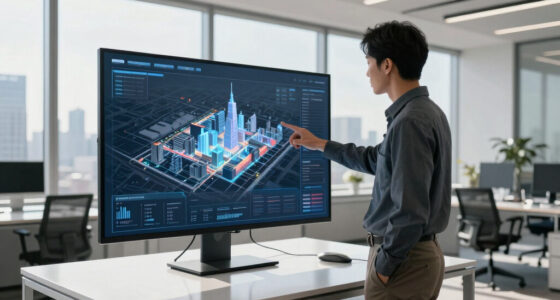
Multiple cities worldwide are now deploying living digital twins—dynamic, real-time virtual replicas of urban environments that integrate sensor data, satellite imagery, and AI analysis. These models allow city officials to monitor, simulate, and question their urban areas with unprecedented precision, transforming governance and planning.
The concept of digital twins has evolved from static maps to live, data-driven models capable of real-time updates. Cities like Singapore, Helsinki, and Las Vegas have launched operational versions that incorporate data from IoT sensors, satellite feeds, and underground mapping. These models can predict traffic flows, optimize utility management, and simulate environmental impacts.
Recent technological advancements, particularly in Wide-Area Motion Imagery (WAMI) and all-weather radar, enable continuous, comprehensive monitoring of city movements and activities, archived for analysis and rewind. When fused with advanced AI capable of understanding complex data, these models become interactive tools—allowing officials to ask natural language questions about city operations or simulate emergency scenarios.
However, this technological convergence raises concerns about surveillance and sovereignty. The same tools that improve urban planning can also serve as instruments of oversight, raising questions about privacy, data control, and external influence, especially when models rely on foreign AI systems.
The city that watches itself: the living digital twin, and the god’s-eye view we’re building
Soon most cities will exist twice — once in concrete, once as a live data model you can rewind, simulate, and question in plain language. Persistent sensing + frontier AI turn the planner’s digital twin into an oracle. The most useful thing we’ve built — and the most powerful surveillance instrument. Both at once.
- Plan better — cities & rural: traffic, zoning, energy, land use
- Emergency response — route crews, one live picture, ~50% faster
- Disaster resilience — simulate, track live, assess damage in hours
- Mass surveillance — track everyone, retroactively, forever
- Pattern-of-life — AI links movements, infers associations
- Social control — no warrant, no suspicion (cf. Baltimore, 2021 ruling)
We’re building a city that watches itself, remembers everything, and can be asked anything. The technology won’t choose between saving lives and ending privacy — we will, through the rules we write now, while the twin is still under construction and the defaults haven’t yet hardened into permanence. WAMI and the living twin open our lives to a view from the heavens that, from the dawn of civilization until a heartbeat ago, was reserved for gods and stars. The question is no longer whether we can see everything — it’s who gets to look, and who watches the watchers.
Implications of Self-Monitoring Urban Digital Twins
The development of self-watching digital twins offers potential benefits such as enhanced urban management, improved emergency response, and resource efficiency. Nonetheless, it also introduces considerations related to privacy, surveillance, and sovereignty. Urban authorities should evaluate these technologies carefully to balance benefits with potential risks and establish appropriate governance frameworks.

Meshnology LoRa ESP32-S3 Board – 915MHz W10 AIOT Dev Kit with GPS Blue Tooth WiFi AI Meshtastic LoRaWAN Ar duino Compatible Perfect for Starter Maker Smart City Industrial Control Application
Ultra-Powerful Processing: The W10 Development Board Kit is powered by the 32-bit LX7 dual-core processor with a clock…
As an affiliate, we earn on qualifying purchases.
As an affiliate, we earn on qualifying purchases.
Evolution of Urban Digital Modeling and Sensor Technologies
The concept of digital twins originated as static digital representations for urban planning, exemplified by Singapore’s Virtual Singapore launched after 2012 flooding. Recent advances in sensor technology, such as WAMI and all-weather radar, have expanded these models into live, continuous systems. The development of AI capable of processing diverse data sources has enabled natural language interaction and predictive capabilities. This progress has facilitated the deployment of operational city twins, transforming urban governance from reactive to proactive management.
“The integration of sensors, AI, and real-time data allows for a comprehensive understanding of urban environments, enabling more informed decision-making.”
— Thorsten Meyer, AI researcher

Geodesign, Urban Digital Twins, and Futures
As an affiliate, we earn on qualifying purchases.
As an affiliate, we earn on qualifying purchases.
Unresolved Issues in Digital Twin Deployment and Governance
Questions remain regarding the widespread adoption of digital twins, particularly concerning privacy protections, data sovereignty, and security vulnerabilities. The reliance on external AI systems raises considerations about control over critical infrastructure. Regulatory frameworks are still evolving, and there is an ongoing need to address potential misuse or external interference.

Deep Learning for Satellite Imagery with Python: End-to-End Workflows for Image Analysis, Object Detection, and Change Monitoring
As an affiliate, we earn on qualifying purchases.
As an affiliate, we earn on qualifying purchases.
Next Steps in Urban Digital Twin Development and Regulation
Further deployment and refinement of digital twin technologies are expected, with expansion into rural areas and infrastructure networks. Regulatory bodies are working to establish standards related to privacy, security, and sovereignty. International cooperation and governance frameworks are likely to be discussed as these systems become integral to urban management and security.

The AI Revolution in Project Management: Elevating Productivity with Generative AI
As an affiliate, we earn on qualifying purchases.
As an affiliate, we earn on qualifying purchases.
Key Questions
What exactly is a digital twin in a city?
A digital twin is a virtual, data-driven replica of a city that integrates real-time information from sensors, satellites, and other sources to monitor, simulate, and analyze urban systems.
How do digital twins improve city planning?
They enable planners to simulate changes, forecast outcomes, and optimize resource allocation before implementing physical modifications, thereby supporting more informed decision-making.
What are the privacy concerns associated with digital twins?
Since these models can track individual movements and behaviors, there are potential risks related to surveillance and data security, especially when external AI systems are involved.
Are digital twins vulnerable to hacking?
As interconnected digital systems, they could be targets for cyberattacks, which might disrupt city functions or compromise sensitive data. Implementing appropriate security measures is essential to mitigate these risks.
Will this technology be available to all cities?
While adoption is increasing, factors such as cost, technical capacity, and infrastructure may limit accessibility for some cities, potentially leading to disparities in digital governance.
Source: ThorstenMeyerAI.com