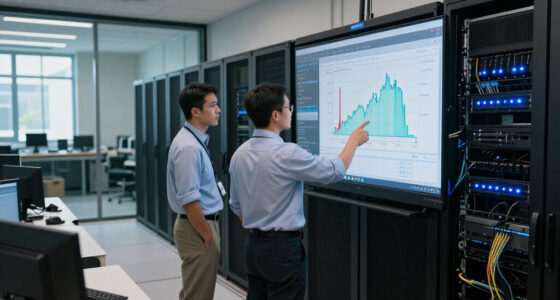

📊 Full opportunity report: How Energy Constraints Could Slow Down AI Breakthroughs on ThorstenMeyerAI.com — validation score, market gap, and execution plan.

Get business pricing on office and shipping supplies
- Business-only prices and quantity discounts
- Tax-exempt purchasing
- Multiple users, one account, clear invoices
TL;DR
Despite significant investments in AI infrastructure, energy capacity constraints—particularly in power generation and grid capacity—may slow AI breakthroughs by 2030. The bottleneck is not money but physical infrastructure, especially in the US and China.
Energy capacity constraints are increasingly seen as a key factor that could slow down AI advancements by 2030, despite large investments in AI infrastructure. Experts warn that the physical limitations of power generation and grid capacity may become the primary bottleneck, impacting the ability to scale AI systems rapidly.
Data-center electricity consumption is projected to nearly double from 485 TWh in 2025 to 950 TWh by 2030, with AI-focused facilities growing four times faster than other sectors. However, the critical constraint lies in power capacity, measured in gigawatts, which determines whether new data centers can be connected to the grid. Global data-center capacity is expected to reach approximately 290 GW by 2030, up from 132 GW in 2026, but the infrastructure to support this expansion faces significant physical and permitting delays.
In the United States, the interconnection queue alone holds projects totaling around 2,300 GW, with wait times of about five years. This mismatch between demand and physical capacity is compounded by aging infrastructure, with over half of US coal plants predating 1980. Despite the high level of investment—estimated at $650 billion by major tech firms—actual capacity buildout is constrained by the ability to manufacture transformers, permit new transmission lines, and interconnect new power generation.
Meanwhile, China has deployed nearly ten times the new power capacity of the US in 2025, with over 543 GW added compared to about 55 GW in the US. China’s faster deployment and lower power costs give it an advantage in powering AI infrastructure, while US export controls on advanced chips limit China’s AI compute capabilities. The geopolitical race is thus centered on power generation capacity and chip technology, not just AI models or investments.
For three years AI was a chip story. It quietly stopped being the binding constraint — the way it always does in a physical build-out, from the clever thing to the boring thing underneath.
When someone says AI is “only 3% of electricity,” they’re quoting consumption to make it sound modest. Capacity is where the bottleneck bites.
Impact of Energy Limitations on Global AI Development
This energy infrastructure bottleneck could slow the pace of AI breakthroughs, especially in the US and China, which are competing for dominance. Limited grid capacity and aging infrastructure threaten to delay the connection of new data centers, constraining the growth of AI capabilities. The race for AI supremacy is increasingly dependent on physical energy resources and infrastructure, making energy policy and grid modernization critical to future AI progress.
high capacity power transformers for data centers
As an affiliate, we earn on qualifying purchases.
As an affiliate, we earn on qualifying purchases.
Energy Infrastructure and Geopolitical Competition in AI
For the past three years, the focus in AI has been on chip hardware, with the US leading in advanced semiconductor technology. However, this emphasis is shifting toward energy capacity, as the physical infrastructure to power AI systems becomes the new bottleneck. China has aggressively expanded its power generation capacity, adding nearly 543 GW in 2025 alone, while the US has added about 55 GW. Despite high investment levels—over $650 billion committed by US tech giants—building and permitting new power infrastructure remains slow, with long interconnection queues and aging plants hampering progress.
This shift underscores a structural asymmetry: the US leads in chip technology but faces energy supply limitations, whereas China leads in power generation but is constrained by chip technology and export controls. The outcome of this competition may hinge on which side can overcome their respective infrastructure bottlenecks first.
"The bottleneck is no longer chips but electrons. The physical capacity to generate and transmit power is now the critical constraint for AI scaling."
— Thorsten Meyer
industrial-grade transmission line components
As an affiliate, we earn on qualifying purchases.
As an affiliate, we earn on qualifying purchases.
Uncertainties in Infrastructure Buildout and Geopolitical Dynamics
It remains unclear how quickly governments and industries can overcome permitting, manufacturing, and aging infrastructure challenges. The exact timeline for resolving the power capacity gap and its impact on AI development is still uncertain, especially given geopolitical tensions and supply chain constraints.
energy-efficient data center cooling systems
As an affiliate, we earn on qualifying purchases.
As an affiliate, we earn on qualifying purchases.
Next Steps in Addressing Energy Bottlenecks for AI
Efforts are expected to focus on accelerating grid modernization, increasing power generation capacity, and streamlining permitting processes. Monitoring developments in US and Chinese power infrastructure expansion, as well as policy responses, will be critical in assessing how these bottlenecks evolve and influence AI progress over the next few years.
power grid capacity expansion equipment
As an affiliate, we earn on qualifying purchases.
As an affiliate, we earn on qualifying purchases.
Key Questions
Why is power capacity more critical than energy consumption for AI growth?
Power capacity, measured in gigawatts, determines whether data centers can be connected to the grid at peak times. Without sufficient capacity, even high investment levels cannot translate into operational AI infrastructure, creating a physical bottleneck.
How does aging infrastructure affect AI development?
Many US power plants and transmission lines are decades old, which complicates upgrades and new connections. This delays the deployment of new data centers needed for AI scaling.
What is the significance of China's power capacity growth?
China’s rapid expansion of power generation capacity gives it a competitive edge in powering AI infrastructure, enabling faster deployment and lower costs compared to the US.
Could energy constraints cause a global slowdown in AI progress?
Yes, if infrastructure buildout does not keep pace with demand, particularly in key regions like the US and China, it could slow down the rate of AI breakthroughs and deployment.
Source: ThorstenMeyerAI.com
Halloween Picks
halloween
As an affiliate, we earn on qualifying purchases.