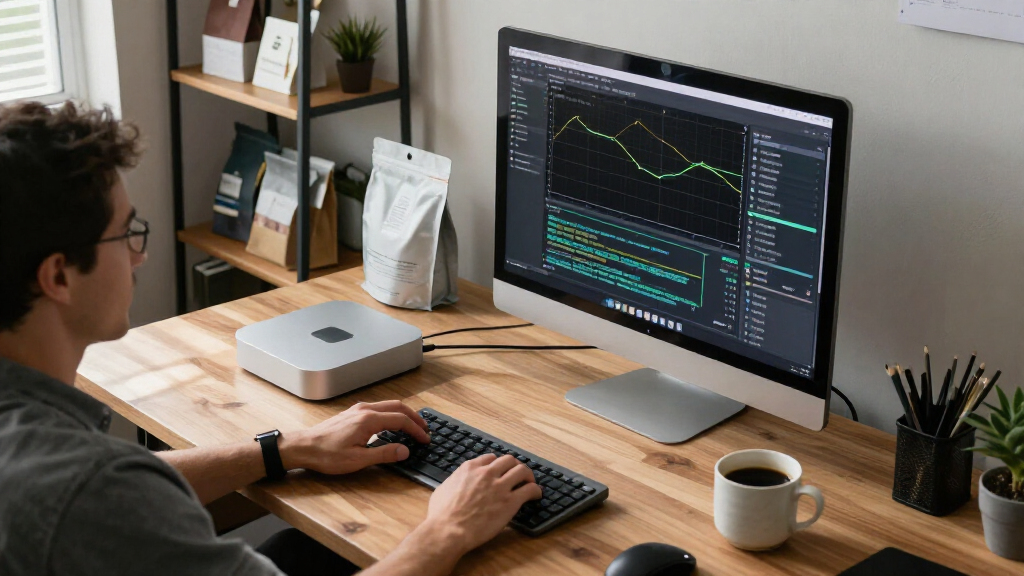

🔍 Read the full analysis: A Mac Mini For Local AI: Models, Memory, And Tradeoffs on ThorstenMeyerAI.com

Get business pricing on office and shipping supplies
- Business-only prices and quantity discounts
- Tax-exempt purchasing
- Multiple users, one account, clear invoices
TL;DR
Apple is promoting the Mac mini as a desktop for always-on AI agents, and its unified memory can run some open models locally. A model’s memory needs, the system’s available capacity and the Mac’s lower bandwidth than a data-center GPU limit what fits and how quickly it responds.
Apple is marketing its Mac mini as “the leading desktop for always-on agentic computing,” putting local AI among the computer’s central uses. The machine’s shared unified memory lets its GPU access a relatively large pool of system memory, but which models run depends on configuration, context length and the memory left for macOS and other apps.
Apple’s current Mac mini options, as listed on its U.S. site on November 16, 2026, range from an M6 configuration with 16 GB of unified memory for $899 to an M5 Pro model with 64 GB for $3,199. The M6 can be configured with up to 32 GB; the M5 Pro with up to 64 GB. These are list prices for the cited configurations, not a comparison of total ownership costs.
Published model requirements show what those capacities may accommodate. Google lists its Gemma 4 12B model at 6.7 GB at 4-bit precision, and its 31B model at 17.5 GB at 4-bit. The 31B model’s listed requirement rises to 34.9 GB at 8-bit and 69.9 GB at 16-bit, so the highest-precision version exceeds the largest Mac mini’s 64 GB before accounting for the operating system, apps or context.
OpenAI says its gpt-oss-20b runs within 16 GB of memory. By contrast, it sizes gpt-oss-120b for a single 80 GB GPU. These published figures are model-specific guidance, not guarantees of a particular speed or user experience on a Mac mini. Actual capacity for a model’s context and other software will be lower than the machine’s headline memory total.
Memory Sets the Local AI Ceiling
The Mac mini’s appeal is that a local model can run without sending each prompt to a cloud service. That can keep data on the computer, allow offline use and avoid per-token charges from an external model provider. Apple also describes the computer as suitable for agents that wait for work; the source material reports a 4-watt idle figure, though that figure should not be read as power use during active AI processing.
Those benefits come with a performance and capacity trade-off. Apple lists memory bandwidth of 153 to 170 GB/s for M6 configurations and 307 GB/s for M5 Pro. Nvidia specifies 3.35 TB/s for the H100 SXM, roughly 11 times the M5 Pro’s listed bandwidth. Bandwidth is one factor in how quickly a model can generate text, not a complete benchmark: results also depend on the model, software, precision and workload.
For readers choosing hardware, memory is not merely a general-purpose upgrade. It can determine whether a desired model fits at all, while added context and concurrent applications consume further capacity. A lower-cost model may therefore be sufficient for smaller quantized models, while a larger configuration costs more without matching the memory capacity or bandwidth of a data-center GPU.
Products Worth Considering

Dell UltraSharp U2724DE 27-Inch WQHD IPS Black Monitor

Dell XPS Tower 8960 Desktop, Intel Core i7-13700, NVIDIA GeForce RTX 4060, 16GB DDR5, 512GB SSD

Dell UltraSharp U4025QW 40-Inch Curved 5K2K WUHD LED Monitor
As an affiliate, we earn on qualifying purchases.
AI models store learned values called weights, which must be available while the model generates a response. Apple’s MLX documentation says its processors use a unified memory architecture in which the CPU and GPU access the same pool. This differs from a common PC arrangement where a graphics card has its own memory, which can constrain a model if its weights do not fit there.
That design makes the Mac mini’s full memory pool relevant to local AI, but the pool is shared with macOS and other applications. Google says its Gemma memory estimates cover static model weights and that larger context windows require significantly more memory. A model that loads successfully may still have less room for long documents, extended conversations or other running software.
Apple’s August announcement followed a supply warning reported in April. On an April 30 earnings call, CEO Tim Cook said demand recognition for the Mac mini and Mac Studio as AI platforms was happening faster than Apple had predicted, according to MacRumors. The available material does not establish how that demand or supply situation has changed since the announcement.
““the leading desktop for always-on agentic computing””
— Apple, in its August 25, 2026 Mac mini announcement
Real-World Performance Still Varies
The cited material does not provide standardized, side-by-side benchmarks for the listed Gemma or OpenAI models running on each Mac mini configuration. Memory estimates indicate whether weights may fit; they do not establish generation speed, response quality or the best configuration for a particular task. The effect of quantization on quality also depends on the model and workload.
It is also unclear how much memory a given agent will need in practice once its context, tools and other apps are included. Apple says Thunderbolt 5 can be used to cluster Mac minis to run larger models on-device, but the material does not specify cluster performance, setup requirements or cost. The 4-watt idle figure likewise does not describe energy use while the computer is actively running a model.
Check Configuration and Workload
Anyone considering a Mac mini for local AI should match the intended model’s published memory requirements to the exact configuration, leaving headroom for macOS, applications and context. Prices and specifications in this report reflect Apple’s U.S. listings on November 16, 2026, and may change. The source material gives no scheduled follow-up announcement or benchmark release; real-world comparisons would help clarify speed and practical capacity across configurations.
Key Questions
Can the base 16 GB Mac mini run AI models locally?
Published figures suggest some smaller models may fit: Google lists Gemma 4 12B at 6.7 GB at 4-bit precision, and OpenAI says gpt-oss-20b runs within 16 GB. Those figures do not leave 16 GB entirely available for model weights, since macOS, apps and context also need memory.
Which Mac mini has the most memory?
The M5 Pro Mac mini can be configured with up to 64 GB of unified memory, according to Apple’s U.S. listings dated November 16, 2026. The cited top configuration costs $3,199 and includes 1 TB of storage.
Does a model that fits necessarily run quickly?
No. Fitting the model is different from generating responses quickly. Memory bandwidth is one relevant factor: Apple lists up to 307 GB/s for the M5 Pro, compared with Nvidia’s 3.35 TB/s specification for the H100 SXM. Those figures are hardware specifications, not direct performance tests of the same model.
Can the largest open models run on one Mac mini?
Not all of them. OpenAI sizes gpt-oss-120b for a single 80 GB GPU, while the largest Mac mini configuration in the cited lineup has 64 GB. Apple says Thunderbolt 5 can cluster multiple Mac minis for larger on-device models, but no cluster performance figures are provided here.
Source: ThorstenMeyerAI.com