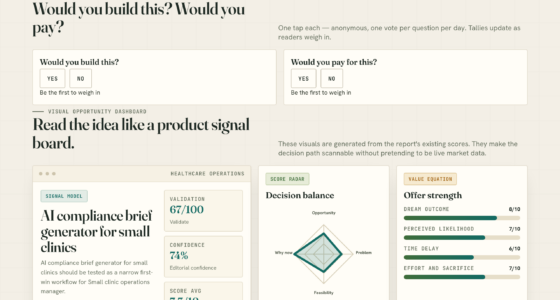

📊 Full opportunity report: World Model Readiness: Are You Ready for AI That Acts? on ThorstenMeyerAI.com — validation score, market gap, and execution plan.

Get business pricing on office and shipping supplies
- Business-only prices and quantity discounts
- Tax-exempt purchasing
- Multiple users, one account, clear invoices
TL;DR
AI is shifting from models that describe to those that predict and act. A new diagnostic tool measures organizational readiness for this transition, which has significant implications for AI deployment and safety.
Major AI research efforts and industry initiatives are now focused on building and deploying world models—AI systems capable of predicting environmental changes and taking actions, not just generating language or images. A new diagnostic tool, World Model Readiness, has emerged to evaluate whether organizations are prepared for this shift, which could significantly alter AI deployment and safety considerations.
Since late 2024, industry leaders such as Yann LeCun, Google DeepMind, Meta, Nvidia, and Waymo have announced or launched projects aimed at developing world models—AI systems that understand and predict the dynamics of real-world environments. These models go beyond language prediction to simulate physical, visual, and operational changes, enabling AI to predict consequences and act autonomously.
Yann LeCun’s startup, Advanced Machine Intelligence (AMI Labs), raised approximately billion dollars to focus on world models, highlighting the significant investment and interest in this area. Meanwhile, DeepMind’s Genie 3 can generate photorealistic 3D worlds from prompts in real time, marking a step toward production-ready environment modeling.
Despite rapid progress, experts acknowledge that current systems are data- and compute-intensive, with notable limitations in physical reasoning and real-world applicability. The reality gap—the difference between simulation and messy real-world deployment—remains a critical challenge. The World Model Readiness diagnostic is designed to evaluate whether organizations possess the necessary data, processes, and oversight to adopt such systems safely and effectively.
World Model Readiness — are you ready for AI that acts?
LLMs describe. World models predict and act. The next AI shift isn’t “have we adopted a chatbot” — it’s whether you’d know what to do with a model that anticipates consequences.
Independent commentary, produced with AI assistance under human editorial oversight. The views are the author’s own and may change. World Model Readiness is an early, positioning-stage diagnostic — an assessment framework, not a prediction, guarantee, or technical advice; its conclusions depend on the framework’s assumptions. “World models” are an emerging, rapidly-evolving area of AI; statements about the field reflect publicly reported developments as of mid-2026 and may quickly date. References to companies, labs, and products describe public reporting and imply no affiliation, endorsement, or verification. Product, model, and company names are trademarks of their respective owners.
Implications of Transitioning to Action-Oriented AI
The shift toward AI that predicts and acts could transform industries by enabling autonomous decision-making in complex environments. However, it introduces new safety, oversight, and operational challenges. Organizations unprepared for this transition risk deploying systems that may act unpredictably or cause harm, underscoring the importance of assessing readiness before adoption.
The diagnostic tool helps organizations identify gaps in data, process modeling, supervision, and calibration, preventing premature deployment and ensuring safer integration of world models into real-world operations. This transition could redefine AI’s role from suggestion to autonomous action, impacting safety standards, regulatory approaches, and operational efficiency.
As an affiliate, we earn on qualifying purchases.
Rapid Industry Shift Toward Autonomous Environment Modeling
Over the past year, major AI labs and tech companies have announced significant investments and breakthroughs in world modeling. Yann LeCun’s departure from Meta to launch AMI Labs, and the release of Genie 3 by DeepMind, exemplify this momentum. These efforts aim to create AI systems capable of understanding and predicting complex physical and visual environments, moving beyond language-centric models.
While promising, these developments are still early, with current models heavily reliant on large datasets and computational resources. The performance limitations and the persistent reality gap highlight that widespread deployment in real-world settings remains a challenge. The focus now is on assessing organizational readiness to safely adopt these technologies as they mature.
“The move from descriptive to predictive and action-oriented models marks a fundamental shift that organizations must prepare for now.”
— Thorsten Meyer, AI researcher
As an affiliate, we earn on qualifying purchases.
Uncertainties About Practical Deployment and Safety
It remains unclear how quickly and reliably current world models will overcome challenges like the reality gap, data requirements, and safety concerns. The diagnostic tool can identify readiness gaps, but whether organizations can effectively address these issues in time is still uncertain. Additionally, regulatory and ethical frameworks for autonomous actions are still evolving.
real-world environment simulation software
As an affiliate, we earn on qualifying purchases.
As an affiliate, we earn on qualifying purchases.
Next Steps for Organizations and Industry Stakeholders
Organizations should begin using World Model Readiness diagnostics to evaluate their current capabilities and identify gaps. Industry groups and regulators are likely to develop standards for safe deployment of autonomous, action-capable AI systems in the coming months. Continued research and collaboration will be essential to bridge the remaining technical and safety challenges before widespread adoption occurs.
AI safety and deployment diagnostics
As an affiliate, we earn on qualifying purchases.
As an affiliate, we earn on qualifying purchases.
Key Questions
What is a world model in AI?
A world model is an AI system that builds an internal representation of an environment, enabling it to predict how it will change in response to actions, rather than just describing or generating content.
Why is organizational readiness important now?
As AI systems evolve from descriptive to predictive and autonomous, organizations need to assess their data, processes, and safety measures to ensure safe and effective deployment, avoiding unintended consequences.
What are the main challenges in deploying world models?
Key challenges include the reality gap between simulation and real-world complexity, high data and compute requirements, and developing oversight and safety protocols for autonomous actions.
How can organizations prepare for this shift?
Organizations should evaluate their current data infrastructure, process modeling capabilities, supervision systems, and calibration methods using readiness diagnostics, and stay informed about evolving safety standards.
When might we see widespread adoption of action-capable AI?
While progress is rapid, widespread deployment depends on overcoming technical challenges and establishing safety standards. Industry experts suggest this could be several years away, with ongoing assessments guiding the pace.
Source: ThorstenMeyerAI.com
Columbus Day / Indigenous Peoples' Day Picks
long weekend sales
As an affiliate, we earn on qualifying purchases.