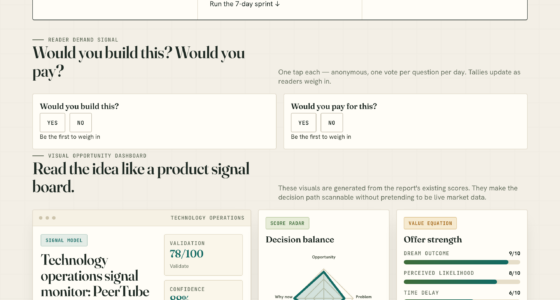
📊 Full opportunity report: The Local-First Agentic Operator on ThorstenMeyerAI.com — validation score, market gap, and execution plan.

Get business pricing on office and shipping supplies
- Business-only prices and quantity discounts
- Tax-exempt purchasing
- Multiple users, one account, clear invoices
TL;DR
A new approach demonstrates that one person, empowered by agentic AI, can develop and operate diverse software portfolios previously requiring entire organizations. This shift redefines software creation and management.
Recent developments reveal that a single operator, utilizing agentic AI, has constructed and manages an 18-product portfolio across diverse domains, challenging the notion that such scale requires a company. This shift highlights a new model of software creation, where individual effort, supported by AI, can match organizational scale and complexity, with significant implications for the future of software development and operational autonomy.
The portfolio includes products spanning content engines, decision tools, open-source intelligence analyzers, and regulated systems, all built under a unified local-first and provider-agnostic philosophy. These tools are designed to run on owned hardware and self-hosted, avoiding dependence on third-party cloud providers, thereby reducing fragility and control risks.
Crucially, the entire suite was created not by traditional developers but by an operator using agentic AI. This AI-assisted process allows someone without coding expertise to describe, build, and modify software, with humans guiding the AI’s output through editing and judgment. The approach emphasizes building by subtraction, removing unnecessary features and noise to focus on core functionality.
This portfolio demonstrates that a single person can now produce and manage software systems that previously required large teams, fundamentally shifting the dynamics of software creation and management.
The Local-First Agentic Operator
Eighteen products that looked like a sprawl were never eighteen things. They were one thing, built eighteen times. This is the thesis underneath all of them — named.
- Not “solo beats funded team.” Depth still wins most single contests. The narrower, truer claim: the floor moved — one person can now do what recently took many.
- Breadth is strength and risk. Eighteen products is resilience and a focus problem; several are seeds, not trees.
- The AI part is assisted, not autonomous. Strip away human judgment and subtraction and you get faster mediocrity, not a portfolio.
- A pattern, not a prescription. This fit one operator, one skill set, one moment. The honest version of any manifesto includes “this worked for me.”
A synthesis and a statement of one operator’s working philosophy — independent commentary, produced with AI assistance under human editorial oversight. The views are the author’s own and may change. This is not business, financial, legal, or technical advice, and the four-facet framing is a personal operating pattern, not a prescription or a claim of results. Individual products carry their own terms, disclaimers, and limitations in their respective articles; several are early- or positioning-stage. Product, model, and company names are trademarks of their respective owners; mention does not imply endorsement.
Implications of a Single Operator Building Complex Software
This development signals a potential shift in how software is built and maintained, reducing reliance on large organizations and enabling individuals to undertake projects at scale. It raises questions about future employment models, intellectual property, and the democratization of software creation. Additionally, the emphasis on local control and provider-agnostic systems enhances security and resilience, especially in regulated or sensitive domains.
For industries and professionals, this could democratize innovation, lower barriers to entry, and accelerate deployment cycles. However, it also introduces challenges around quality assurance, oversight, and the potential for fragmentation if such individual efforts are not coordinated or standardized.
As an affiliate, we earn on qualifying purchases.
Evolution of Solo Software Development with AI Assistance
Historically, building and maintaining complex software portfolios required large teams, extensive coordination, and organizational infrastructure. Recent advances in AI, particularly agentic AI capable of human-guided coding, have begun to challenge this paradigm. Over the past 18 days, a series of 18 products exemplifies this shift, illustrating how a single operator can produce a diverse set of tools across domains such as content management, decision-making, and intelligence analysis.
This approach is rooted in four core principles: local-first ownership, provider-agnostic flexibility, AI-assisted human editing, and subtraction-based design. The concept was first proposed as a thesis that the “unit” of software development is now the individual, amplified by AI, rather than the organization. The portfolio demonstrates this in practice, showing that the traditional scale of software production is no longer a prerequisite for complex, multi-domain systems.
“The unit isn’t ‘the startup.’ It’s ‘the person, amplified.’ This reframe is the ground everything else stands on.”
— Thorsten Meyer, source author
As an affiliate, we earn on qualifying purchases.
Unanswered Questions About Long-Term Viability
It is not yet clear how sustainable or scalable this model is over time, especially regarding quality control, security, and coordination among multiple such solo operators. The long-term implications for industry standards and job roles remain unconfirmed, and the process’s reproducibility at larger scales is still under observation.
open-source intelligence analysis software
As an affiliate, we earn on qualifying purchases.
As an affiliate, we earn on qualifying purchases.
Next Steps for Adoption and Validation
Further testing and validation are expected as more operators adopt this approach, potentially leading to new tools, standards, and best practices. Monitoring how these solo efforts integrate into broader ecosystems and whether they can maintain quality and security will be critical. Additionally, industry discussions around regulation, intellectual property, and collaboration models are likely to intensify.
As an affiliate, we earn on qualifying purchases.
Key Questions
Can a single person truly replace a large software team?
While the portfolio demonstrates significant capabilities, it remains to be seen whether individual operators can consistently match large teams in all aspects, especially for highly complex or regulated systems.
What role does AI play in this new development?
AI acts as an assistant, enabling individuals to describe, build, and modify software with minimal technical expertise, effectively amplifying their capacity without requiring traditional coding skills.
Are there risks associated with local-first, provider-agnostic systems?
Yes, potential risks include security vulnerabilities, maintenance challenges, and difficulties in standardization, which need to be managed carefully as the approach scales.
Will this approach be adopted across industries?
Its adoption depends on industry needs, regulatory constraints, and the development of supporting tools and standards. Early signs suggest strong interest in sectors valuing control and flexibility.
Source: ThorstenMeyerAI.com
Fall Picks
fall essentials
As an affiliate, we earn on qualifying purchases.