
🔍 Read the full analysis: Robots In The Factory: Uses And Possibilities on ThorstenMeyerAI.com

Get business pricing on office and shipping supplies
- Business-only prices and quantity discounts
- Tax-exempt purchasing
- Multiple users, one account, clear invoices
TL;DR
The International Federation of Robotics reported that 5 million industrial robots were operating worldwide in 2025, with China accounting for 59% of new installations. Research cited by ThorstenMeyerAI.com finds different employment effects in the United States and Germany, so robot adoption does not have one uniform effect on jobs.
Five million industrial robots were operating in factories worldwide in 2025, according to the International Federation of Robotics (IFR), as manufacturers continued to automate tasks such as handling hot metal and welding. A November 24 report by ThorstenMeyerAI.com traces that growth from General Motors’ early use of Unimate and examines why the effect on employment differs across countries and studies.
The IFR counted 5 million industrial robots in operation in 2025, 9% more than in 2024 and more than twice the total seven years earlier. Factories installed more than 600,000 robots during 2025. China accounted for 354,000 installations, or 59% of the world total. The United States installed almost 38,500, up 12%; Japan installed 36,219, down 19%; South Korea installed 30,000; and Germany installed fewer than 25,000, down 8%, the report says.
The technology’s early factory role was hazardous material handling. In 1961, a Unimate robot began unloading a die-casting press at a General Motors plant in Trenton, New Jersey, according to the IFR and The Henry Ford museum, which holds the machine. The roughly 4,000-pound robot lifted hot castings and stacked them. Robots later took on welding: the IFR says GM’s 1969 installation at Lordstown, Ohio, automated more than 90% of body welding, compared with 20% to 40% at traditional plants.
To compare adoption across economies, the IFR uses robot density: industrial robots per 10,000 manufacturing employees. Its 2024 figures, published in April 2026, put South Korea at 1,220, Singapore at 818, Germany at 449 and Japan at 446. The United States ranked eighth at 307, against a world average of 132. These figures measure robot use relative to manufacturing employment, not the number of jobs gained or lost.
Infographic 01 · Five million robots
Where the robots work
Sixty-five years after the first Unimate, five million industrial robots work in the world's factories. South Korea has by far the most per worker.
Robots per 10,000 employees in manufacturing · 2024
Where the new robots went · 2025
- China: 354,000 installed, 59% of the world total.
- United States: almost 38,500 (+12%), again the second-largest market.
- Japan 36,219 (−19%) · South Korea 30,000 · Germany fewer than 25,000 (−8%), Europe’s largest market.
Robot density = operational industrial robots per 10,000 employees in manufacturing. China (166 in 2024) is not compared here: the IFR switched to updated Chinese labour data in 2026, which changed the denominator.
Sources: IFR, robot density press release, 8 Apr 2026 (data 2024); IFR, World Robotics 2026 press release, 24 Sep 2026.
Powered by Thorsten Meyer AI
Robot Growth and Factory Jobs
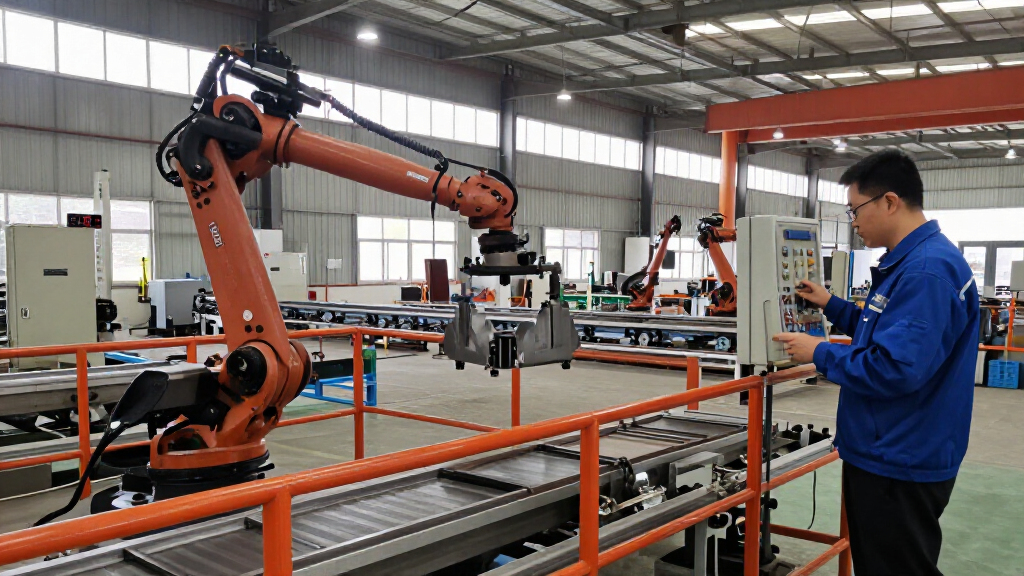
The figures show that factory automation is a large and geographically concentrated change in production. Robots can take on hot, heavy or hazardous tasks, as Unimate did, and can perform repetitive work such as spot welding. That can alter how factories are staffed and what work employees do, while raising questions about job access and displacement.
The employment evidence in the source report does not support a single global conclusion. It cites economists Daron Acemoglu and Pascual Restrepo, whose research estimated that each additional industrial robot in the United States between 1990 and 2007 displaced about 3.3 workers across the economy, or roughly 400,000 jobs in total. Those are the researchers’ estimates for a defined period, not a count of every job effect from automation or a forecast for current installations.
The report contrasts that result with Germany, where it says researchers found almost two factory jobs lost per new robot and a roughly similar number of service jobs gained, leaving the total employment effect around zero. The comparison matters because job outcomes may depend on a country’s industries, labor market and the jobs counted. The report also cautions that workers who never enter factory employment may experience automation differently from those who remain employed.
Products Worth Considering

FLEXISPOT 36-Inch Height-Adjustable Standing Desk Converter, Black

Samsung 27-Inch Odyssey G5 QHD Gaming Monitor (G51F)

Brother HL-L6210DW Monochrome Duplex Wireless Laser Printer
As an affiliate, we earn on qualifying purchases.
From Unimate to Global Factories
Industrial robots developed from an earlier idea of programmable material transfer. George C. Devol filed a U.S. patent for a “programmed article transfer” in December 1954; it was granted in June 1961. Devol and entrepreneur Joseph Engelberger formed Unimation, whose robot went to GM’s Ternstedt plant in Trenton to unload a die-casting press, according to the IFR and The Henry Ford.
Robots moved into welding as manufacturers sought ways to automate demanding production tasks. Japan’s Kawasaki signed a licence agreement with Unimation in 1968 and completed its first Kawasaki-Unimate 2000 in 1969, according to Kawasaki’s company history. Germany’s KUKA built the Famulus in 1973; the IFR describes it as the first robot with six electromechanically driven axes. These milestones show how factory robots expanded from a single material-handling application into different industrial roles.
Adoption now varies widely between countries. Robot density offers a more useful comparison than installation totals alone because it accounts for the size of each country’s manufacturing workforce. But neither measure, on its own, establishes whether automation increases productivity, changes working conditions or reduces employment.
What the Job Estimates Measure
The robot totals and density figures describe machines in operation or installed, not the net effect of automation on workers. The job estimates cited in the report cover particular countries, periods and research methods. The U.S. estimate applies to 1990–2007; it should not be treated as a direct count of jobs lost in 2025 or a prediction of what current robot growth will do.
The source material provides a summary of the German findings but not the study details needed to compare its method directly with the U.S. research. It also does not quantify the roles created by robot production, maintenance or changes in factory output. The distribution of costs and benefits among workers, firms and regions remains unclear from the figures presented.
Tracking Adoption and Employment
The next useful benchmark will be updated IFR data on installations and robot density, alongside new research that measures employment over a clearly defined period. Those figures can show whether China’s large share of installations continues and whether adoption spreads across industries and manufacturing markets.
For the employment question, readers will need studies that separate factory job losses from changes elsewhere in the economy and identify which workers are affected. The November 24 report presents historical evidence and current adoption figures, but it does not offer a forecast for future jobs. Until comparable research addresses newer installations, the extent of automation’s net employment effect remains unsettled.
Key Questions
How many industrial robots were operating worldwide in 2025?
The International Federation of Robotics counted 5 million industrial robots in operation worldwide in 2025, 9% more than in 2024.
Which country installed the most industrial robots in 2025?
China installed 354,000 robots in 2025, accounting for 59% of global installations, according to the IFR figures cited by ThorstenMeyerAI.com.
Do industrial robots reduce the number of jobs?
The research cited in the report gives different results by country and period. Acemoglu and Restrepo estimated job displacement in the United States between 1990 and 2007; the report describes Germany’s overall employment effect as about zero after factory losses and service-sector gains. These findings do not establish one outcome for all countries or current automation.
What was the first industrial robot used for?
Unimate began operating at a General Motors plant in Trenton, New Jersey, in 1961, unloading a die-casting press and stacking hot metal parts, according to the IFR and The Henry Ford museum.
Source: ThorstenMeyerAI.com