📊 Full opportunity report: How Youth-Services Software Can Support Parental Consent on IdeaNavigator AI — validation score, market gap, and execution plan.

Get business pricing on office and shipping supplies
- Business-only prices and quantity discounts
- Tax-exempt purchasing
- Multiple users, one account, clear invoices
TL;DR
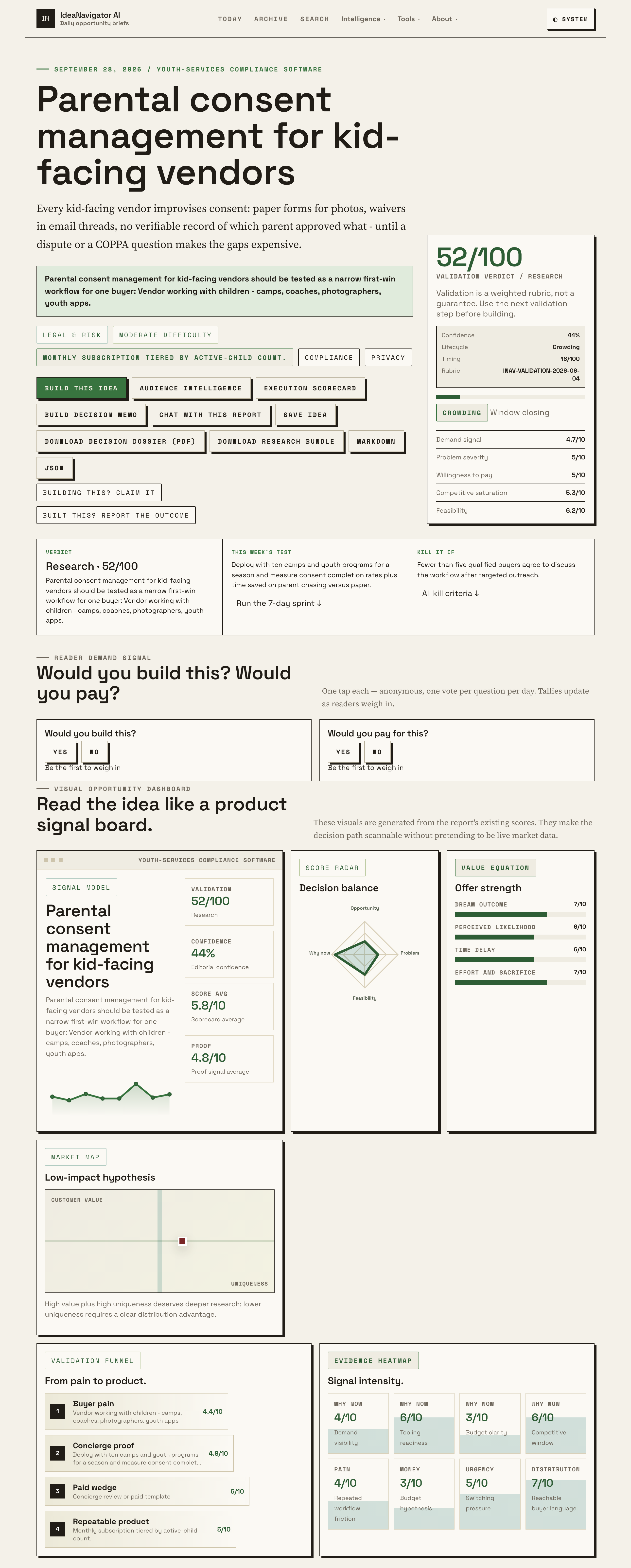
A proposal outlines phone-based consent management software for camps, coaches, photographers and youth apps, with records for each child and consent type. The concept has not been validated with customers; a proposed pilot with ten programs would measure completion rates and time saved compared with paper forms.
The proposal describes a problem in how some youth-service vendors collect consent: photo permissions may be handled on paper, waivers exchanged in email and approvals stored without a clear record of which parent agreed to which use. IdeaNavigator AI says those informal processes can leave vendors unable to readily verify consent if a dispute or privacy question arises.
The suggested minimum product would offer vendor-branded forms that parents complete on their phones. The forms could cover photography, data collection, medical information and liability. The proposal also lists identity checks calibrated to the risk of each permission, a per-child consent ledger, expiry tracking and an exportable audit record.
The commercial model proposed is a monthly subscription priced according to the number of active children. To test demand and operations, the proposal recommends a season-long deployment with ten camps or youth programs, measuring consent completion and time spent following up with parents against paper-based processes. No participating programs, dates, pricing or measured results are provided.
Records Could Reduce Consent Gaps
For a camp or youth program, permission is not a single yes-or-no decision. A parent might agree to participation while declining photography, or approve one kind of data use but not another. A system that keeps each authorization tied to a child, purpose and expiry date could make it easier for staff to check what was approved and when.
That potential value remains a product hypothesis. The proposal does not establish that vendors commonly lose consent records, that parents would complete digital forms at higher rates, or that a subscription would save enough staff time to justify its cost. The suggested pilot would need to measure those outcomes and account for setup and ongoing administration.
Clear records may also matter when a parent questions how a child’s photograph or information was used. Whether a particular digital record is sufficient for a legal or regulatory obligation depends on the circumstances and applicable rules; the proposal does not provide legal guidance or show that the product would guarantee compliance.
Paperwork Is the Proposed Starting Point
The idea is framed as a narrow first workflow for vendors that work directly with children, rather than as a broad compliance platform. Camps, coaches, photographers and youth applications are named as possible customers. Their consent needs can differ: a camp may gather medical details, while a photographer may chiefly need permission to use images.
IdeaNavigator AI points to updates to the federal Children’s Online Privacy Protection Rule, state privacy laws and parents’ concerns about photo and data use as reasons to explore the opportunity now. It does not identify a particular enforcement action, state statute or recent policy change, so those references describe the proposal’s rationale rather than a documented trigger for a product launch.
The concept centers on replacing scattered forms and messages with a mobile flow and a searchable record. Its proposed identity checks would vary with the sensitivity of a request, though the proposal does not specify how those checks would work or what evidence vendors would retain.
Demand And Safeguards Remain Untested
There is no evidence in the proposal that a product has been built, that vendors have agreed to use it, or that parents have tested its forms. The proposed ten-program trial has no reported schedule, participants or results. Demand, consent completion rates and time savings therefore remain unknown.
Several design questions are also unanswered: how parent identity would be checked, how separated or otherwise authorized caregivers would be handled, how changes or withdrawals would appear in a child’s record, and how sensitive medical information would be protected. The proposal does not state retention periods, security controls, pricing or how the service would support different legal requirements.
A Ten-Program Trial Is Proposed
The next step suggested by IdeaNavigator AI is to recruit ten camps and youth programs for a season-long pilot. The test would compare digital consent completion and staff time spent chasing permissions with the programs’ paper-based process.
No pilot has been announced, and no launch date or follow-up milestone is available. If a trial proceeds, its results could show whether vendors and parents use the workflow as intended and whether the time saved supports a subscription business. Until those findings are reported, the platform remains a proposed opportunity rather than a proven service.
Source: IdeaNavigator AI
Key Questions
Has a parental-consent platform for youth vendors launched?
No launch is reported. IdeaNavigator AI has described a proposed product and a possible pilot.
Who would the proposed service be for?
The proposal names camps, coaches, photographers and youth apps as potential customers that work with children.
What would the proposed product do?
It would offer mobile consent forms for matters such as photos, data collection, medical information and liability, along with per-child records, expiry tracking and audit exports.
Has the idea been tested with families or vendors?
No test results are reported. The proposal recommends a season-long pilot with ten programs to measure completion rates and staff time spent following up with parents.
Source: IdeaNavigator AI
Halloween Picks
halloween
As an affiliate, we earn on qualifying purchases.