

📊 Full opportunity report: Driver Monitoring Cameras In Every New EU Car: What Changed And Why on IdeaNavigator AI — validation score, market gap, and execution plan.

Get business pricing on office and shipping supplies
- Business-only prices and quantity discounts
- Tax-exempt purchasing
- Multiple users, one account, clear invoices
TL;DR
EU vehicle safety rules require driver drowsiness and attention warnings in new vehicle types, with requirements phased in from 2022 and 2024. The supplied material does not establish that every new EU car must contain a driver-monitoring camera; the required warning function can use different technical approaches.
The development highlighted by IdeaNavigator AI is a monitoring opportunity for automotive operators, not evidence of a new camera mandate. The exact equipment fitted to a vehicle depends on how its system meets the rules.
European Union vehicle safety rules require new cars to warn drivers when they show signs of drowsiness or reduced attention, but the material behind a recent trend brief does not establish that every new EU car must include a camera. The distinction matters for drivers and automotive businesses: the required safety function is a warning system, while a camera is one possible way to monitor a driver.
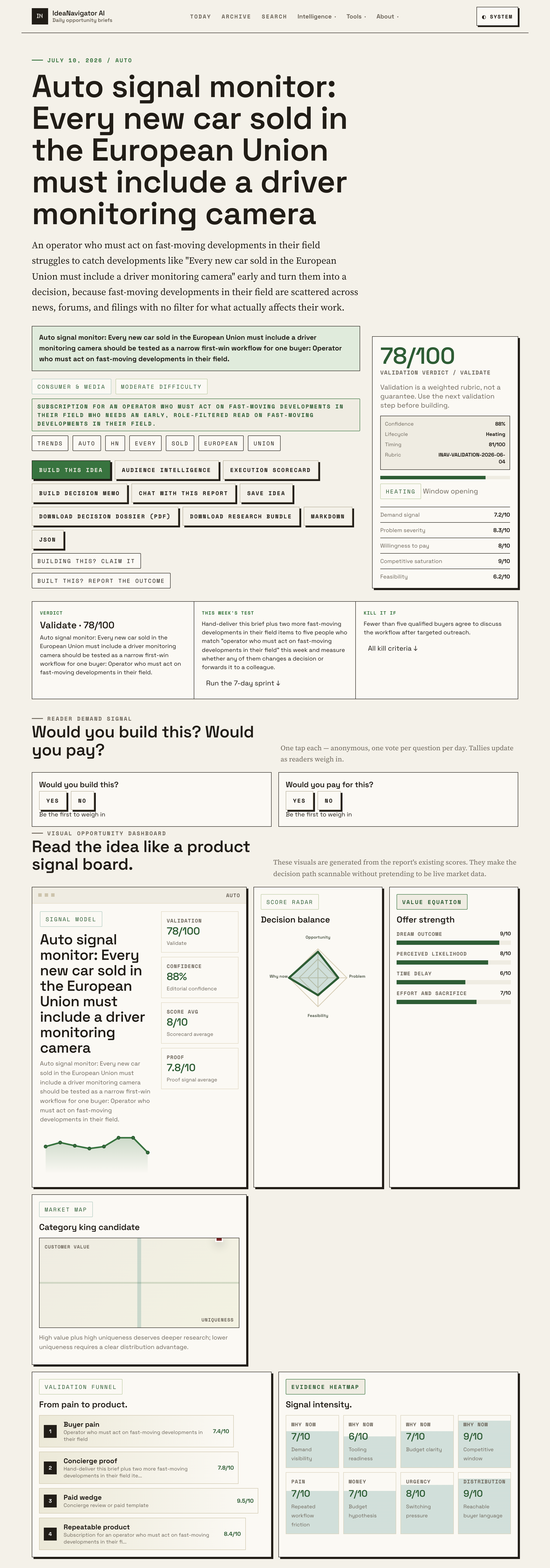
The trend brief from IdeaNavigator AI framed the development as a requirement for every new car sold in the EU to include a driver-monitoring camera. Its supplied description, however, offers no regulation text, regulator statement, or technical documentation supporting that specific claim. It describes an automotive signal-monitoring product concept and proposes validating it with operators who need to track fast-moving developments.
The relevant EU measure is part of the General Safety Regulation, which introduced safety requirements in stages. Under Regulation (EU) 2019/2144, from July 2022 the requirements applied to new vehicle types; from July 2024, they extended to all new vehicles covered by the rules. Driver drowsiness and attention warning is among the required safety features. Commission Delegated Regulation (EU) 2021/1341 sets detailed requirements for those warning systems. The dates refer to the rollout of vehicle requirements, not a newly announced camera rule.
A warning system and a camera are not interchangeable descriptions. The delegated regulation specifies the performance and testing requirements for the warning system; it does not establish the brief’s claim that every covered vehicle must use a camera. The brief does not identify a new EU decision, cite a camera-specific provision, or name a particular camera technology that every vehicle must use.
The Difference Between Warnings and Cameras
For drivers, the practical point is that attention warnings are required in covered new vehicles, while the brief does not show that a camera is universally required. Drivers checking a specific car’s equipment should consult its manual or ask the manufacturer how its attention-warning system works.
For automakers and suppliers, the distinction affects product planning and public claims. Describing the rule as a camera mandate could misstate the compliance requirement, while overlooking the warning-system obligation would miss a significant vehicle safety standard. Companies tracking regulation need to confirm whether a development changes the law, the technical standards, or only the market’s choice of implementation.
The brief also points to a business question rather than a confirmed regulatory change: whether automotive operators value a same-day, role-filtered digest of developments. IdeaNavigator AI proposes delivering short briefs and measuring whether they affect a decision or are forwarded to colleagues. No results from that proposed validation are provided.
How the EU Safety Rules Took Effect
The EU’s General Safety Regulation, Regulation (EU) 2019/2144, sets safety requirements for vehicles placed on the market. It introduced a broader package of measures, including driver drowsiness and attention warnings, as regulators sought to reduce road deaths and serious injuries. The regulation’s phase-in dates were July 2022 for new vehicle types and July 2024 for all new vehicles in scope. Commission Delegated Regulation (EU) 2021/1341 provides detailed requirements for driver drowsiness and attention warning systems.
That staged approach is important when interpreting headlines about “every new car.” It concerns which new vehicles must meet specified safety requirements at each phase. The cited regulations establish a warning-system requirement; they do not substantiate the trend brief’s claim that one specific sensor, such as a camera, must be fitted universally.
Whether Cameras Are Specifically Required
The supplied IdeaNavigator AI brief does not identify a camera-specific EU legal provision or show that regulators have adopted a new mandate requiring a camera in every new car. Regulation (EU) 2019/2144 and Commission Delegated Regulation (EU) 2021/1341 address the broader driver drowsiness and attention warning requirement. The brief also does not specify which vehicle categories or technical implementations its camera claim covers.
It remains unclear what prompted the brief’s camera wording, whether it refers to a particular interpretation or technology, and whether any new legal development occurred beyond the phased-in safety rules. IdeaNavigator AI’s proposed market test has no reported findings here, so there is no evidence yet about whether automotive operators would change decisions or share such alerts.
Check the Rule and Test the Brief
Automotive businesses evaluating the claim should consult Regulation (EU) 2019/2144, the detailed requirements in Commission Delegated Regulation (EU) 2021/1341, and vehicle-specific compliance documentation before treating it as a camera mandate. Manufacturers can clarify what monitoring technology a particular model uses and how it meets the warning requirement.
IdeaNavigator AI proposes testing its monitoring concept by hand-delivering this brief and two other developments to five people who match its intended operator profile, then tracking whether any brief changes a decision or is forwarded. The material gives no date for results. Until a camera-specific rule or further evidence is identified, the development should be described as an EU driver-warning requirement, not a confirmed universal camera requirement.
Sources: Regulation (EU) 2019/2144, the General Safety Regulation; Commission Delegated Regulation (EU) 2021/1341 on driver drowsiness and attention warning systems; IdeaNavigator AI trend brief.
Key Questions
Does every new car sold in the EU have to include a driver-monitoring camera?
The supplied material does not substantiate a universal camera requirement. Regulation (EU) 2019/2144 and Commission Delegated Regulation (EU) 2021/1341 set requirements for driver drowsiness and attention warning systems; they do not establish the trend brief’s claim that every covered vehicle must use a camera.
What driver-monitoring feature do the EU rules require?
The General Safety Regulation includes a requirement for driver drowsiness and attention warning in covered new vehicles. Commission Delegated Regulation (EU) 2021/1341 sets detailed requirements for these systems. The requirement was phased in, applying to new vehicle types from July 2022 and all new vehicles in scope from July 2024.
When did the requirements take effect?
Under Regulation (EU) 2019/2144, the first phase applied from July 2022 to new vehicle types. The requirements extended to all new vehicles covered by the rules from July 2024.
What does IdeaNavigator AI propose?
It proposes a focused monitor that tracks fast-moving developments and turns relevant items into short briefs explaining what changed, why it matters, and what an operator might do. It suggests testing the idea with five potential users and measuring whether briefs affect decisions or are forwarded.
Source: IdeaNavigator AI
Halloween Picks
halloween
As an affiliate, we earn on qualifying purchases.