🔍 Read the full analysis: The Assembly Line’s Link To A Five-Dollar Daily Wage on ThorstenMeyerAI.com

Get business pricing on office and shipping supplies
- Business-only prices and quantity discounts
- Tax-exempt purchasing
- Multiple users, one account, clear invoices
TL;DR
A 2026 episode from ThorstenMeyerAI.com examines how Ford’s moving assembly line cut the labor time to assemble a Model T chassis, while workers were leaving at high rates. It says Ford responded on Jan. 5, 1914, by reducing the workday from nine hours to eight and raising minimum daily pay from $2.34 to $5, a change followed by lower turnover.
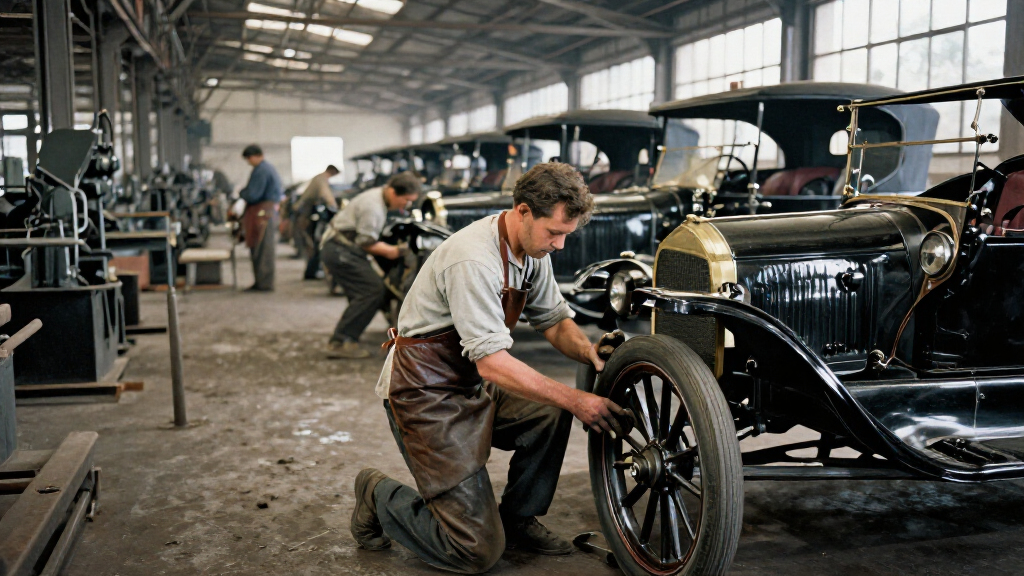
Ford’s five-dollar day was introduced in January 1914 as the company grappled with workers leaving its newly reorganized factory, according to a Nov. 6 episode from ThorstenMeyerAI.com. The account connects the pay increase and shorter workday to the disruption of the moving assembly line, which sharply reduced the labor time needed to build a car chassis but coincided with annual turnover reported at 370%.
The episode says Ford cut the working day from nine hours to eight on Jan. 5, 1914, while raising minimum daily pay from $2.34 to $5. The increase was presented as profit sharing and came with conditions, though the source material does not detail those conditions. It reports that Ford’s turnover rate fell to 54% in 1914.
The production changes were rapid. Ford’s own figures, as presented in the episode, put the labor needed to assemble a Model T chassis at 12 hours and 28 minutes when the vehicle remained stationary. By early 1914, the moving line had reduced that figure to 1 hour and 33 minutes—about an 88% reduction in labor time.
The episode cites research by economists Daniel Raff and Lawrence Summers, who drew on earlier labor research and company surveys. Their figures show Ford hired 50,448 people in 1913 to maintain an average workforce of 13,623. The report says about one in ten workers was absent on an average day. Those figures describe turnover and attendance at Ford, not the experience of every factory or worker in the United States.
Why Ford Raised the Daily Wage
The episode’s central argument is that Ford’s pay change addressed a production problem: a factory could not reliably benefit from faster assembly if workers kept leaving or missing shifts. The line reduced the labor time assigned to each chassis, while the reported turnover figures show how difficult it was to keep enough people in place to run the operation.
That makes the five-dollar day relevant beyond the size of the wage itself. It illustrates a tension in industrial production: breaking a job into repetitive, tightly timed tasks can raise output, but the resulting work may be difficult to sustain. The episode says Ford’s turnover fell after the change, and quotes Henry Ford later describing it as a cost-cutting measure. That is the company’s retrospective explanation, not proof that wages alone caused the decline.
The account also challenges a familiar explanation that Ford raised wages mainly so workers could afford the cars they made. It argues that Ford’s immediate problem was staffing, not a shortage of buyers. The source gives production and workforce figures to support that interpretation, but they do not by themselves settle every motive behind the policy.
Products Worth Considering

Logitech MX Keys S Combo Wireless Keyboard and Mouse, Graphite

Dell Pro 14 Plus P1425 14-Inch Portable Monitor

Canon imagePROGRAF PRO-1100 17-Inch Professional Wireless Inkjet Photo Printer
As an affiliate, we earn on qualifying purchases.
From Stationary Chassis to Moving Line
Before the moving line, workers assembled a car around a chassis in one place, bringing parts to it. The episode says Ford began testing assembly-line methods in April 1913 with a small component called the flywheel magneto. Henry Ford’s 1922 book, My Life and Work, written with journalist Samuel Crowther, is the source for many of the production details. The episode identifies those figures as Ford’s own account, rather than an independent company audit.
Ford’s account says the magneto job was divided into 29 operations and the component moved between workers. It records the time for the task falling from about 20 minutes to 13 minutes and 10 seconds, and later to five minutes after further changes. The company then applied the approach to chassis assembly: an early test pulled the chassis down a line, before later changes raised it to waist height and divided the work further.
The broader claim that the line reduced the need for worker judgment comes from Ford himself. He described the aim as reducing “the necessity for thought” and limiting workers’ movements. The episode’s historical focus is therefore both a production innovation and a change in the organization of factory labor; it does not claim that the assembly line immediately eliminated industrial jobs.
““the reduction of the necessity for thought on the part of the worker and the reduction of his movements to a minimum.””
— Henry Ford, quoted from My Life and Work
What the Wage Figures Cannot Prove
The episode reports that turnover fell from 370% in 1913 to 54% in 1914, but the figures alone do not establish that the wage increase was the only cause. The package also shortened the workday, and the pay was conditional profit sharing. The source material does not specify the conditions, how many workers received the full amount, or how the figures were calculated across the year.
There is also a difference in the reported turnover estimates: the episode says the Henry Ford museum gives a figure of about 380%, compared with 370% in the research it cites. It does not resolve that discrepancy. Ford’s production figures largely come from his own later account, while the staffing data are attributed to researchers drawing on historical sources. Readers should treat the measures according to their stated sources rather than as a single independently verified dataset.
The source excerpt ends during its discussion of absenteeism and does not provide a full account of the five-dollar day’s eligibility rules or workers’ views. It also does not establish how the policy affected pay distribution, household purchasing power, or conditions over the longer term. Those questions remain outside the evidence provided.
The Episode’s Wider Labor Question
The published episode places the Ford story within a larger history of industrial work. It says U.S. factory employment rose by about a third between 1910 and 1920, while cautioning against the idea that the assembly line immediately reduced the overall number of factory jobs. That figure is presented without a detailed statistical source in the supplied material, so its definitions and measurement basis are not specified here.
The episode also points to the use of robots on modern production lines, framing automation as a continuation of changes in how factory labor is organized. It does not offer current automation figures or make a forecast about the number of jobs affected. Its next step is explanatory rather than a newly announced policy or event: tracing how production methods, staffing needs and wages became connected at Ford.
Key Questions
What was Ford’s five-dollar day?
Ford announced the policy on Jan. 5, 1914, raising minimum daily pay from $2.34 to $5 and reducing the workday from nine hours to eight. The episode says the pay was offered as conditional profit sharing.
Why does the episode say Ford raised pay?
It argues that Ford was trying to address high worker turnover as the company reorganized production around a moving assembly line. The source does not establish that turnover was the sole motive.
How much faster did chassis assembly become?
According to figures from Henry Ford’s account cited by the episode, labor time per chassis fell from 12 hours and 28 minutes to 1 hour and 33 minutes by early 1914—about an 88% reduction.
How high was turnover at Ford in 1913?
The episode reports a rate of 370%, based on research citing 50,448 hires to maintain an average workforce of 13,623. It notes that the Henry Ford museum gives a slightly higher estimate, about 380%.
Did Ford raise pay so workers could buy cars?
The episode disputes that familiar explanation and says staffing was the immediate problem. That is the episode’s interpretation; the supplied material does not provide conclusive evidence that establishes every reason behind Ford’s decision.
Source: ThorstenMeyerAI.com