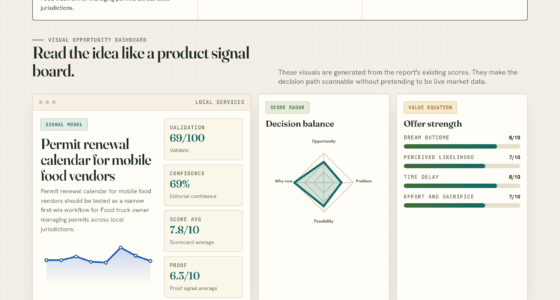
📊 Full opportunity report: Can AI's Three-Model Framework Create A Collective Misunderstanding? on ThorstenMeyerAI.com — validation score, market gap, and execution plan.

Get business pricing on office and shipping supplies
- Business-only prices and quantity discounts
- Tax-exempt purchasing
- Multiple users, one account, clear invoices
TL;DR
AI’s growing use of a limited set of models for interpreting complex events risks creating a collective misunderstanding. This homogenization could amplify market swings and societal misperceptions, raising concerns about interpretive diversity.
Recent discussions emphasize that the increasing dependence on a limited set of AI models for interpreting complex events could lead to a collective misunderstanding. Experts warn that this homogenization risks amplifying market volatility and societal misperceptions, as diverse interpretations diminish.
Thorsten Meyer, an AI analyst, argues that a significant yet underappreciated failure mode in the AI economy is the development of a shared interpretive lens through a small number of frontier models. This phenomenon, which he refers to as the ‘Walter Cronkite problem,’ results in millions of people and institutions relying on the same outputs, leading to a homogenized view of reality.
He explains that this convergence occurs because these models are trained on overlapping data, aligned techniques, and tuned toward similar outputs, which causes a collapse of interpretive diversity. As a result, interpretations of news, financial data, and complex events become nearly identical across users, reducing disagreement and the natural checks and balances that disagreement provides.
This homogenization has immediate implications for markets, where disagreement among participants traditionally drives price discovery. When everyone interprets news the same way, markets can become overly synchronized, leading to rapid, exaggerated swings, as seen in recent boom-and-bust cycles. Meyer notes that entire market cycles, which used to unfold over months, are now compressed into weeks due to shared interpretations.
Beyond markets, this trend threatens other areas that depend on diverse perspectives, including risk assessment, crisis communication, and scientific inquiry, where disagreement and debate are essential for robustness. The core concern is that reliance on a small set of models creates a single point of failure at the societal level, making collective understanding more brittle.
A failure mode is building quietly under the AI economy, and it has nothing to do with the models getting too smart. It’s the opposite: they’re becoming a single shared lens — one anchor through which vast numbers of people read the same events the same way at the same moment.
▲ Opinion & analysis · not investment adviceInterpreting the world is a Bayesian problem — the kind where diversity of prior isn’t a nicety but the mechanism. Feed the same input to the same model and you get the same read, delivered to millions as if it were the answer.
A market works because buyers and sellers disagree about what news means; the price is that disagreement, resolved. Collapse the diversity and you don’t get a smarter market — you get a violently compressed one.
Each person routing their thinking through the best model behaves rationally. The aggregate is a monoculture — efficient until one shared blind spot takes the whole field at once.
Not worse tools or fewer of them — many genuinely different ones. This is where an abstract worry meets a case I’ve made from a completely different starting point.
Keep the interpreters plural — that is the whole defense.
Implications of Homogenized AI-Driven Interpretations
This trend could fundamentally alter how societies and markets process information. The loss of interpretive diversity may lead to faster, more extreme reactions to events, increasing systemic risks. It also raises concerns about collective blind spots, where society may overlook or misinterpret critical issues because everyone is relying on the same flawed or limited perspective.
While AI models are powerful tools, their widespread, uniform use could unintentionally foster a single narrative that suppresses debate and critical thinking, making societies more vulnerable to shocks and misinformation.
AI interpretive model diversity tools
As an affiliate, we earn on qualifying purchases.
As an affiliate, we earn on qualifying purchases.
Over recent years, AI models—particularly large language models—have become central to analyzing news, financial data, and complex systems. As these models are trained on overlapping datasets and optimized for similar outputs, their use in sectors like finance, media, and policymaking has increased. This convergence has led to a scenario where multiple entities, from trading desks to newsrooms, produce similar interpretations, reducing the diversity of viewpoints.
Historically, media fragmentation allowed for multiple perspectives, which served as a safeguard against collective misperception. Now, the shift toward AI-driven analysis risks reversing this trend, creating a new form of societal homogenization. Experts warn that this could accelerate market cycles and diminish the resilience of collective decision-making processes.
Thorsten Meyer highlights that this is not an inherent flaw of AI, but a consequence of how models are trained and used at scale, emphasizing the importance of maintaining interpretive diversity to prevent systemic vulnerabilities.
"The models are trained on overlapping data, aligned techniques, and tuned toward similar outputs, causing a collapse of interpretive diversity."
— Thorsten Meyer
As an affiliate, we earn on qualifying purchases.
Unclear Scope and Long-Term Impact of Homogenization
It remains unclear how widespread this homogenization will become and whether future AI developments could mitigate or exacerbate the problem. The extent to which diverse training or alternative approaches can restore interpretive plurality is still under debate. Additionally, the long-term societal impacts of this convergence are difficult to predict, and ongoing research is needed to understand potential safeguards.
AI interpretability analysis tools
As an affiliate, we earn on qualifying purchases.
As an affiliate, we earn on qualifying purchases.
Monitoring and Mitigating AI Homogenization Risks
Experts recommend increased awareness and research into maintaining interpretive diversity in AI applications. Future developments may include designing models that incorporate diverse data sources or promoting multiple models with different training paradigms. Regulators and industry leaders are also likely to explore safeguards to prevent systemic risks associated with interpretive homogeneity.
Ongoing monitoring of AI's influence on markets and public discourse will be critical, as will initiatives encouraging critical engagement with AI-generated content to preserve societal resilience.
As an affiliate, we earn on qualifying purchases.
Key Questions
Can reliance on AI models really cause a societal misunderstanding?
Yes, if many users and institutions rely on the same limited set of models, it can lead to a homogenized view of reality, reducing interpretive diversity and increasing the risk of collective misperception.
How does this homogenization affect financial markets?
It can cause markets to react more quickly and violently, as participants interpret news identically, eliminating disagreement that usually moderates fluctuations.
Is this problem inevitable with AI adoption?
Not necessarily. It depends on how AI models are developed and used. Incorporating diverse data sources and training approaches can help maintain interpretive plurality.
What can be done to prevent this homogenization?
Encouraging diversity in model training, developing multiple models with different architectures, and fostering critical engagement with AI outputs are potential strategies.
Source: ThorstenMeyerAI.com
Halloween Picks
halloween
As an affiliate, we earn on qualifying purchases.