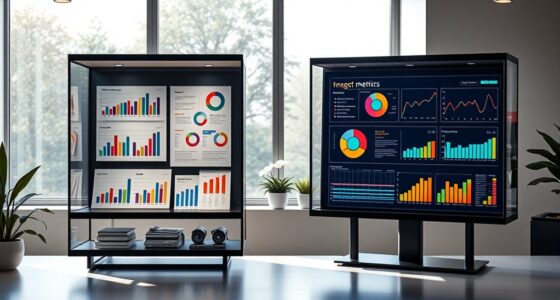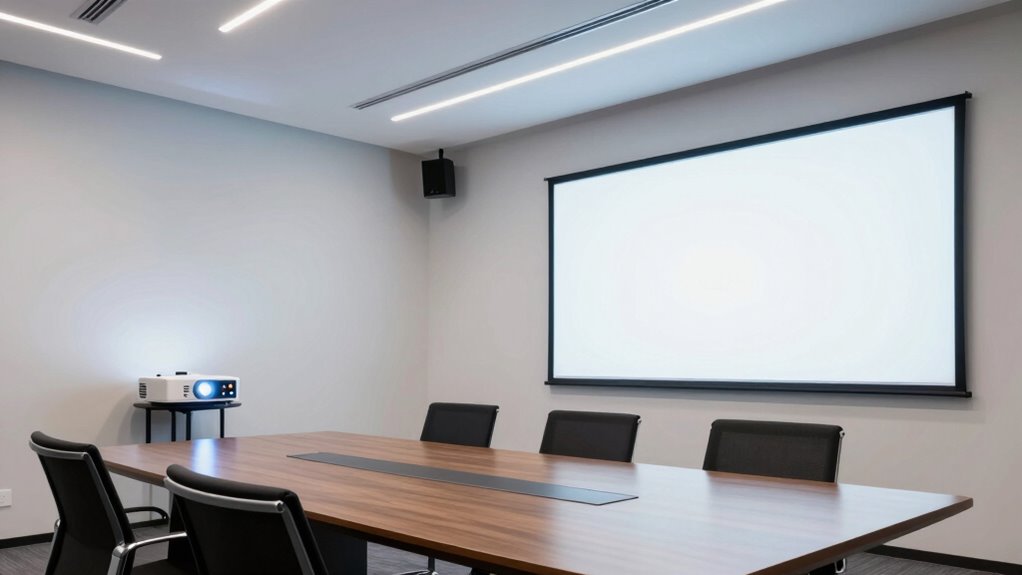

When choosing between projectors and large displays for your team room, consider your lighting conditions, content clarity needs, and budget. If you often display detailed visuals or HD videos, a high-resolution large display might be best, especially in well-lit spaces. Projectors work well in darker rooms and cost less upfront but may sacrifice clarity. To find the best fit for your specific environment and needs, explore these factors further to make a confident decision.

Get business pricing on office and shipping supplies
- Business-only prices and quantity discounts
- Tax-exempt purchasing
- Multiple users, one account, clear invoices
Key Takeaways
- Match device resolution with the detail level of content to ensure clarity and sharpness.
- Consider lighting conditions; projectors need dim environments, while large displays work well in bright rooms.
- Evaluate budget and maintenance costs for long-term affordability and ease of upkeep.
- Assess room size and viewing distance to determine the optimal screen size and type.
- Prioritize content presentation needs, such as high-definition visuals or detailed charts, when choosing the device.
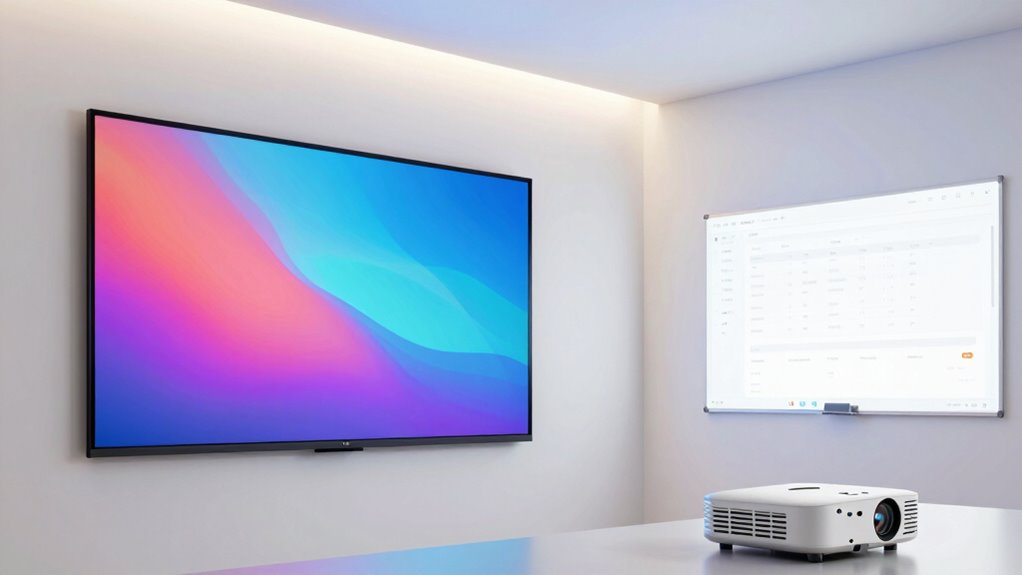
When deciding between projectors and large displays, understanding your specific needs and environment is crucial. One of the first factors to consider is screen resolution. If your team frequently reviews detailed visuals, charts, or high-definition videos, a display with a high resolution, such as 4K or higher, guarantees sharp, clear images without pixelation. Projectors often have lower native resolutions, which can compromise image clarity, especially in well-lit rooms. On the other hand, many modern large displays now offer ultra-high-definition options, making them ideal for tasks requiring precision and clarity. Think about the types of content you’ll present most often and choose a solution that supports the resolution needed to communicate your message effectively. Additionally, consider the native resolution of each device, as it directly impacts image sharpness and overall presentation quality. It’s also important to evaluate the brightness levels, since projectors generally require dimmer environments for optimal viewing, whereas large displays can perform well in various lighting conditions. Moreover, assessing the cost and maintenance of each option can influence your decision, especially when considering long-term use and budget constraints.
4K large display for conference room
As an affiliate, we earn on qualifying purchases.
As an affiliate, we earn on qualifying purchases.
Frequently Asked Questions
What Is the Typical Lifespan of Projectors Versus Large Displays?
You’ll find that projectors typically last around 5,000 to 10,000 hours, but their lifespan depends on factors like projector brightness and bulb quality. Large displays, especially LED or LCD screens, usually last 50,000 to 100,000 hours, offering longer durability. So, if you want longevity, high display resolution and durable technology make big screens a smarter choice, while projectors may need bulb replacements over time.
How Do Maintenance Costs Compare Between Projectors and Large Displays?
You’ll find that maintenance costs differ substantially between projectors and large displays. Projectors generally need more frequent maintenance, like bulb replacements and filter cleanings, increasing maintenance frequency and repair costs over time. Large displays require less frequent upkeep, mainly involving occasional cleaning and software updates, which tend to be lower in cost. Overall, large displays usually have lower ongoing maintenance costs, making them more cost-effective long-term.
Are There Energy Efficiency Differences Between the Two Options?
Projectors generally consume less energy than large displays, making them more power-efficient for team rooms. Their energy consumption varies depending on the model and brightness settings, but they typically use less power during operation. Large displays, especially LED or LCD screens, tend to have higher power efficiency due to advanced technology and consistent brightness levels. Your choice depends on balancing energy savings with display quality and usage needs.
Which Option Offers Better Integration With Modern Collaboration Tools?
Large displays generally offer better integration compatibility with modern collaboration tools because they often feature seamless software synchronization, making it easy to connect with apps like Zoom, Microsoft Teams, or Slack. Projectors may require additional adapters or setup steps, which can complicate integration. So, if smooth software synchronization is your priority, a large display provides a more straightforward, user-friendly experience for team collaboration.
How Does Ambient Lighting Affect Projector and Display Visibility?
Think of ambient light as the weather for your presentation—cloudy skies can obscure your message. Bright ambient light diminishes screen clarity for both projectors and displays, making images seem washed out. For ideal visibility, control ambient light with curtains or dimming options, ensuring your team can easily see content. Keep the environment in mind, and your visuals will shine clearly, no matter the lighting conditions.
portable projector for team presentations
As an affiliate, we earn on qualifying purchases.
As an affiliate, we earn on qualifying purchases.
Conclusion
Ultimately, choosing between projectors and large displays depends on your team’s specific needs, space, and budget. Think of it like picking a vehicle—you wouldn’t choose a sports car for hauling furniture, just as you wouldn’t pick a projector if clarity and brightness are top priorities. By weighing the pros and cons carefully, you’ll find the perfect fit that makes your team’s collaboration smooth and enjoyable, like a well-oiled machine working seamlessly together.
As an affiliate, we earn on qualifying purchases.
high-resolution projector for business
As an affiliate, we earn on qualifying purchases.
As an affiliate, we earn on qualifying purchases.
Halloween Picks
halloween
As an affiliate, we earn on qualifying purchases.