As a team leader, understanding DMAIC helps you guide process improvements systematically. You’ll start by clearly defining issues, setting measurable goals, and mapping out the current workflow. Next, you gather data to assess performance and analyze root causes behind problems. Then, you implement targeted solutions and establish controls to keep gains steady. Mastering each step enhances your ability to lead continuous improvement efforts—exploring further reveals how to effectively apply these principles in practice.
Key Takeaways
- Understand the DMAIC framework: Define, Measure, Analyze, Improve, and Control for structured process improvement.
- Clearly identify problems and set measurable objectives during the Define phase to guide team efforts.
- Collect and analyze data accurately in the Measure and Analyze phases to uncover root causes of issues.
- Implement solutions and use control tools like charts to sustain improvements over time.
- Lead with data-driven decisions, ensuring continuous monitoring and process stability for long-term success.
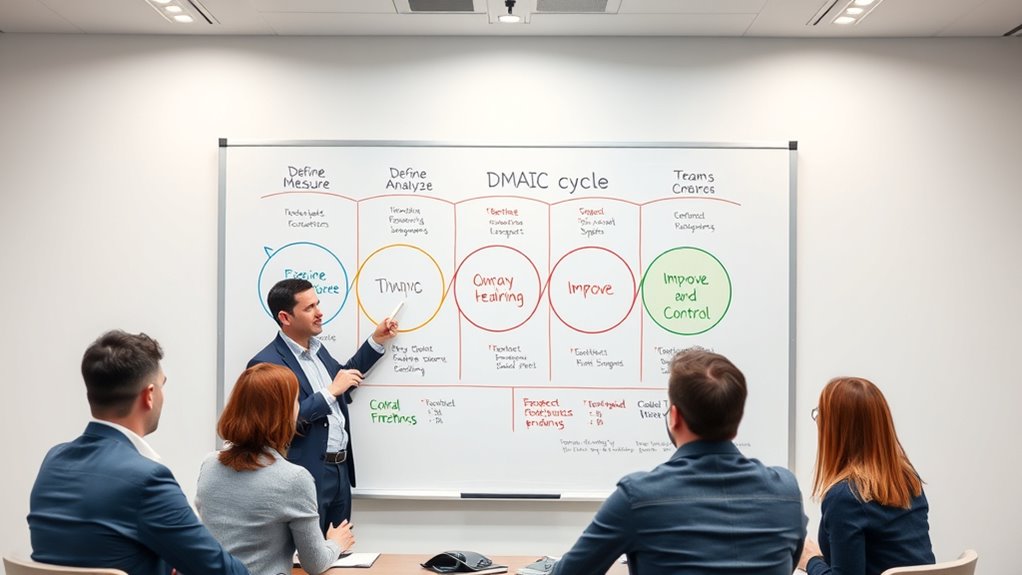
Are you looking for an effective way to improve your team’s processes and solve complex problems? If so, understanding the basics of DMAIC can be a game-changer. DMAIC, which stands for Define, Measure, Analyze, Improve, and Control, provides a structured framework that helps you identify issues, analyze root causes, and implement sustainable solutions. As a team leader, mastering this methodology allows you to drive continuous improvement and make data-driven decisions. To get started, you’ll want to familiarize yourself with essential tools like statistical tools and process mapping, which are fundamental to each phase of DMAIC.
Master DMAIC to lead continuous improvement with data-driven solutions and essential process mapping tools.
In the Define phase, your goal is to clearly identify the problem and set specific, measurable objectives. Here, process mapping becomes invaluable. It helps you visualize the current workflow, revealing bottlenecks, redundancies, and sources of variation. Mapping out each step allows you to see the process as a whole, making it easier to pinpoint where improvements are needed. As you create these process maps, you’ll gain insights into how different activities relate to each other and where delays or defects occur. This clarity sets a solid foundation for the subsequent phases.
When you move into the Measure phase, your focus shifts to gathering data that accurately reflects the current process performance. This is where statistical tools come into play. They help you quantify problems, track variability, and establish baseline metrics. Techniques like control charts, histograms, and scatter plots enable you to analyze data patterns and identify trends. Proper measurement is essential because it provides objective evidence of issues and helps you determine whether changes lead to real improvements. Be meticulous in collecting and analyzing data, ensuring your measurements are valid and reliable.
In the Analyze phase, you’ll dig deeper into the data to uncover root causes. Statistical tools such as hypothesis testing or regression analysis can reveal relationships and factors contributing to defects or inefficiencies. Process mapping combined with these tools allows you to visualize where the process deviates from expectations and why. This step is critical for targeting your improvement efforts effectively, avoiding guesswork, and focusing on the true sources of problems.
Finally, as you implement solutions in the Improve phase, your understanding from previous steps guides your actions. Once changes are made, control charts and other statistical tools help you monitor the process over time, ensuring gains are sustained. By continuously tracking key metrics, you keep your team accountable and prevent regressions. Throughout each phase, process mapping and statistical tools serve as your navigational aids, making the complex task of process improvement manageable and precise. As a team leader, leveraging these tools within the DMAIC framework empowers you to lead your team confidently toward operational excellence.
Top picks for "dmaic basic team"
Open Amazon search results for this keyword.
As an affiliate, we earn on qualifying purchases.
Frequently Asked Questions
How Do I Choose the Right Projects for DMAIC?
To select the right DMAIC projects, start with a root cause analysis to identify areas needing improvement. Engage stakeholders early to understand their concerns and priorities. Focus on projects that have a significant impact on your goals, are measurable, and align with organizational strategy. Choosing high-impact, data-driven projects ensures your team can effectively address root causes and deliver meaningful results.
What Skills Are Essential for Leading DMAIC Teams?
Think of leading DMAIC teams as steering a ship through choppy waters—you need strong skills to keep everyone on course. You must excel in team motivation and communication strategies, inspiring your team to stay engaged and focused. Your ability to listen, clarify goals, and foster collaboration fuels progress. With these skills, you’ll navigate challenges smoothly, turning team effort into successful project completion.
How Do I Measure Success in a DMAIC Project?
You measure success in a DMAIC project by analyzing performance metrics and conducting data analysis to assess improvements. Track key performance indicators (KPIs) before and after implementing solutions to see if targets are met. Use data analysis to identify trends, validate results, and guarantee sustained gains. If the metrics show significant improvement and goals are achieved, you’ve successfully completed your DMAIC project.
What Are Common Challenges Faced During DMAIC Implementation?
Imagine steering through a maze, where each turn reveals a new challenge. During DMAIC implementation, you often face obstacles like resistance to change and difficulty in root cause analysis. Change management becomes vital to gain team buy-in, while thorough root cause analysis uncovers the real issues behind problems. Overcoming these hurdles requires clear communication, patience, and adaptability, ensuring your project stays on course toward successful process improvement.
How Can I Sustain Improvements After Project Completion?
To sustain improvements after your project, you should implement continuous monitoring to track progress and identify issues early. Additionally, focus on cultural integration by encouraging team members to embrace new processes and behaviors. Regular reviews, training, and open communication help embed these changes into daily routines. By maintaining engagement and accountability, you’ll guarantee lasting success and continuous improvement within your organization.
Conclusion
So, now that you’re a DMAIC pro, go ahead and conquer those projects with the finesse of a process guru. Who knew that breaking down problems could be so thrilling? Just remember, when things get messy, you’ve got the tools—no magic wand needed. So, gear up, lead confidently, and maybe even impress your boss with your newfound ability to turn chaos into order. After all, what’s better than being a process superhero?