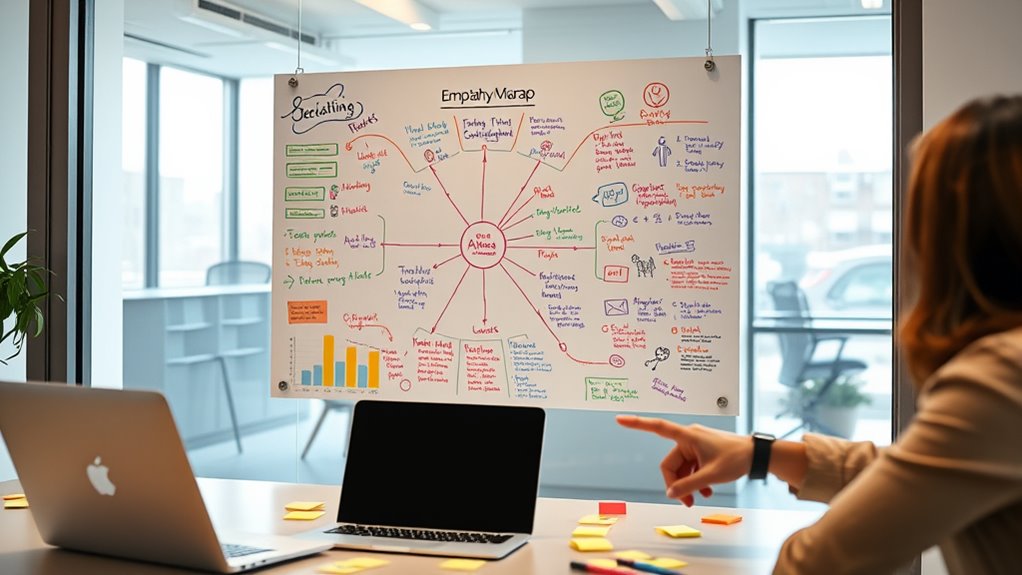

To create empathy maps as a leader, start by observing and listening actively to your team members. Ask open-ended questions to uncover what they say, think, feel, and do. Document these insights to understand their motivations and challenges better. Use this map to tailor your communication, support, and leadership approach. Continuously update it as you gather more insights, helping you build trust and stronger relationships. Keep exploring to deepen your understanding.
Key Takeaways
- Gather insights through active listening, open-ended questions, and observation to accurately fill out each component of the empathy map.
- Focus on understanding team members’ sayings, thoughts, feelings, and actions to uncover underlying motivations and challenges.
- Validate insights by reflecting on emotional states and behaviors, avoiding assumptions for authentic understanding.
- Use the empathy map to tailor communication, support strategies, and address underlying issues like feeling undervalued or workload concerns.
- Continuously update the empathy map as team dynamics evolve to foster trust, improve relationships, and enhance leadership effectiveness.

Have you ever wondered how some leaders seem to connect effortlessly with their teams? The secret often lies in their ability to understand others deeply, which is where empathy maps come into play. An empathy map is a simple but powerful tool that helps you visualize what your team members are experiencing, thinking, feeling, and saying. To get started, you need to familiarize yourself with the empathy map components—these include what people say, think, do, and feel. By systematically exploring these areas, you gain a clearer picture of their motivations and challenges. This understanding is essential for practicing leadership empathy techniques that build trust and foster genuine connections.
Understanding team members deeply through empathy maps fosters trust and authentic connections.
When you approach empathy mapping, think of it as a way to step into your team members’ shoes. Begin by gathering insights through active listening and open-ended questions. As you observe and listen, fill out the empathy map components based on what you learn. For instance, what are they saying about their work or frustrations? What do their words reveal about their concerns or aspirations? What do they do that might indicate stress or engagement? And most importantly, how do they feel—are they motivated, overwhelmed, or undervalued? Your goal is to capture their emotional landscape accurately, which requires genuine curiosity and without assumptions. This process helps you identify gaps between perception and reality, so you can adapt your leadership style accordingly.
Leadership empathy techniques hinge on your ability to listen empathetically and validate your team members’ experiences. When you use empathy maps, you’re not just collecting data—you’re actively demonstrating that you value their perspectives. This validation encourages openness and honesty, fostering a culture of trust. Effective leaders use these insights to tailor their communication, provide targeted support, and address underlying issues that might not be immediately obvious. For example, if an employee feels undervalued, recognizing their feelings allows you to implement meaningful recognition or adjust workload expectations. By continuously updating your empathy map, you stay aligned with your team’s evolving needs, which strengthens mutual respect and collaboration.
Ultimately, mastering empathy map components and applying leadership empathy techniques transforms your approach from transactional to relational. It’s about more than just managing tasks; it’s about connecting authentically with your team. As a leader, you can create an environment where everyone feels heard, understood, and supported. This not only boosts morale but also enhances productivity and loyalty. So, start small—practice filling out empathy maps regularly, listen actively, and truly seek to understand. Over time, this habit becomes second nature, empowering you to lead with compassion, insight, and genuine empathy.
Frequently Asked Questions
How Often Should Leaders Update Their Empathy Maps?
You should update your empathy maps regularly, ideally every few months, to stay aligned with your team’s evolving needs. Incorporate team feedback during these updates to gain fresh insights and guarantee accuracy. Frequent updates help you remain empathetic, responsive, and effective as a leader. Keep an eye on changing dynamics and encourage ongoing communication, so your empathy maps reflect current realities and foster stronger connections with your team.
Can Empathy Maps Be Used for Remote Team Management?
Yes, empathy maps work great for remote team management. For example, imagine you use an empathy map to understand a team member’s challenges with virtual collaboration. It highlights their needs for clear communication and cultural sensitivity. By focusing on these insights, you can tailor your approach, foster trust, and improve engagement across diverse, remote teams, ensuring everyone feels understood and valued despite physical distance.
What Tools Are Best for Creating Empathy Maps?
You should use digital tools and collaboration platforms like Miro, MURAL, or Lucidspark to create empathy maps easily. These tools offer intuitive templates and real-time collaboration features, making it simple to gather insights from your team and visualize your empathy map. They help you engage everyone, regardless of location, and quickly adapt your strategy based on your team’s needs and feedback.
How Do Empathy Maps Improve Team Communication?
You improve team communication by fostering emotional awareness and practicing active listening. Empathy maps highlight unspoken feelings and perspectives, revealing hidden motivations. This creates a bridge between surface-level interactions and genuine understanding, making conversations more meaningful. When you use empathy maps, you show team members you truly care, encouraging openness and collaboration. Consequently, conflicts decrease, trust grows, and your team communicates more effectively, driven by shared understanding rather than assumptions.
Are Empathy Maps Suitable for All Leadership Styles?
Yes, empathy maps suit all leadership styles, but you should consider cultural considerations and emotional intelligence. As a leader, you adapt empathy maps to respect diverse backgrounds and emotional nuances. This approach helps you better understand your team members, fostering trust and collaboration. Whether you’re authoritative or participative, integrating empathy maps can enhance your effectiveness by aligning your style with your team’s unique needs and cultural contexts.
Conclusion
Now that you know how to create empathy maps, aren’t you ready to deepen your understanding of your team? By stepping into their shoes, you’ll foster stronger connections and inspire trust. Remember, leadership isn’t just about guiding others—it’s about truly understanding their experiences. So, are you prepared to lead with empathy and make a real difference? Start today, and watch your team thrive like never before.