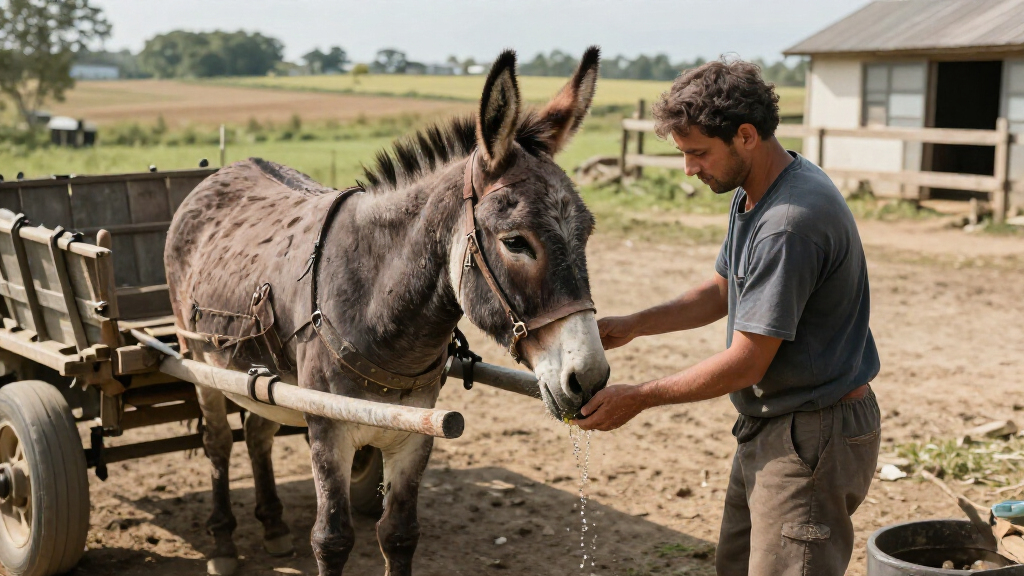

🔍 Read the full analysis: The Story Behind 26.7 Million Displaced Working Animals on ThorstenMeyerAI.com

Get business pricing on office and shipping supplies
- Business-only prices and quantity discounts
- Tax-exempt purchasing
- Multiple users, one account, clear invoices
TL;DR
A historical account published by ThorstenMeyerAI.com says horses and mules on U.S. farms peaked at 26.7 million in 1918, then fell to 3.1 million by 1960 as tractors spread. The episode uses that change to examine automation’s effects on farm labor and the limits of comparing animals with human workers.
ThorstenMeyerAI.com published a historical report on November 4 tracing how tractors displaced working horses and mules on U.S. farms, whose combined numbers peaked at 26.7 million in 1918 and had fallen to 3.1 million by 1960. The account frames the change as an early automation case study while cautioning that its implications for human workers are an analogy, not a forecast.
The report draws its animal counts from the U.S. Census Bureau’s 1975 Historical Statistics of the United States, Colonial Times to 1970, which reprints annual Department of Agriculture estimates. Horses alone reached a peak of 21.4 million in 1915; mules continued increasing, bringing the combined total to 26.7 million on January 1, 1918. By 1960, the combined count was 3.1 million, a decline of almost 90% from the peak.
The account links that decline to the rapid adoption of tractors. It reports about 1,000 tractors on U.S. farms in 1910, 246,000 in 1920, and 4.69 million in 1960. Around 1955, tractors outnumbered horses and mules for the first time, according to the figures cited. The report identifies the Fordson, launched by Henry Ford in 1917, as an inexpensive, lightweight tractor aimed at smaller farms; the Henry Ford museum describes it as a mass-produced model that rapidly became popular.
Animals required land for feed as well as labor. The cited agricultural statistics estimate that 93 million acres in 1915—more than a quarter of harvested U.S. cropland—grew feed for horses and mules. The report says that area had fallen to about five million acres by 1960. Tractors were part of a broader mechanization shift that also involved combines and other equipment, along with changes in seed and fertilizer use.
Mechanization Reshaped Farm Work
The change involved more than replacing one source of farm power with another. The report says U.S. farm employment peaked at 13.6 million in 1916 and fell to 4.5 million by 1970, while the national labor force doubled. It also cites a Department of Agriculture estimate that one farm worker supplied 7.1 people in 1910 and 47.1 in 1970; the latter figure includes people abroad supplied through exports.
These figures show how a more productive farm sector could support fewer workers, while other jobs and population growth were increasingly found outside agriculture. The account says that shift required people to move to cities. It does not establish that tractors alone caused the employment decline: machinery arrived alongside other technological and economic changes.
The story is relevant to current automation debates because it shows that productivity gains can transform work and the land devoted to supporting it. But the fate of farm animals cannot be mapped directly onto human workers. People can move between occupations, organize politically, and influence policy—differences the report says matter when evaluating the comparison.
Products Worth Considering

Canon PIXMA PRO-200S Wireless Professional Inkjet Photo Printer

HP Sprocket Portable 2×3 Instant Photo Printer, Lilac, with ZINK Paper Bundle

FLEXISPOT EN1 Electric Standing Desk, 60 x 24 in, Black
As an affiliate, we earn on qualifying purchases.
From Horse Power to Tractors
Before tractors became widespread, horses and mules powered ploughs, seed drills, reapers, and wagons. The animals consumed feed throughout the year, while a tractor required fuel when operating. The report presents the prospect of reclaiming feed acreage for crops as one economic incentive for mechanization, alongside the machines’ ability to do farm work.
Farm machinery adoption continued after tractors: the account cites roughly 4,000 combines in 1920, 190,000 in 1940, and more than one million by 1960. It also notes that data in the historical series do not all use identical census dates, and that the Department of Agriculture counted horses and mules together from 1951. Those qualifications matter when comparing individual years.
The report connects the historical case to economist Wassily Leontief, who compared workers with horses replaced by tractors in 1983. It says Leontief also pointed to a major distinction: horses could not vote. The episode’s central point is that the analogy can prompt questions about displacement, but does not establish that human workers will experience the same outcome.
Limits of the Horse Analogy
The historical animal and machinery counts are drawn from named statistical series, but the figures are not perfectly comparable year to year: the source notes differing census dates for tractor counts and a change in how horses and mules were counted. The account also describes several developments occurring together, including machinery, fertilizer, and improved seed. It does not isolate how much of the change in farm employment came from tractors alone.
Nor does the historical case show what will happen to workers affected by current automation. The report’s discussion of modern agricultural technology is limited: it says John Deere introduced a 16-camera autonomy kit in February 2025 for tillage on select large tractors, and reports China’s claim that about 74% of ploughing, sowing, and harvesting was mechanized in 2023. The source does not provide additional detail here on the measurement methods, job effects, or broader capabilities of those systems.
Where Farm Automation Stands
The report points to present-day farm automation as a developing, specialized area rather than a complete replacement for farm labor. The cited John Deere system performs tillage on select large tractors; the source does not say that it can handle every agricultural task or operate across all farms. Its account of mechanization in China is attributed to China and gives a 2023 figure, without further detail on how the share was calculated.
For readers following the story, the next useful evidence would be more specific information on which tasks autonomous equipment performs, how widely it is adopted, and what happens to employment and working conditions in affected areas. The historical record provides a case to compare against, but the report does not establish a timetable or outcome for today’s workers.
Key Questions
How many working horses and mules were on U.S. farms at the peak?
The historical series cited in the report estimates 26.7 million on January 1, 1918: about 21.2 million horses and 5.5 million mules.
How many remained by 1960?
The source reports 3.1 million horses and mules on farms in 1960, down almost 90% from the combined 1918 peak.
What happened to the working animals?
The account says farmers generally stopped breeding replacements as tractors spread, and the working population aged out. It describes no single mass event.
Does the story prove that automation will eliminate human jobs?
No. The episode presents the horse comparison as an analogy, not a law or forecast. It also points to differences between animals and people, including workers’ ability to move between jobs and participate in politics.
What modern farm automation does the report identify?
It cites a John Deere 16-camera autonomy kit introduced in February 2025 for tillage on select large tractors. The source does not describe it as capable of performing every farm task.
Source: ThorstenMeyerAI.com