
📊 Full opportunity report: Organize Content, Reviews, And Publishing With Social Media Tasks on IdeaNavigator AI — validation score, market gap, and execution plan.

Get business pricing on office and shipping supplies
- Business-only prices and quantity discounts
- Tax-exempt purchasing
- Multiple users, one account, clear invoices
TL;DR
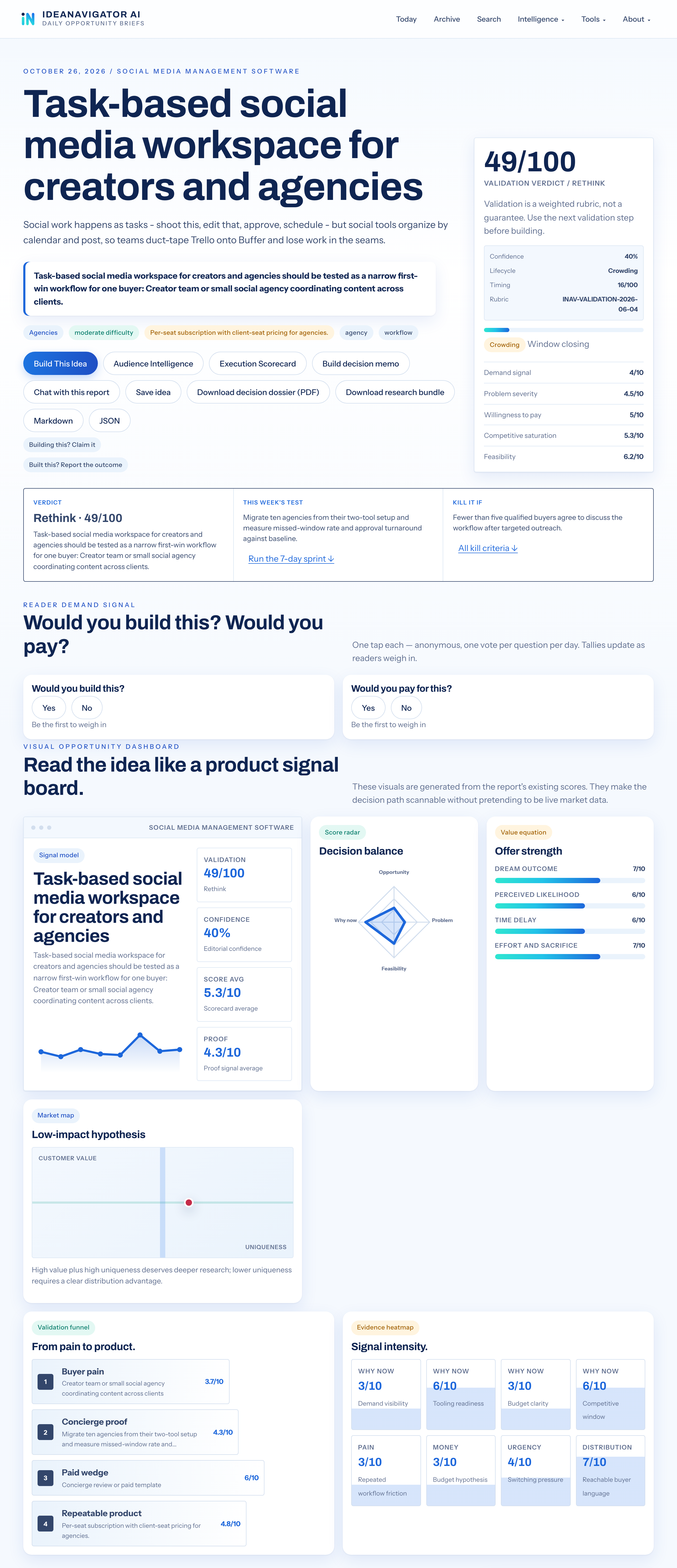
IdeaNavigator AI has outlined an early-stage product concept for creators and small social agencies: manage each social post as a task from brief through approval and publishing. The proposal calls for testing it with 10 agencies and comparing missed publishing windows and approval turnaround with their current workflows; no test results or product launch are reported.
IdeaNavigator AI has proposed a task-based workspace for creator teams and small social agencies that would connect content production, client review and publishing in one workflow. The concept remains at the validation stage: it recommends migrating 10 agencies from their current two-tool setups and measuring missed publishing windows and approval turnaround, but provides no results from such a test.
The proposed product treats each social post as a task, rather than organizing work only around a calendar or a published post. Its suggested stages are brief, asset creation, editing, approval and scheduling. A team would track a post through those steps in one workspace, with the intended endpoint being publication.
The minimum viable product outlined in the proposal includes client-facing approval links, asset versioning and scheduling that can begin after approval. These are product features being proposed, not capabilities of a currently available service identified in the material. The concept also suggests a per-seat subscription, with a separate client-seat pricing approach for agencies.
For validation, the proposal recommends moving 10 agencies away from their existing combination of tools, then comparing missed-window rates and approval turnaround against each agency’s baseline. It does not define the measurement period, specify which tools would be replaced, or report whether any agencies have agreed to participate.
Connecting Approval to Publishing
The concept targets a practical coordination problem for teams handling content across clients: work must pass through several production steps, while review and publishing may be managed in separate systems. When teams divide those steps between a social scheduler and a general project-management tool, the proposal argues, tasks can fall between them. That is a stated problem framing, not evidence that all agencies experience the same level of disruption.
If a single task record can carry a post from brief to approval and scheduling, it could give teams one place to check status, find the latest asset and identify what is holding up publication. Client review and asset versioning are central to that proposition because they address collaboration and handoffs, not just the timing of posts.
The suggested pilot would make the idea more testable by focusing on operational measures rather than broad claims about productivity. Comparing results with agencies’ own baselines could show whether the workflow changes approval time or missed publishing windows. No outcome can be inferred until such a comparison is conducted and its method and results are reported.
Products Worth Considering

Dell XPS 14 Premium 14.5-Inch Touchscreen Laptop, 3.2K OLED 48–120Hz, Intel Core Ultra 7 255H, 32GB RAM, 1TB SSD

Vari ComfortEdge Electric Standing Desk, 60 x 30 in, Black/Slate

Dell UltraSharp 27 Thunderbolt Hub Monitor (U2726DER), QHD
As an affiliate, we earn on qualifying purchases.
From Separate Tools to One Workflow
The proposal describes social-media work as a chain of tasks: a post is briefed, its assets are prepared, edits are made, a client reviews it, and the approved content is scheduled. It says existing social tools often center on calendars and posts, while teams use generic project-management tools to track the work around them. The resulting combination—described in the proposal as using Trello alongside Buffer—is an example of the kind of two-tool setup the concept aims to replace, not a finding about every team’s software.
The stated market is social media management software, with creator teams and small agencies coordinating work across multiple clients as the intended initial buyers. The rationale is that higher content-velocity expectations have increased the amount of coordination involved, while scheduling products have left some work-management needs to general-purpose tools. Those points explain the proposal’s assumptions; no market sizing, customer survey or independent evidence is included in the material provided.
Rather than recommending a broad launch, the plan frames the next step as a narrow first-win workflow for one buyer group. That focus would let a product team test whether agencies will adopt an integrated production pipeline before expanding its intended audience or feature set.
Pilot Results Have Not Been Reported
No product launch, participating agencies or pilot findings are confirmed in the proposal. It is not clear whether development has begun, whether any agency has agreed to test the workspace, or when a trial might take place. The proposal also gives no baseline figures for missed publishing windows or approval turnaround, so there is no quantified performance claim to assess.
Further details of the suggested test remain open, including how long agencies would use the system, how results would be measured, and whether comparisons would account for differences in team size, client approval practices or posting volume. Pricing is described only as a possible per-seat model with client-seat pricing; no rates or billing terms are specified. The concept likewise does not name a product or identify a company building it.
Agency Testing Is the Proposed Step
The next step set out in the concept is to migrate 10 agencies from their current two-tool workflows and compare missed-window rates and approval turnaround with each agency’s baseline. A useful update would clarify whether the agencies have been recruited, which features are included in the test, and the period over which outcomes will be tracked.
Until those details and results are available, the workspace should be understood as a product proposal rather than a demonstrated solution. Evidence from a defined pilot could help establish whether teams adopt the post-as-task workflow and whether the intended measures change; the current material does not establish either outcome.
Source: IdeaNavigator AI
Key Questions
Has the task-based social media workspace launched?
No launch is reported. The material describes a proposed product and a validation plan, not an available service.
Who is the proposed workspace for?
Its initial intended users are creator teams and small social agencies coordinating content across clients.
What would the workspace include?
The proposed minimum viable product would track posts through brief, asset, edit, approval and scheduling stages, with client approval links, asset versioning and scheduling after approval.
How would the idea be tested?
The proposal recommends testing with 10 agencies and comparing missed publishing windows and approval turnaround with each agency’s existing baseline. No test results are provided.
What pricing is being considered?
The concept suggests a per-seat subscription, including client-seat pricing for agencies, but gives no prices or finalized terms.
Source: IdeaNavigator AI