
TL;DR

Get business pricing on office and shipping supplies
- Business-only prices and quantity discounts
- Tax-exempt purchasing
- Multiple users, one account, clear invoices
Hugging Face has launched Microduck, a small, open-source robot that uses reinforcement learning to perform basic movements and tasks. Priced at $399, it aims to democratize embodied AI, though practical limitations remain. The development signals a shift toward accessible, physical AI platforms.
Hugging Face has introduced Microduck, a small, open-source robot priced at $399, equipped with reinforcement learning capabilities that enable it to perform movements such as waddling, sitting, and even rollerblading. This development marks a significant step in making embodied AI accessible and affordable, with the robot shipping before Christmas to pre-order customers. The launch highlights Hugging Face’s strategy to democratize physical AI, similar to its impact on language models, by providing developers with open, forkable hardware and software tools. Learn more about AI strategies.
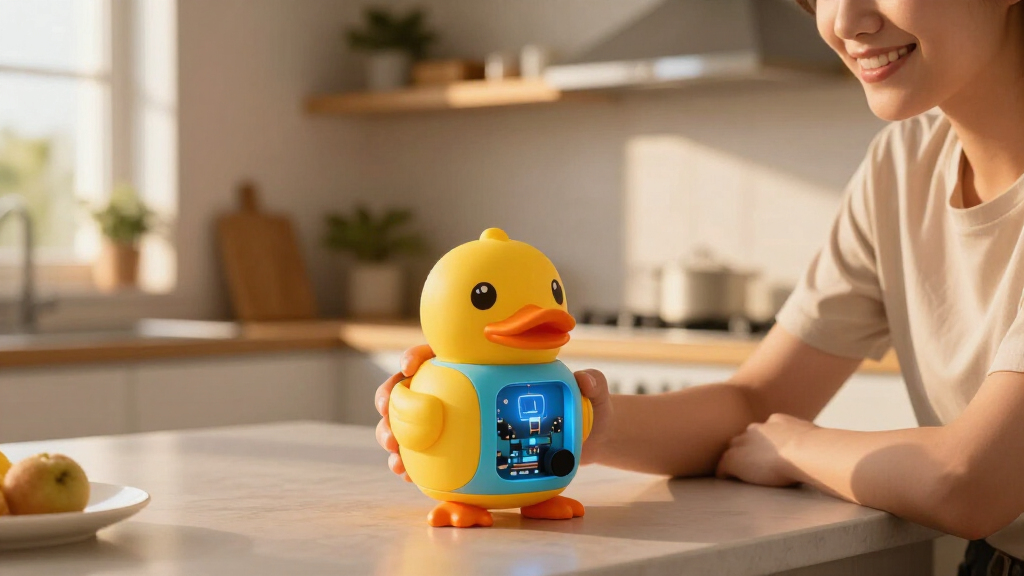
Microduck is a compact, bipedal robot approximately 25 centimeters tall and weighing less than 800 grams. It features 15 motors across its legs, head, and neck, along with sensors including two IMUs for balance, a LiDAR, a camera, a microphone, and a speaker. Its articulated beak functions as a gripper capable of lifting objects up to 800 grams. The robot can perform various movements such as waddling, sitting, recovering from falls, and following laser pointers, with demo videos showing it rollerblading. Priced at $399, preorders opened on Thursday, with shipments expected before Christmas.
While the hardware is impressive for its price point, experts caution that the demos—like sock retrieval and rollerblading—are curated highlights. For more on AI hardware developments, see inside Minimax H3. Real-world reinforcement learning involves extensive trial and error, which may not translate seamlessly into reliable everyday behavior on such low-cost hardware. Furthermore, the robot’s integrated sensors and connectivity raise privacy considerations, as it continuously observes and listens within a home environment.
Open-Source Reinforcement Learning for Embodied AI
The launch of Microduck represents a major shift toward democratizing embodied AI. By providing an affordable, open-source platform, Hugging Face aims to enable a broader community of developers and hobbyists to experiment with physical AI behaviors. This approach parallels the company’s influence in open language models, now extended to robotics. The potential for widespread experimentation could accelerate innovation, lower barriers for research, and challenge traditional, proprietary robotics development.
However, the open nature of the platform also introduces security and privacy challenges, especially given recent incidents involving open infrastructure. The move signals a strategic push to make AI and robotics more accessible, but it also raises questions about safety, data privacy, and the readiness of such systems for real-world deployment.
open source robot kit for beginners
As an affiliate, we earn on qualifying purchases.
As an affiliate, we earn on qualifying purchases.
Hugging Face’s Open-Source Robotics Strategy and Industry Impact
Hugging Face’s entry into robotics follows its established success in open AI models and datasets. The company’s acquisition of Pollen Robotics in April 2025 provided the hardware expertise needed to develop Microduck. The platform is designed to be a learning environment where developers can train, fork, and modify behaviors using open-source tools hosted on GitHub. This approach aims to challenge the dominance of proprietary, high-cost robotics systems often used by industry giants.
Prior to Microduck, Hugging Face released Reachy Mini, a stationary robot focused on communication, but Microduck shifts the focus to movement and embodied AI. The broader industry has seen increasing interest in open robotics platforms, but few offer such a combination of affordability, accessibility, and open development environment. The move aligns with a broader trend toward democratizing AI and robotics, making these technologies usable by smaller labs, startups, and individual developers.
“Reinforcement learning means failing thousands of times: the whole method is trial, error, tumble, adjust, repeat. Our design makes failure affordable and safe.”
— Clem Delangue, CEO of Hugging Face
AI robot toy with reinforcement learning
As an affiliate, we earn on qualifying purchases.
As an affiliate, we earn on qualifying purchases.
Unresolved Challenges in Practical Deployment
It is not yet clear how reliably Microduck will perform outside curated demos, given the complexity of reinforcement learning on low-cost hardware. The extent of privacy and security risks posed by its continuous sensors and connectivity remains to be fully assessed. Additionally, the long-term adoption and community engagement levels are still uncertain as the product begins shipping.
As an affiliate, we earn on qualifying purchases.
Next Steps for Microduck and Open Robotics Ecosystem
Hugging Face will begin fulfilling preorders before Christmas, with early adopters and developers testing the platform in diverse environments. The company plans to update the open-source codebase based on community feedback, potentially adding new behaviors and capabilities. Industry observers will watch for how well Microduck’s open approach fosters innovation and whether it influences broader adoption of open robotics platforms.
hobbyist robotics kit with sensors
As an affiliate, we earn on qualifying purchases.
As an affiliate, we earn on qualifying purchases.
Key Questions
Can Microduck perform household chores?
No, Microduck is designed as a learning platform and toy-scale robot. Its movements are experimental, and it is not built for practical household tasks.
What makes Microduck different from other robots?
Its open-source hardware and reinforcement learning platform set it apart, enabling developers to read, fork, and retrain its behaviors easily, democratizing physical AI development.
Are there privacy concerns with Microduck?
Yes, as it includes cameras, microphones, and sensors that operate continuously in a home environment, raising data privacy and security considerations that users should evaluate.
Will Microduck be suitable for commercial applications?
Currently, Microduck is primarily a developer and learning platform. Its reliability and safety for commercial or household use are not yet established.
Source: ThorstenMeyerAI.com
Halloween Picks
halloween
As an affiliate, we earn on qualifying purchases.