
TL;DR

Get business pricing on office and shipping supplies
- Business-only prices and quantity discounts
- Tax-exempt purchasing
- Multiple users, one account, clear invoices
Halloween themed promotional items are branded products designed around seasonal imagery and activities, from treat bags for family events to drinkware and totes for employees or clients. Choose based on who will receive them, how they will use them, product safety, total cost, and ordering lead time; practical items with clear branding can stay memorable after October 31.
A bowl of candy can disappear in an hour; a well-chosen tote might carry groceries for months. That difference is the heart of Halloween themed promotional items: a giveaway should feel fun in the moment and make sense for the person taking it home.
Halloween falls on October 31, giving businesses a clear seasonal hook for events, customer appreciation, employee gifts, and retail campaigns. But a pumpkin graphic alone will not make a product effective. You need to match the item to the audience, keep the brand readable, and account for safety, cost, and a tight seasonal schedule.
This guide walks you through those decisions with practical examples. You’ll learn which products fit children, employees, and clients; how to make seasonal design look polished; and what to check before approving an order. These are broad planning principles, not a live product or price roundup: availability, supplier lead times, and local requirements can change.
Match the product to its audience and handout setting: a school fair and a client event call for different choices.
Use the after-October test to compare an everyday item with a single-event novelty giveaway.
Keep Halloween imagery distinct from the logo, and test any QR code on the actual product.
Get a complete quote that includes customization, packaging, shipping, and minimum quantities.
Check children’s product guidance and verify environmental claims with product-specific information.
Choose Halloween giveaways that fit the people receiving them
Halloween themed promotional items work best when the product fits both the recipient and the circumstances of the handoff. A family event often involves people juggling coats, candy, and children, so a lightweight treat bag or sheet of stickers has an advantage: it is easy to carry and quick to distribute. At an evening networking event, guests may be more receptive to a reusable cup or tote because they have room to carry it and a likely use for it afterward. A mismatch creates friction; even a well-made product can become clutter if recipients cannot conveniently use or take it.
Start by picturing the handoff, not just the product on a supplier’s page. Ask how long people will be at the event, what they are already carrying, whether they can safely use the item, and where they might use it later. At a street fair, parents may value a bag that keeps treats together, while a small toy could be difficult to manage. At a seated employee gathering, a mug might be welcome, but a bulky item could be inconvenient for someone traveling home by transit.
Common options include treat bags, candy packaging, glow accessories, stickers, temporary tattoos, themed apparel, drinkware, and reusable totes. Treat this as a menu, not a popularity ranking: each choice has a different job and cost. A bookstore hosting a children’s costume afternoon might use stickers because they are inexpensive, compact, and easy to hand out. A software company giving gifts to employees might choose drinkware because it can serve a daily purpose, though it will generally require more budget and careful attention to design quality.
Then evaluate the useful part of the item, not only the branded surface. Comfortable tote handles, a cup that is pleasant to hold, and stickers suited to their intended use all improve the chance that someone keeps the giveaway. If the practical feature is poor, recipients may remember the inconvenience more than the logo. Think of the product as a party invitation: it should make sense for the guest and the setting, not merely match the decorations.
As an affiliate, we earn on qualifying purchases.
Pick practical products that keep working after Halloween
Halloween themed promotional items can earn attention beyond the event when they solve a small, recurring problem. Reusable drinkware, tote bags, apparel, and desk accessories have potential to stay in circulation after candy wrappers and paper cobwebs are gone. That longer life gives a brand more opportunities to be seen, but it is not automatic: a product has to be durable, comfortable, and appropriate for everyday settings. A cheap tote that tears or a mug with an overly loud design may be used less than a simple, well-made novelty item.
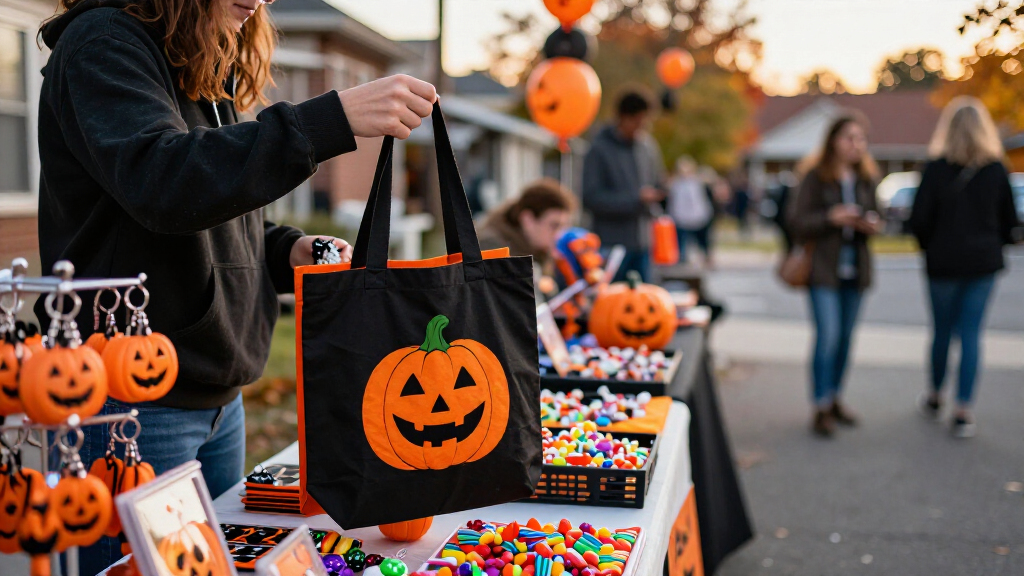
Try the after-October test: would someone still use this item on November 1, and in what situation? A plain black tote with a modest orange bat may work for grocery shopping because the seasonal detail is subtle. A bag printed with a specific event date may feel more personal at the event but less relevant the next morning. Neither is universally better. The first prioritizes repeat use and broad visibility; the second prioritizes commemoration and a sense of occasion.
Consider the recipient’s routine before assuming an item will be useful. An employee who commutes by car might welcome a travel mug, while someone who already has several may not. A client could use a sturdy notebook at work, but a tote may be a better fit if they regularly carry materials. This is why perceived usefulness matters as much as theoretical usefulness: the item needs to fit the person’s habits, not simply have a practical label.
For an employee gathering, imagine a guest walking out into a chilly evening with a branded mug and a snack pack. The mug has a clear use at the office the next morning, while the snack offers immediate value. For a client campaign, a useful notebook or sturdy tote can carry your logo into a meeting without turning every surface into an advertisement. In both cases, a restrained design helps the item feel like a gift rather than a demand for attention.
Practical value gives seasonal branding more time to be seen. A design can be playful, but the product still needs a reason to leave the drawer.
Balance lifespan against purpose and cost. A short-lived giveaway may be entirely appropriate for a one-time children’s activity, where low cost and easy distribution matter more than long-term branding. A reusable item may make more sense for employee appreciation, where quality can reflect how the organization values its staff. If you are comparing a disposable item with a durable one, consider total cost, packaging, storage, and the likelihood of actual use—not just unit price or the number of possible impressions.
As an affiliate, we earn on qualifying purchases.
Make your Halloween design festive without hiding your logo
Halloween themed promotional items look professional when seasonal imagery supports the brand instead of swallowing it. Use pumpkins, bats, ghosts, or autumn colors as accents, then leave enough contrast and open space for people to read your name. If your logo disappears into a busy pattern, the product may look festive but fail as promotion. More decoration is not always more memorable: visual competition makes it harder for someone to recognize the brand quickly, especially at a crowded event or from a distance.
Picture a dark-purple tote printed with tiny orange bats across every inch. From a few feet away, the design becomes visual noise. Now give the bats one corner, place a white logo in a clear area, and add a short message in a typeface large enough to read at arm’s length. The second version feels more deliberate—and works better when someone carries it through a crowded event. The useful test is not whether the artwork looks polished on a large screen, but whether its main elements remain distinct at the actual imprint size.
Keep the campaign goal visible. If you want event attendance, a QR code can point to a mobile-friendly schedule; if you want to offer a discount, label the code with a clear prompt such as “Scan for the fall offer.” This context tells recipients why scanning is worth their time and what they will get. A code without a prompt can look suspicious or simply be ignored. On a small or curved surface, the code may also be difficult to scan, so test a printed sample at the expected distance and under ordinary lighting. If it fails, use a larger imprint area or move the QR code to a card or tag.
Subtle seasonal graphics can give products a longer life than a design tied to one year, date, or single event, because the item remains appropriate after the occasion. But specificity has value too: a commemorative staff gift may be more meaningful when it includes the event name. Decide which outcome matters most—ongoing use or a keepsake—and design accordingly. Before approving artwork, check the imprint area, logo size, text contrast, and how the design looks on the item itself, not only on a screen.
As an affiliate, we earn on qualifying purchases.
Compare giveaways by audience, use, and tradeoff
The best Halloween promotional item depends on who receives it and what you want them to do with it. Treat bags and stickers suit quick family-event handouts because they are compact and generally simple to distribute; drinkware and totes can fit workplace or client gifting when the recipient has a reason to keep using them. Those advantages come with tradeoffs: reusable items may cost more, require more storage, and need stronger quality control. Use the comparison below as a starting point, then verify product details, current availability, and costs with your supplier.
| Recipient or setting | Possible item | Why it may fit | What to check |
|---|---|---|---|
| Children at a community event | Treat bag, stickers, pencil | Lightweight, easy to distribute, and simple to carry | Age guidance, small parts, materials, and applicable safety requirements |
| Families outdoors after dark | Glow accessory | Can add visibility at an evening activity | Product instructions and safety details; do not present it as a replacement for supervision or proper safety equipment |
| Employees at an office event | Drinkware, tote, desk item | May have a practical role after the celebration | Quality, customization, shipping, and whether the design suits everyday use |
| Adult guests or clients | Apparel, reusable tote, snack pack | Can feel useful or considerate in a social setting | Sizes, food details where relevant, packaging, and total delivered cost |
For example, a neighborhood market giving out hundreds of items to families may need a compact product that staff can hand over quickly and recipients can carry alongside their purchases. A company hosting a smaller client reception can spend more time on packaging and personalization, because the handoff is more considered and there may be fewer recipients. The market’s priority may be reliable quantity and low handling effort; the company may place greater weight on quality and presentation. Choosing one item for both settings could mean paying for features one audience does not value.
Use the table to narrow choices, not to assume every item fits every recipient. Then compare the practical tradeoffs: expected use, ease of distribution, storage and shipping, and the consequences if the item is unsuitable. Check specifications, especially for children’s items, and ask the supplier for current details. Product popularity, regulations, and availability vary by market and season, so a familiar product name is not a substitute for checking the specific item.
As an affiliate, we earn on qualifying purchases.
Order early and calculate the full cost before you commit
Halloween products have a short distribution window, so your plan needs time for design approval, production, shipping, and event preparation. The exact lead time depends on the product and supplier; ask for the current schedule rather than relying on last year’s estimate. Ordering early is not only about avoiding a missed date. It also leaves room to correct artwork, review a sample, or adjust quantities before a seasonal item loses much of its usefulness.
Use this simple sequence before placing an order:
- Set the distribution plan: estimate attendance or expected handouts, and decide where and when you will give items away.
- Choose the audience-fit product: compare usefulness, quality, safety information, and how long the item may stay in use.
- Approve the artwork: check the logo, message, imprint area, colors, and any QR code on a product mockup.
- Request the complete quote: include customization, packaging, shipping, minimum quantities, and any other stated fees.
- Confirm production and delivery dates: get the supplier’s current schedule and leave time for receiving and sorting the shipment.
For a practical example, imagine a store expecting 250 visitors at a weekend event. Ordering exactly 250 giveaways may leave no room for extra staff, damaged products, or higher turnout. Ordering far more can create boxes of leftovers in November. Estimate based on past attendance, event format, storage, budget, and the cost of either running short or keeping extras. The best quantity is a risk decision: a modest buffer can protect the event, but the right size depends on how costly shortages and leftovers would be.
The lowest quoted unit price may not be the lowest total cost. A modestly priced item can become expensive after setup, packaging, and delivery; a bulk deal can waste money if you cannot use the remaining stock. Consider costs alongside usefulness: a more durable product may justify a higher price if recipients will use it, while extra features have little value if they do not improve the experience. Get every cost in writing and confirm the final quantity and arrival date before approving production.
Check safety and environmental claims before handing items out
Before distributing Halloween promotional items, check whether the product suits its recipients and whether its material claims are specific and supported. Children’s products deserve extra attention: review age guidance, small parts, materials, and applicable safety requirements. These checks matter because the same feature that makes an item appealing—small size, for example—can create a risk for a young child. The product’s seasonal theme does not change the need to understand what you are handing out.
Suppose a business gives glow accessories to families at an outdoor event. The items may help people stand out in low light, but you should not describe them as a substitute for adult supervision or proper safety equipment. A short, clear handout instruction can help, and staff should know where to direct questions about the product. If a supplier cannot provide relevant product information, treat that uncertainty as a reason to pause or choose another item rather than assuming the item is suitable.
Environmental language also needs care. Words such as “recycled,” “compostable,” and “biodegradable” can depend on the product’s composition and how it is disposed of. A claim might apply to only one part of an item or require conditions that recipients cannot access. Ask the supplier what the claim covers, what evidence supports it, and what disposal conditions apply. If a reusable tote aligns with your organization’s goals, consider its durability and packaging too; a reusable label alone does not tell the whole story if the bag is poorly made or rarely used.
For a small business, this may mean choosing a simple, durable giveaway with minimal packaging rather than adding a sweeping environmental claim to the artwork. Precise language protects trust: a limited, verifiable statement is more credible than a broad promise that the product cannot substantiate. Product specifications and applicable requirements differ, so confirm them for the specific item and market before distribution.
Frequently Asked Questions
What are popular Halloween promotional items?
Common choices include treat bags, candy packaging, glow accessories, stickers, temporary tattoos, apparel, drinkware, and reusable totes. The best option depends on your audience and setting: a children’s event may call for stickers, while a client gathering may suit drinkware. Availability and popularity vary by season and location.
What are good Halloween giveaways for children?
Treat bags, stickers, pencils, and age-appropriate glow accessories are common options. Check age guidance, small parts, materials, and applicable safety information before ordering. Glow products may help with visibility at an evening event, but they are not a replacement for adult supervision or proper safety equipment.
When should a business order Halloween promotional products?
Order early enough to allow time for artwork, approvals, production, shipping, and event preparation. Lead times vary by product and supplier, so request the current production and delivery schedule before committing. Add a buffer for receiving and sorting the items before your event.
How can I make Halloween merchandise look professional?
Use seasonal imagery as an accent, keep strong contrast, and give your logo enough space to remain recognizable. Check the design at the product’s actual size; small text that looks clear on a monitor may be hard to read on a tote or cup. If you add a QR code, test it on the printed item and send it to a mobile-friendly page.
How can I compare the cost of Halloween promotional items?
Request a complete quote that includes the product, customization, packaging, shipping, and minimum order quantity. Compare the delivered total and the expected usefulness of each item, not only the quoted unit price. Order quantities should reflect expected attendance, storage, budget, and the risk of leftovers or running short.
What makes a Halloween giveaway more sustainable?
Consider durable reusable products, minimal packaging, and material claims you can verify with the supplier. Ask what terms such as “recycled” or “compostable” mean for that specific item and what disposal conditions apply. A product’s impact also depends on whether recipients use it and how they dispose of it.
Conclusion
Choose the giveaway by starting with the person who will carry it home, not the Halloween graphic you want printed on it. Match the item to the setting, make the brand easy to read, and confirm safety details, complete costs, and delivery timing before you approve the order.
A good seasonal promotion should feel like a treat, not clutter. Give people something useful enough to survive the last piece of candy—and let your brand travel with it.
Halloween Picks
halloween
As an affiliate, we earn on qualifying purchases.