
TL;DR

Get business pricing on office and shipping supplies
- Business-only prices and quantity discounts
- Tax-exempt purchasing
- Multiple users, one account, clear invoices
Bloomberg’s financial terminal began as the Market Master, a computer-based system delivered to Merrill Lynch in 1982 with U.S. government bond data and calculation tools. The product combined market information and analysis in one interface, and the company renamed it the Bloomberg Terminal after Innovative Market Systems rebranded as Bloomberg LP in 1987.
Bloomberg’s financial terminal began in 1982 as the Market Master, a system that supplied Merrill Lynch with U.S. government bond prices and tools for bond calculations. The product brought data and analysis together in one computer interface, helping Innovative Market Systems establish a business in a financial information industry then served by phone calls, printed sheets and specialist publications, according to an account by IEEE Spectrum.
Michael Bloomberg cofounded Innovative Market Systems (IMS) after leaving Salomon Brothers, where he had helped build computerized financial systems. He was joined by former colleagues Thomas Secunda, Duncan MacMillan and Charles Zegar. Bloomberg believed financial firms would pay for specialized data, and IMS set out to build a terminal that could provide current information and perform quantitative analysis using historical data.
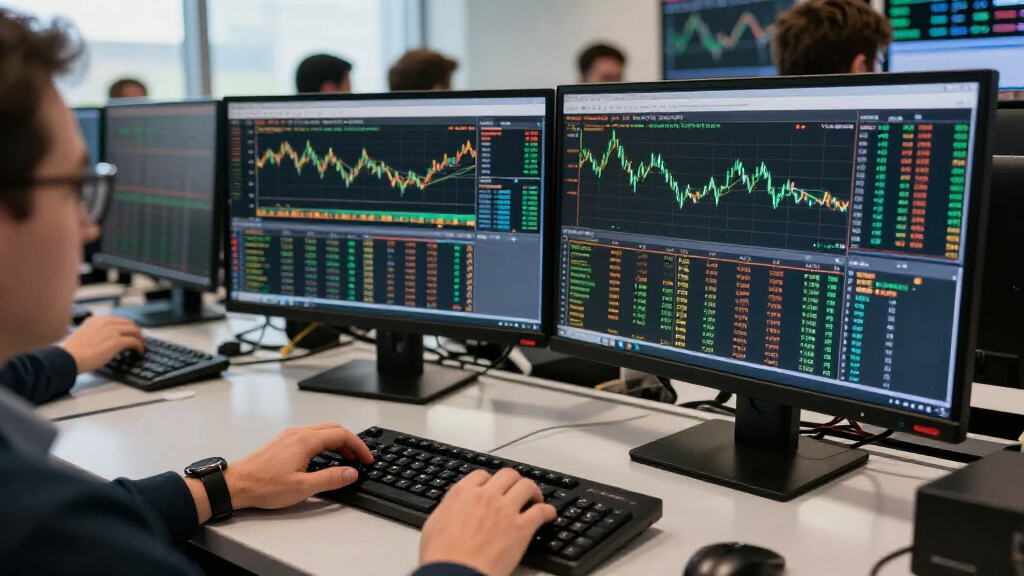
The initial Market Master combined a monochrome CRT monitor, a custom keyboard and a communications controller linked to IMS’s private network. Its initial offering was narrow: U.S. government bond prices and bond calculations. The larger plan was to give users a desk-based system for investment calculations and analysis, including running market scenarios and producing yield curves.
IMS’s first client was Merrill Lynch, which invested $30 million for a 30 percent stake and exclusive rights to the terminals for five years. The first 22 units were delivered in 1982. Merrill Lynch later waived its exclusivity, in 1984. Five years after launch, IMS changed its name to Bloomberg LP, and the Market Master became known as the Bloomberg Terminal, the IEEE Spectrum account says.
Why One Financial Interface Mattered
The terminal’s significance lay in bringing financial data and analytical tools into a single system. Before IMS’s product, users often had to gather news and market information from separate services, make calls or consult printed materials, then do their own calculations. An integrated interface offered a more direct way to examine prices and assess bonds.
The launch also coincided with changes in markets that made bond analysis more pressing. The source account describes a period when trading was moving toward electronic systems and U.S. interest rates were becoming more freely determined. With bond prices more volatile, investors had greater reason to evaluate values and yields. The terminal was not simply a faster display: its calculation tools were intended to help users interpret the information they received.
The broader lesson in the account is that financial technology has repeatedly changed how quickly market information moves and how people access it. The Bloomberg Terminal’s early design addressed a practical business problem—fragmented information and labor-intensive analysis—through a dedicated computer, keyboard and communications network. Its later identity grew from that original, more limited bond-focused service.
As an affiliate, we earn on qualifying purchases.
From Ticker Tape to Market Master
Financial information services long predated computer terminals. IEEE Spectrum’s account traces commercial business information back to the Mercantile Exchange in 1841 and describes Paul Julius Reuter’s news and stock-price service in the following decade. Telegraph-based ticker machines later delivered stock prices to users, with Edward Calahan introducing a telegraphic ticker in 1867 and Thomas Edison patenting an improved design in 1871.
By the late 19th and early 20th centuries, messengers and stock tickers carried market information between trading floors and brokerage offices. Electronic screens arrived in 1960, when Quotron introduced a paperless service for displaying market quotes. Other providers followed over the next two decades. When IMS entered the field in 1981, financial firms could already buy information from companies such as Reuters and Dow Jones, but they still had to combine sources and carry out much of their own analysis.
IMS’s approach depended on its own closed communications network, rather than the commercial internet, which was not available at the time. The terminal keyboard—nicknamed the “Chiclet”—used color-coded, finance-specific function keys. A dedicated phone line connected the controller to a local hub; centralized computers held databases, processed requests and sent results back to the terminal.
““IMS proposed an integrated system with a single interface.””
— IEEE Spectrum’s account of IMS’s early product
professional bond analysis software
As an affiliate, we earn on qualifying purchases.
As an affiliate, we earn on qualifying purchases.
What the Historical Account Leaves Open
The source describes the terminal’s origins and early design, but it does not provide a detailed year-by-year record of later product changes, adoption rates or the size of Bloomberg LP’s business today. It also does not quantify how much time or money early users saved, so the practical gains beyond the system’s stated functions cannot be measured from this account alone.
The account says Merrill Lynch invested $30 million and received a 30 percent stake, but it does not detail the terms of that investment or the circumstances of the 1984 waiver of exclusivity. Those points should not be read as a complete history of the company’s financing or commercial agreements.
As an affiliate, we earn on qualifying purchases.
The Terminal’s Longer Development
The account’s early timeline ends with the 1987 name change, when IMS became Bloomberg LP and Market Master took on the Bloomberg Terminal name. It does not describe subsequent software releases or later expansion into other services. A fuller account of the product’s development would need to trace those later changes separately, rather than infer them from its 1982 launch.
What is established here is the sequence: IMS was founded in 1981, its first 22 terminals reached Merrill Lynch in 1982, the client waived exclusivity in 1984, and the company and product adopted their Bloomberg names five years after launch. The source offers no further milestone or announced next step; this is a historical account, not a report of a new product development.
As an affiliate, we earn on qualifying purchases.
Key Questions
When did the first Bloomberg terminals reach a customer?
The first 22 Market Master terminals were delivered to Merrill Lynch in 1982, according to IEEE Spectrum’s account.
What did the original Market Master do?
At launch, it provided U.S. government bond prices and tools for bond calculations. The broader goal was to support investment analysis, market scenarios and yield-curve production.
Why did IMS build a private network?
Commercial internet access was not available at the time. The terminal’s controller used a dedicated phone line to connect to a local hub, where centralized computers stored data and processed requests.
When did the Market Master become the Bloomberg Terminal?
IEEE Spectrum says IMS rebranded as Bloomberg LP five years after the 1982 launch, and the Market Master then became known as the Bloomberg Terminal.
Source: hn
Halloween Picks
halloween
As an affiliate, we earn on qualifying purchases.