In a TRIZ workshop, counterintuitive exercises push you to challenge assumptions and explore unexpected solutions. By shifting perspectives and employing techniques like paradoxical prompts and lateral thinking, you unleash creative ideas that may seem illogical at first. These exercises break mental blocks, foster innovation, and empower teams to find simple, effective solutions. Keep exploring, and you’ll discover how these powerful methods can transform your problem-solving approach and ignite new opportunities.
Key Takeaways
- Counterintuitive exercises challenge assumptions and promote lateral thinking, revealing innovative solutions beyond conventional methods.
- Incorporating paradoxical prompts and constraints stimulates creative problem-solving during TRIZ workshops.
- Reframing problems to explore opposite perspectives uncovers hidden opportunities and root causes.
- Techniques like contradiction analysis and resource resolution help break mental barriers and foster breakthrough ideas.
- Creating a safe environment encourages risk-taking, collaboration, and openness to unconventional solutions in the workshop.
As an affiliate, we earn on qualifying purchases.
What Is TRIZ and Why Is It a Game-Changer for Problem Solving?

TRIZ is a powerful problem-solving methodology that helps you find innovative solutions by systematically analyzing and overcoming contradictions in your design or process. It encourages innovative thinking by challenging your assumptions and prompting you to see problems from new angles. Instead of sticking to traditional approaches, TRIZ guides you to reframe problems, revealing hidden opportunities. This problem reframing enables you to develop creative solutions faster and more effectively. By focusing on the core contradictions within your challenge, TRIZ allows you to break free from mental blocks and explore alternative possibilities. Additionally, TRIZ incorporates systematic analysis, which enhances your ability to identify root causes and develop robust solutions. It also emphasizes the importance of contradiction elimination, which helps to resolve conflicting requirements within your project or design. Implementing TRIZ techniques can also improve problem reframing skills, making you more adaptable in complex situations. Ultimately, it transforms complex issues into manageable tasks, making it a game-changer for anyone enthusiastic to access innovative solutions and improve their problem-solving skills.
As an affiliate, we earn on qualifying purchases.
How Do Counterintuitive Exercises Unlock Creative Solutions?

Counterintuitive exercises challenge your usual way of thinking, encouraging you to see problems from unexpected angles. They push you beyond your default heuristic thinking, which often relies on familiar patterns and shortcuts. By deliberately questioning assumptions, you can bypass cognitive biases like anchoring or confirmation bias that limit creativity. These exercises force you to reframe issues, revealing hidden solutions that might seem illogical at first. They disrupt your habitual thought processes, making room for innovative ideas. As a result, you become more open to unconventional approaches and break free from mental constraints. This shift in perspective helps you uncover creative solutions that wouldn’t surface through traditional problem-solving methods, unshackle fresh insights and enabling breakthrough innovations.
paradoxical prompts for creativity
As an affiliate, we earn on qualifying purchases.
As an affiliate, we earn on qualifying purchases.
How Do TRIZ Workshops Challenge Assumptions to Spark Innovation?

A TRIZ workshop challenges your assumptions by actively prompting you to question the underlying principles that shape your thinking. By encouraging you to examine and break free from ingrained beliefs, it fosters essential mindset shifts that open new avenues for problem-solving. These exercises push you beyond conventional thinking, making you see challenges from fresh perspectives. As a result, your creativity sparks, enabling you to identify innovative solutions that might have seemed impossible before. The process dismantles mental barriers, helping you realize that many assumptions are just constraints you can challenge or reframe. This dynamic environment pushes you to think differently, inspiring breakthroughs that drive technological and process improvements. Understanding the importance of analytical thinking in problem-solving can further enhance your ability to innovate. Additionally, practicing creative problem-solving techniques within the workshop can amplify these benefits. Incorporating AI-driven insights can further support your ability to challenge assumptions and generate innovative ideas. Cultivating a mindset of continuous learning can also help sustain the innovative practices developed during the workshop. Ultimately, TRIZ workshops transform your approach, making innovation a natural outcome of challenging assumptions.
As an affiliate, we earn on qualifying purchases.
What Are Common Counterintuitive Techniques Used in TRIZ Sessions?

You might be surprised to learn how applying the Contradiction Matrix can reveal innovative solutions by challenging your assumptions. Resolving resource contradictions often leads to unexpected breakthroughs, even when it seems counterintuitive. Balancing functionality and cost pushes you to think creatively about optimizing performance without overspending. Exploring Free Floating designs can offer flexible and adaptable solutions that seamlessly integrate with existing backyard layouts. Incorporating connected fitness technologies into these designs can further enhance adaptability and user engagement. Additionally, understanding regulatory compliance is crucial when implementing these strategies to ensure adherence to industry standards and legal requirements. Recognizing the significance of creative problem-solving methods can also help unlock innovative ideas in these counterintuitive exercises, especially when embracing innovative thinking techniques that challenge conventional wisdom.
Contradiction Matrix Application
Have you ever wondered why some TRIZ sessions seem to produce surprising breakthroughs? It’s often due to the use of the Contradiction Matrix, which employs paradoxical thinking to challenge assumptions. This technique helps you identify creative paradoxes—situations where opposing requirements coexist—prompting unconventional solutions. By mapping specific engineering contradictions to inventive principles, the matrix guides you toward counterintuitive ideas that might seem illogical at first. Instead of attacking problems head-on, you embrace contradictions as opportunities for innovation. The paradoxical approach encourages you to think beyond traditional trade-offs, *discover* solutions that initially feel counterintuitive. Applying the Contradiction Matrix transforms complex problems into manageable puzzles, revealing hidden pathways to breakthrough ideas through strategic use of paradoxical thinking.
Resource Contradiction Resolution
When resolving resource contradictions in TRIZ sessions, practitioners often turn to counterintuitive techniques that challenge conventional thinking. These methods help optimize resource allocation and boost efficiency in unexpected ways. Here are four common techniques:
- Divide and Conquer: Break down the problem to allocate resources more effectively.
- Use of Contradictions: Identify conflicting requirements and resolve them by rethinking resource distribution.
- Resource Recycling: Reuse existing resources instead of acquiring new ones to improve efficiency.
- Contradiction Elimination: Transform resource conflicts into opportunities for innovative solutions by questioning assumptions.
Additionally, understanding decoding slang and informal language can facilitate clearer communication and idea sharing during brainstorming sessions.
Functionality vs. Cost
In TRIZ sessions, balancing functionality and cost often requires unconventional thinking that challenges standard assumptions. Instead of always aiming for maximum functionality, consider reducing costs by simplifying designs or using alternative materials. Counterintuitively, cutting back on certain features can lead to more efficient solutions that still meet core needs. Similarly, focusing on functionality enhancement doesn’t always mean adding complexity; sometimes, improving a single feature yields better results without increasing costs. Techniques like separating functions or eliminating unnecessary parts can open up innovative ideas. By shifting your perspective from a linear cost versus function mindset, you discover creative ways to optimize performance while minimizing expenses. This counterintuitive approach helps you find solutions where increased functionality and cost reduction work hand in hand.
How Can You Incorporate Counterintuitive Exercises Into Your Problem-Solving Process?

Curious about how to make your problem-solving more innovative? Incorporating counterintuitive exercises can boost your mental agility and help you see solutions differently. Here are four ways to do it:
- Set creative constraints—limit your options intentionally to spark fresh ideas.
- Challenge assumptions—question the obvious to uncover hidden opportunities.
- Use paradoxical prompts—ask yourself what would happen if the opposite were true.
- Engage in lateral thinking—deliberately approach problems sideways, breaking routine patterns.
- Exploring the astrological signs associated with charm and attractiveness can open new perspectives on personal traits and perceptions.
Real-World Examples of Solutions Unlocked Through TRIZ Exercises
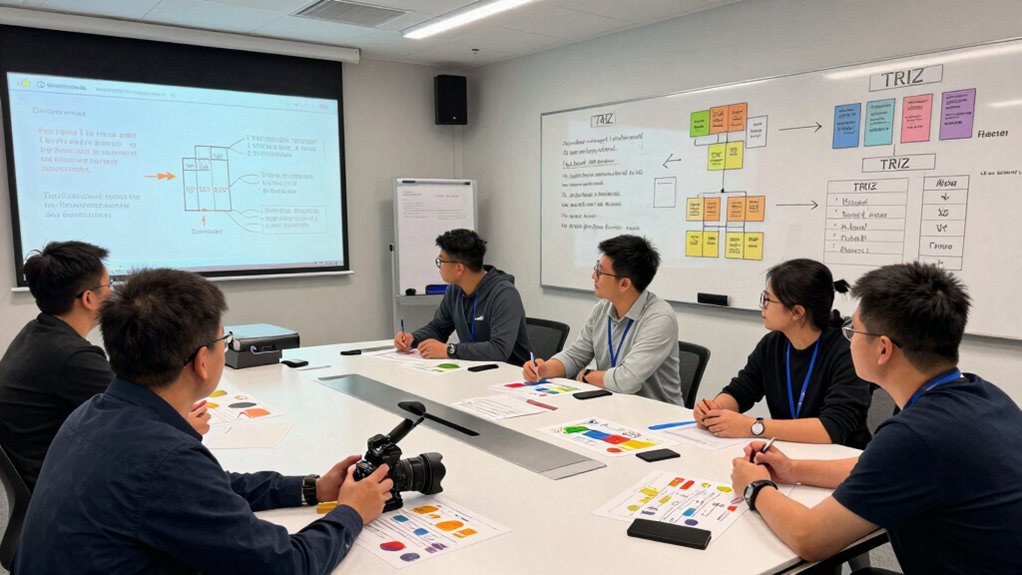
Have you ever wondered how TRIZ exercises lead to breakthrough innovations? These exercises foster innovative thinking by encouraging you to reframe problems from different angles. For example, a manufacturing team used problem reframing to address equipment downtime, identifying overlooked causes and developing a simple, cost-effective solution that increased productivity. In another case, designers of a consumer product applied TRIZ principles to eliminate unnecessary parts, reducing weight and cost without sacrificing performance. These real-world examples show how TRIZ exercises help teams see beyond traditional solutions, revealing creative ideas that might not emerge through conventional approaches. By challenging assumptions and shifting perspectives, you can uncover innovative solutions faster and more effectively, transforming complex problems into opportunities for breakthrough innovation. Additionally, incorporating professional techniques such as using specialized tools or expert guidance can further enhance the effectiveness of TRIZ exercises. Exploring how navigation and mapping strategies are integrated into problem-solving processes can also unlock new avenues for solutions. Incorporating systematic analysis methods can reveal hidden relationships and opportunities that might otherwise be overlooked. Employing visualization tools can further clarify complex problems and inspire innovative ideas. Furthermore, understanding the importance of vetted approaches ensures that solutions are reliable and sustainable over time.
What Are the Benefits of Using Counterintuitive Exercises for Teams and Individuals?

Ever wonder how counterintuitive exercises can disclose fresh perspectives and innovative solutions? These exercises boost your ability to embrace creative risk taking and enhance mental flexibility. By challenging assumptions, you’re encouraged to think outside the box and see problems differently. Here are some key benefits:
- Strengthen your creative risk-taking skills to explore unconventional ideas.
- Improve mental flexibility, enabling you to adapt quickly to new challenges.
- Break mental blocks that limit innovative thinking.
- Foster team collaboration through shared exploration of counterintuitive approaches. Additionally, engaging in these exercises cultivates a growth mindset, encouraging continuous learning and resilience.
- Reinforce the importance of exploring alternative viewpoints to uncover hidden opportunities.
Using these exercises helps individuals and teams develop a mindset open to surprising solutions, making your problem-solving process more dynamic and effective. It’s about unlocking potential you might not access through traditional methods.
How to Design Effective Counterintuitive Exercises for Your Workshop

Designing effective counterintuitive exercises begins with clearly identifying the specific mindset or thinking patterns you want to challenge. Focus on creating a mindset shift by framing problems in unexpected ways, encouraging participants to see beyond conventional solutions. Incorporate creative constraints that limit usual approaches, forcing participants to think differently. For example, set rules that restrict certain resources or methods, prompting innovative ideas within these limits. Make sure your exercises are challenging yet achievable, pushing participants to embrace the unfamiliar. Use real-world scenarios relevant to your team’s work to increase engagement. By carefully designing exercises that leverage creative constraints, you help unseal unconventional thinking and foster the mindset shift necessary for breakthrough solutions. Fostering kindness and positive change can also enhance group cohesion and open-mindedness, making creative exercises more effective. Additionally, integrating elements that address group dynamics can improve collaboration and overall problem-solving effectiveness. Recognizing the influence of astrological signs on perceptions can also help tailor exercises to diverse perspectives, enriching the creative process.
How Can You Overcome Resistance and Encourage Unconventional Thinking?

What strategies can you use to overcome resistance and foster unconventional thinking? First, promote a mindset shift by encouraging openness to new ideas, which helps eliminate bias. Second, challenge assumptions directly to disrupt ingrained thinking patterns. Third, create a safe environment where unconventional ideas are welcomed without judgment. Fourth, use exercises that highlight the value of counterintuitive solutions, making participants comfortable with the unfamiliar. By focusing on bias elimination and cultivating a growth mindset, you’ll reduce resistance. This approach helps participants see beyond their default perspectives, liberating innovative ideas. Remember, resistance often stems from fear of the unknown, so guiding your team through these strategies encourages them to embrace and explore unconventional thinking confidently.
How to Measure the Impact of TRIZ Counterintuitive Exercises

Measuring the impact of TRIZ counterintuitive exercises is essential to understanding their effectiveness in fostering innovation. You can use quantitative metrics like the number of new ideas generated, problem resolutions, or process improvements to gauge tangible results. Additionally, tracking time saved or cost reductions offers concrete evidence of progress. Complement these with qualitative feedback from participants to capture insights on how their thinking shifted and their confidence in applying TRIZ principles. Surveys, interviews, and reflective sessions reveal perceptions and deeper understanding that numbers alone can’t show. Combining these approaches provides a thorough view of the exercises’ influence, helping you refine your methods and demonstrate tangible value to stakeholders. This balanced assessment ensures you continue to leverage counterintuitive exercises effectively in your innovation efforts.
Frequently Asked Questions
How Do You Tailor Counterintuitive Exercises for Different Industries?
You tailor counterintuitive exercises by focusing on industry-specific adaptation, which addresses unique challenges and goals within each sector. First, analyze the industry’s pain points and processes, then incorporate cross-industry strategies to inspire fresh perspectives. Adjust scenarios and examples to resonate with participants’ daily experiences, ensuring the exercises challenge assumptions and spark innovative thinking relevant to their field. This targeted approach helps unleash actionable solutions effectively.
What Are Common Pitfalls When Implementing TRIZ Counterintuitive Techniques?
About 60% of teams struggle with implementing TRIZ counterintuitive techniques, often due to overcoming resistance or misinterpreting solutions. You might find it hard to challenge norms or accept unconventional ideas. To succeed, focus on clear communication, address doubts early, and emphasize that initial confusion often leads to breakthrough insights. Avoid misinterpreting solutions as setbacks; instead, see them as stepping stones toward innovative breakthroughs.
How Long Does It Typically Take to See Results From These Exercises?
You can typically see results from TRIZ counterintuitive exercises within a few weeks to a few months, depending on your engagement level. Timing expectations vary, but consistent practice often leads to breakthroughs in problem-solving. Success indicators include a newfound ability to generate innovative ideas, solve complex issues more efficiently, and recognize patterns others overlook. Stay committed, and you’ll notice these positive changes emerging as you apply the techniques regularly.
Can Beginners Effectively Participate in Complex TRIZ Exercises?
You can absolutely plunge into complex TRIZ exercises as a beginner! While beginner challenges might seem overwhelming at first, these exercises are designed to spark rapid skill development. With patience and practice, you’ll find yourself unraveling solutions faster than you ever imagined. Don’t let initial difficulties hold you back—embrace the challenge, and watch your problem-solving abilities skyrocket, transforming complexity into clarity in record time!
What Resources Are Recommended for Mastering Counterintuitive Problem-Solving?
You should explore resource guides focused on creative thinking and problem-solving techniques to master counterintuitive methods. Books like *Thinkertoys* or *Lateral Thinking* offer practical strategies, while online courses and workshops can deepen your understanding. Practice applying these approaches regularly to sharpen your skills. By actively engaging with these resources, you’ll develop the mindset needed to approach problems creatively and *release* innovative solutions through counterintuitive thinking.
Conclusion
Embracing counterintuitive exercises in TRIZ can truly open new doors to innovation. By challenging your assumptions and thinking outside the box, you’ll discover solutions that once seemed out of reach. Remember, sometimes you have to think backwards to move forward. Keep an open mind, stay curious, and don’t be afraid to shake things up—you might just find the breakthrough you’ve been searching for. After all, fortune favors the bold.