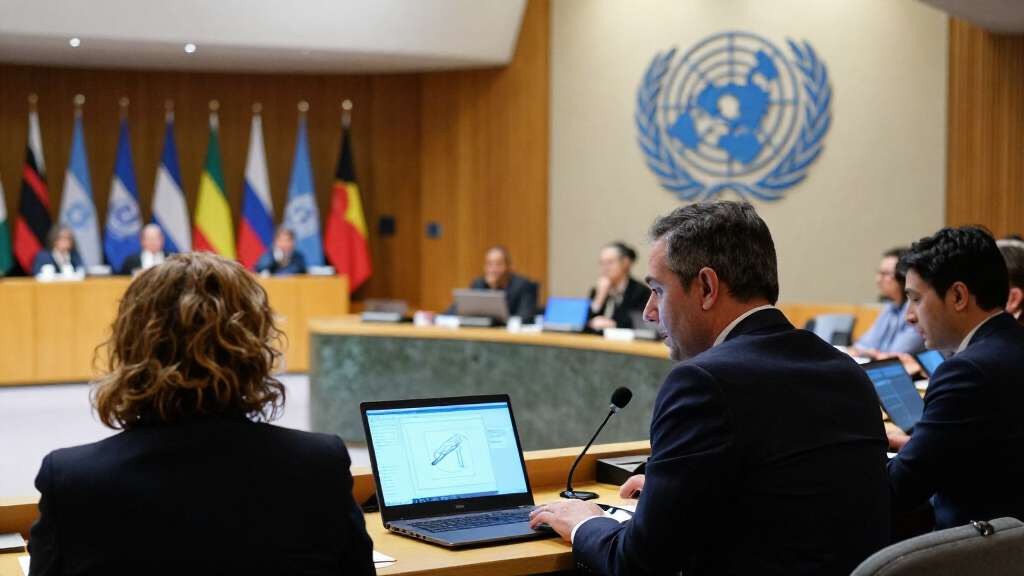

🔍 Read the full analysis: Killer Robot Talks At The UN: The Main Positions And What They Mean on ThorstenMeyerAI.com

Get business pricing on office and shipping supplies
- Business-only prices and quantity discounts
- Tax-exempt purchasing
- Multiple users, one account, clear invoices
TL;DR
A UN review conference tasked experts with developing an instrument on lethal autonomous weapons and reporting in 2028. States left open whether it will be a binding protocol, and scheduled 10 days of talks in Geneva for 2027. The outcome advances work on shared principles but does not create new legal obligations.
The UN Convention on Certain Conventional Weapons review conference has tasked government experts with developing an instrument on lethal autonomous weapons, but stopped short of directing them to negotiate a binding treaty. The decision, adopted in Geneva after talks ended shortly after 4 a.m. on November 21, leaves the instrument’s legal form open and sets a 2028 reporting deadline.
The conference’s decision says the expert group is to “elaborate, by consensus, an instrument, without prejudging its nature.” Its report must recommend the instrument’s legal form and specific format, including whether states should adopt it as a binding protocol. A binding agreement remains possible, but the decision does not promise one or create new obligations.
The group is scheduled to meet for 10 days in Geneva in 2027: March 1–5 and August 30–September 3. Its chair is also due to update a meeting of states parties on November 10–12, 2027. The group’s report is to go to the 2028 meeting. The adopted decision also endorses 20 paragraphs of elements agreed by experts in September 2026.
Those elements address a working definition of autonomous weapons, the application of international humanitarian law, human judgment and control, legal reviews, testing, and safeguards against bias in data sets and AI models. They are part of the agreed basis for continued work; the conference decision does not make them a new treaty or settle how states will apply them.
UN talks on autonomous weapons
From “negotiate” to “elaborate”: the road to 2028
What the weapons convention (CCW) has done so far, and what it agreed in Geneva. Blue: decided. Ochre with “?”: still open.
Dates from the official documents
- First meeting of expertsSet up by the CCW states; talks have run ever since
- 20 paragraphs of elements agreedDefinition, law applies fully, human judgement, accountability
- The mandate for the next two years negotiate a new Protocolelaborate an instrument “without prejudging its nature”
- 10 days of meetings in Geneva1 to 5 March and 30 August to 3 September
- Report and recommendationBinding protocol or not: the group must recommend, by consensus
Sources: CCW final document CCW/CONF.VII/CRP.1/Rev.3 (adopted, Nov 20, 2026), pages 6 to 7; GGE report CCW/GGE.1/2026/3, Sep 14, 2026; working paper CCW/CONF.VII/WP.7, Nov 18, 2026; mandate proposal listed under Main Committee II.
Graphic: Powered by Thorsten Meyer AI
The 2027 Work Ahead
The outcome matters because it keeps an international process moving on weapons that can select and attack targets without a human deciding each strike. But the difference between an instruction to negotiate a protocol and a mandate to develop an instrument whose nature is undecided is substantial: the latter leaves states room to disagree over whether future rules will be binding.
For governments, the 2028 deadline creates a point at which they will have to consider a recommendation on legal form. For defense manufacturers and companies supplying military or dual-use AI, the endorsed elements offer an indication of the issues under discussion, including testing, legal review and human control. They do not change legal requirements today, though those issues may feature in procurement and export discussions before the UN process concludes.
The decision also shows both the value and the constraint of consensus diplomacy. A shared mandate and set of elements can preserve cooperation among states with different positions. At the same time, consensus can limit how far an agreement goes when participants do not accept the same path toward binding rules.
Products Worth Considering

Samsung Odyssey G55C 32-Inch QHD Curved Gaming Monitor

Apple Mac mini Desktop Computer with M5 Pro Chip and AppleCare+ (3 Years)

Dell 27 Plus S2725HSM 27-Inch FHD 144Hz Monitor with Speakers
As an affiliate, we earn on qualifying purchases.
How the Mandate Changed
The discussions took place at the Seventh Review Conference of the Convention on Certain Conventional Weapons, which has addressed lethal autonomous weapon systems through an open-ended group of government experts. The source account says discussions in the convention began in 2013, giving the latest decision a longer history of deliberation.
Several proposals called for a more direct negotiating mandate. A working paper by Austria, Belgium, Brazil, Ireland, Mexico, New Zealand and Panama proposed a time-bound negotiation for a new protocol, with 25 meeting days over one year. Another proposal described in the source called for 15 days of meetings annually and a draft protocol for the 2028 meeting. The final decision instead sets 10 days a year and asks the group to elaborate an instrument without deciding its legal nature in advance.
Because the convention operates by consensus, any state can prevent agreement. The adopted document itself does not name countries that opposed particular wording. Reuters reported that Russia’s opposition weakened the outcome and that Russian procedural objections led to formal meetings being cancelled. Reuters and Al Jazeera reported that the United States, Russia and Israel opposed the push for binding rules. These accounts are reporting on the negotiations, not findings stated in the final text.
““Elaborate, by consensus, an instrument, without prejudging its nature.””
— The adopted conference decision
Binding Rules Still Unsettled
The central unresolved issue is whether the eventual instrument will be a binding protocol or take another form. The conference has not adopted new rules governing autonomous weapons, and the expert group’s recommendation is not due until 2028.
The final document does not identify which states resisted a negotiating mandate. Reports attributing opposition to particular countries come from journalists and diplomats, as described in the source account; they are not named in the official decision. The available material also does not establish what specific provisions, if any, states will ultimately agree to, or how the endorsed elements might be translated into operational rules.
Geneva Sessions in 2027
The expert group is scheduled to meet in Geneva on March 1–5 and August 30–September 3, 2027, for a total of 10 days. Informal meetings involving legal, military and technical experts may also be added. The group’s chair is scheduled to report to states parties at their November 10–12, 2027 meeting.
The main formal milestone is the group’s report to the 2028 meeting of states parties. That report is expected to recommend the instrument’s legal nature and format. Until then, whether states move toward a binding protocol, and what its substantive rules would contain, remains unsettled.
Key Questions
What did the UN conference decide?
It tasked the expert group on lethal autonomous weapons with developing an instrument by consensus and reporting to states parties in 2028. It did not direct the group to negotiate a binding treaty.
Did the decision create new legal obligations?
No. The decision keeps the process going and endorses agreed elements for further work. The source material says it does not change the law today.
Could the eventual instrument still be binding?
Yes. The group must recommend whether states should adopt a binding protocol, but the conference has not committed to that outcome.
When will the experts meet again?
The scheduled 2027 sessions are March 1–5 and August 30–September 3 in Geneva. The group’s report is due at the 2028 meeting of states parties.
Which countries opposed binding rules?
The official decision names no country. The source account cites Reuters and Al Jazeera reports that the United States, Russia and Israel opposed the push for binding rules, while stressing that country-level accounts come from reporting rather than the adopted document.
Source: ThorstenMeyerAI.com