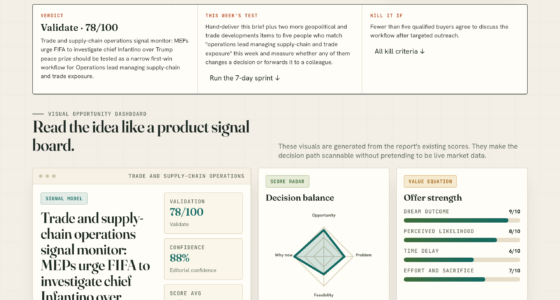

📊 Full opportunity report: Transforming Sensor Data Into AI-Driven Software Sovereignty on ThorstenMeyerAI.com — validation score, market gap, and execution plan.
TL;DR
European agencies are adopting AI-driven software to process sensor data independently, marking a shift in sovereignty for ISR capabilities. The move aims to reduce reliance on external software providers, but details on implementation are still emerging.
European institutions are contracting for AI-driven software to process sensor data independently, marking a significant step toward software sovereignty in intelligence, surveillance, and reconnaissance (ISR). This development shifts control over data exploitation away from external providers, addressing political and economic concerns about dependency.
In recent months, European governments and agencies have moved to secure domestic or regionally controlled software solutions for sensor data analysis, including imagery and radar data. This follows years of expanding sensor networks—such as radar constellations and wide-area cameras—that generate vast torrents of data. The critical gap identified is the lack of autonomous, AI-based software capable of turning this data into actionable intelligence without relying on foreign-controlled platforms.
Contracts have been signed with companies developing AI exploitation stacks that operate locally within Europe, aiming to reduce dependency on US or other non-European providers. These efforts are part of a broader move to assert digital sovereignty over ISR capabilities, with a focus on software control as the new sovereignty frontier. Experts note that this shift is driven by political, economic, and security considerations, especially amid geopolitical tensions.
The ISR Files
From Sensor to Software Sovereignty
One thesis runs through this cluster: collection outran exploitation years ago, and for Europe the sovereignty question has migrated up the stack — from satellites and launch to the software that reads the sensor. These dispatches trace that arc: the physics, the market, the procurement shift, the regulation, and one product being built in public along the way.
The dispatches
Radar That Never Blinks: What SAR Actually Does
The physics minus the mathematics, and what all-weather persistent imaging means for companies, institutions, and governments. Europe is buying constellations now, not imagery.
READ →Wide-Area Motion Imagery: The City-Scale Camera
The WAMI deep-dive from the sensor arc — gigapixel persistence and the analyst crisis it created. Slot reserved; link follows re-upload from archive.
LINK FOLGTDelta: [Sensor-Arc Dispatch]
Slot reserved for the Delta piece from the prior production block; card copy to be restored with the archived article.
LINK FOLGTThe Living Digital Twin
How persistent sensing turns static 3D models into continuously-updated operational replicas — and why that changes ISR economics. Slot reserved; German edition also planned.
LINK FOLGTEurope Is Actually Shopping for Its Palantir Exit
Named contracts, named deadlines, named systems under test: the exploitation-software market moved from sentiment to procurement in ninety days.
READ →Building Corvus ISR, Day 1: Synthetic WAMI First
A WAMI exploitation stack starting from fully synthetic data — the reasoning, the two-edition custody strategy, and the honest bear case.
READ →Synthetic WAMI Scene — Live Detect & Track
Run it in your browser: procedural city, hundreds of movers, live tracker with honest degradation as density climbs. Every pixel synthetic.
LAUNCH DEMO →The August 1 Deadline: Classified Benchmarks
EO 14409 makes capability measurement a national-security instrument — behind a vault door. The European answer should be evaluation in public.
READ →Suggested reading path
The products behind the coverage
SAR/ISR exploitation platform — the software layer this cluster keeps arguing Europe needs to own.
vigilsar.comWAMI exploitation stack, built in public from synthetic data. Sovereign (air-gap) and Governed (EU-cloud) editions.
corvusisr.comPublic, replicable benchmark for defense-relevant AI tasks, ISR signature track — evaluation as public infrastructure.
vigilsar.comAI sensor data processing software
As an affiliate, we earn on qualifying purchases.
As an affiliate, we earn on qualifying purchases.
Implications of AI-Driven Software Sovereignty in Europe
This move represents a strategic shift in military and intelligence sovereignty, allowing European institutions to control their sensor exploitation pipelines. It reduces reliance on external software providers, which can be subject to export controls, sanctions, or geopolitical influence. The development also signals a broader recognition that software control is now as critical as hardware in ISR capabilities, potentially reshaping the market and operational paradigms.
For European security and technological independence, this shift could foster innovation, resilience, and competitive advantage. However, it also raises questions about the pace of deployment, interoperability, and the readiness of regional software ecosystems to handle the scale and complexity of modern sensor data processing.
European ISR software solutions
As an affiliate, we earn on qualifying purchases.
As an affiliate, we earn on qualifying purchases.
European Moves Toward Data and Software Sovereignty
Over recent years, Europe has made significant investments in satellite constellations and sensor networks, including radar and wide-area imaging systems. Countries like Germany, Poland, Portugal, and Greece are now acquiring constellations, transitioning from imagery subscriptions to ownership and control of data sources. Meanwhile, the lower layers of the ISR stack—launch, satellites, and cloud infrastructure—have largely been localized or regionalized.
This spring marked a turning point with the signing of contracts for exploitation software that is not controlled from outside Europe, emphasizing the importance of software sovereignty in the overall ISR architecture. Experts highlight that control over data reading and analysis software is now a critical frontier, as the physics of sensors and the capabilities of AI become central to operational independence.
“The software that reads the sensor data is the new sovereign ground, and it remains substantially unclaimed.”
— an anonymous researcher
autonomous sensor data exploitation tools
As an affiliate, we earn on qualifying purchases.
As an affiliate, we earn on qualifying purchases.
Uncertainties in Deployment and Ecosystem Readiness
It is not yet clear how quickly these AI exploitation stacks will be fully operational at scale across European agencies. Questions remain about the interoperability of different regional systems, the development of robust AI models tailored for diverse sensor data, and the regulatory or security hurdles that might slow adoption. Additionally, the long-term effectiveness of these locally controlled solutions in high-stakes scenarios remains to be seen.
regionally controlled AI exploitation platform
As an affiliate, we earn on qualifying purchases.
As an affiliate, we earn on qualifying purchases.
Next Steps for European ISR Software Sovereignty
European agencies are expected to continue signing contracts and deploying AI exploitation platforms over the coming months. Focus will likely be on testing, interoperability, and scaling these systems across different national agencies. Monitoring the development of regional ecosystems and regulatory frameworks will be crucial, as will observing how these initiatives influence global ISR market dynamics.
Key Questions
What does software sovereignty mean in this context?
It refers to European institutions’ control over the software used to analyze and exploit sensor data, reducing reliance on external providers and enhancing independence in ISR operations.
Why is control over exploitation software considered the new sovereignty frontier?
Because as sensor networks grow and become more sophisticated, the ability to process and interpret data locally with AI-driven tools becomes critical for operational independence and security.
What are the main challenges facing this shift?
Challenges include developing robust, interoperable AI systems at scale, regulatory hurdles, security concerns, and ensuring that the software can handle the complexity and volume of sensor data in real-time scenarios.
How might this development impact global ISR markets?
It could lead to increased regional competition, innovation in AI exploitation tools, and a shift away from reliance on US or other non-European software providers, potentially reshaping market dynamics.
Source: ThorstenMeyerAI.com